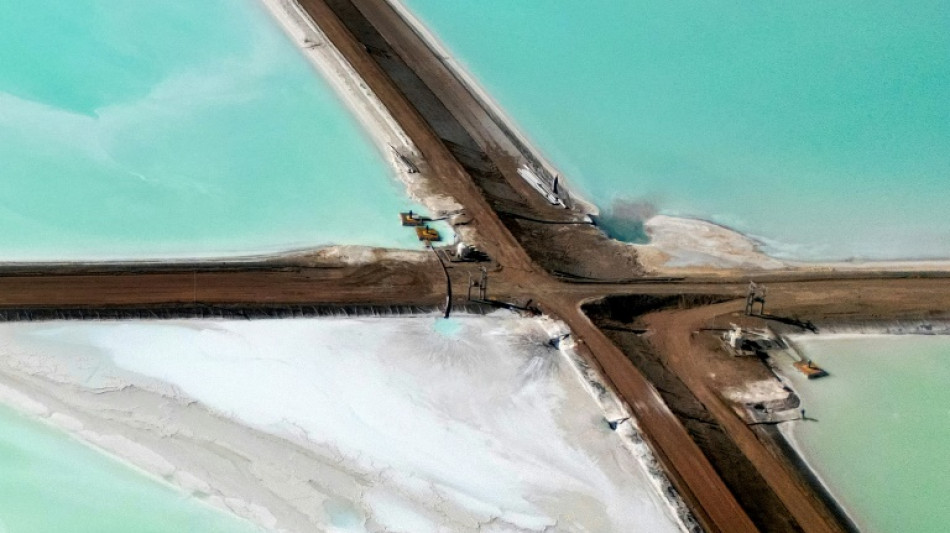
Europe's lithium quest hampered by China and lack of cash / Photo: LUIS ROBAYO - AFP/File

Europe's ambition to be a world player in decarbonised transportation arguably depends on sourcing lithium abroad, especially in South America.
Even the bloc's broader energy security and climate goals could depend on securing a steady supply of the key mineral, used in batteries and other clean energy supply chains.
But Europe has run into a trio of obstacles: lack of money, double-edged regulations and competition from China, analysts told AFP.
China has a major head start.
It currently produces more than three-quarters of batteries sold worldwide, refines 70 percent of raw lithium and is the world's third-largest extractor behind Australia and Chile, according to 2024 data from the United States Geological Survey.
To gain a foothold, Europe has developed a regulatory framework that emphasises environmental preservation, quality job creation and cooperation with local communities.
It has also signed bilateral agreements with about 15 countries, including Chile and Argentina, the world's fifth-largest lithium producer.
But too often it fails to deliver when it comes to investment, say experts.
"I see a lot of memoranda of understanding, but there is a lack of action," Julia Poliscanova, director of electric vehicles at the Transport and Environment (T&E) think tank, told AFP.
"More than once, on the day that we signed another MoU, the Chinese were buying an entire mine in the same country."
The investment gap is huge: China spent $6 billion on lithium projects abroad from 2020 to 2023, while Europe barely coughed up a billion dollars over the same period, according to data compiled by T&E.
- Lagging investment -
At the same time, the bottleneck in supply has tightened: last year saw a 30 percent increase in global demand for lithium, according to a recent report from the International Energy Agency (IEA).
"To secure the supply of raw materials, China is actively investing in mines abroad through state-owned companies with political support from the government," the IEA noted.
China's Belt and Road Initiative funnelled $21.4 billion into mining beyond its shores in 2024, according to the report.
Europe, meanwhile, is "lagging behind in investment levels in these areas", said Sebastian Galarza, founder of the Centre for Sustainable Mobility in Santiago, Chile.
"The lack of a clear path for developing Europe's battery and mining industries means that gap will be filled by other actors."
In Africa, for example, Chinese demand has propelled Zimbabwe to become the fourth-largest lithium producer in the world.
"The Chinese let their money do the talking," said Theo Acheampong, an analyst at the European Council on Foreign Relations.
By 2035, all new cars and vans sold in the European Union must produce zero carbon emissions, and EU leaders and industry would like as much as possible of that market share to be sourced locally.
Last year, just over 20 percent of new vehicles sold in the bloc were electric.
"Currently, only four percent of Chile's lithium goes to Europe," noted Stefan Debruyne, director of external affairs at Chilean private mining company SQM.
"The EU has every opportunity to increase its share of the battery industry."
- Shifting supply chains -
But Europe's plans to build dozens of battery factories have been hampered by fluctuating consumer demand and competition from Japan (Panasonic), South Korea (LG Energy Solution, Samsung) and, above all, China (CATL, BYD).
The key to locking down long-term lithium supply is closer ties in the so-called "lithium triangle" formed by Chile, Argentina and Bolivia, which account for nearly half of the world's reserves, analysts say.
To encourage cooperation with these countries, European actors have proposed development pathways that would help establish electric battery production in Latin America.
Draft EU regulations would allow Latin America to "reconcile local development with the export of these raw materials, and not fall into a purely extractive cycle", said Juan Vazquez, deputy head for Latin America and the Caribbean at the OECD Development Centre.
But it is still unclear whether helping exporting countries develop complete supply chains makes economic sense, or will ultimately tilt in Europe's favour.
"What interest do you have as a company in setting up in Chile to produce cathodes, batteries or more sophisticated materials if you don't have a local or regional market to supply?" said Galarza.
"Why not just take the lithium, refine it and do everything in China and send the battery back to us?"
Pointing to the automotive tradition in Mexico, Brazil and Argentina, Galarza suggested an answer.
"We must push quickly towards the electrification of transport in the region so we can share in the benefits of the energy transition," he argued.
But the road ahead looks long.
Electric vehicles were only two percent of new car sales in Mexico and Chile last year, six percent in Brazil and seven percent in Colombia, according to the IEA.
The small nation of Costa Rica stood out as the only nation in the region where EVs hit double digits, at 15 percent of new car sales.
M.Yamazaki--JT