UK lab promises air-con revolution without polluting gases / Photo: HENRY NICHOLLS - AFP

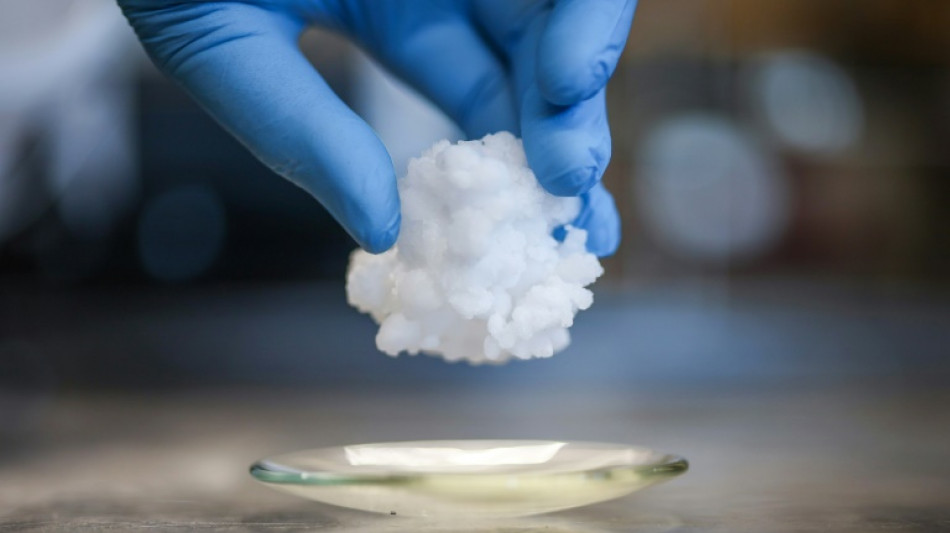
The soft, waxy "solid refrigerant" being investigated in a UK laboratory may not look very exciting, but its unusual properties promise an air-conditioning revolution that could eliminate the need for greenhouse gases.
The substance's temperature can vary by more than 50 degrees Celsius (90 degrees Fahrenheit) under pressure, and unlike the gases currently used in appliances solid refrigerants, it does not leak.
"They don't contribute to global warming, but also they are potentially more energy efficient," Xavier Moya, a professor of materials physics at the University of Cambridge, told AFP.
Approximately two billion air-conditioner units are in use worldwide, and their number is increasing as the planet warms.
Between leaks and energy consumption, the emissions associated with them are also increasing each year, according to the International Energy Agency (IEA).
Moya has been studying the properties of these plastic crystals in his laboratory at the prestigious UK university for 15 years.
On his work surface, a large red and grey machine, topped with a cylinder, tests how the temperature of a substance changes under pressure.
The aim is to identify the best refrigerants among this class of materials, which are already used by the chemical industry and are relatively easy to obtain, even if the exact composition of the crystals eventually selected remains secret.
The phenomenon is invisible to the naked eye, but these crystals are composed of molecules that spin on their own axis.
When the substance is squeezed, that movement stops and the energy is dissipated in the form of heat.
When released, the substance cools its surroundings in what is known as the "barocaloric effect".
- Chilled cans -
"We're expecting demand for air conditioning to increase hugely, globally, between now and 2050," Cliff Elwell, a professor of building physics at University College London, told AFP.
He believes barocaloric solids have the potential to be as efficient as gas, if not more so.
"But whatever we introduce as new technologies always has to hit the basic requirements," which include being compact and quiet enough for use in homes and cars, he said.
Alongside his research at Cambridge, Moya founded the startup Barocal in 2019 to turn his research group's discoveries into tangible products.
It employs nine people and has its own laboratory, which is currently a modest container in a parking lot.
But the startup is attracting interest and in recent years has raised around €4 million ($4.5 million), notably from the European Innovation Council -- an EU program involving the UK -- and Breakthrough Energy, an umbrella group of initiatives founded by US billionaire Bill Gates to reduce greenhouse gas emissions.
It plans to increase its workforce to 25 or 30 this year.
The first air-conditioner prototype is the size of a large suitcase and hums quite loudly when a hydraulic circuit increases or decreases the pressure inside the four crystal-filled cylinders. But it works.
A small refrigerator is attached to the system, and the cans of soda inside are perfectly chilled.
- Cheaper bills -
The prototype has "not really been optimised yet for either mass, volume, or even sound", acknowledged Mohsen Elabbadi, a materials engineer at Barocal.
But the performance of the units they are working to perfect will eventually be comparable with those running on gas, he promised.
While the company is currently focusing on cooling, the technology could also be used to produce heat.
Several teams are studying these materials around the world, but the Cambridge team is a pioneer in the field, according to Breakthrough Energy, which estimates that these devices have the potential to reduce emissions by up to 75 percent compared with traditional units.
Barocal hopes to launch a first product on the market within three years, according to commercial director Florian Schabus.
These will initially be cooling units for "large shopping centres, warehouses, schools" and even "data centres", he said.
The company reasons that the ultimate promise of cheaper bills will convince businesses to stump up the higher initial costs.
Barocal is eventually aiming for retail prices similar to traditional units, allowing it to launch in the residential market.
Y.Hara--JT