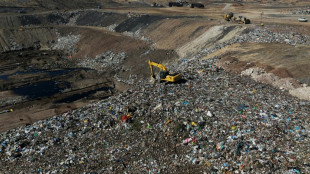
Clamping down on 'forever chemicals' / Photo: JUSTIN SULLIVAN - GETTY IMAGES NORTH AMERICA/AFP/File

Contaminating water and soil, human-made "forever chemicals" widely used since the mid-20th century, are facing increasing regulation worldwide.
Officially known as PFAS, or per- and polyfluoroalkyl substances, they are a family of synthetic chemicals able to withstand intense heat and can repel water and grease.
They are found in cars, planes, clothes, leather, household products, electronics, food processing and medical equipment.
But when they seep into groundwater, surface water and soil, PFAS can pose a toxic health risk and they persist for a very long time.
A recap of key measures regulating the use PFAS:
- Stockholm Convention -
The Stockholm Convention on Persistent Organic Pollutants, concluded in 2001 and coming into force in 2004, was the first international text to regulate organic chemicals, including PFAS.
The Convention, signed by more than 150 countries -- but not the US or China -- added in 2019 to its list of substances banned for production and use, perfluorooctanoic acid (PFOA), used since the 1950s by US company DuPont to manufacture its non-stick coating Teflon.
The Convention has prohibited its use, except under exemption.
Another PFAS, PFHxS or perfluorohexane sulfonic acid, used for example in fire-fighting foam, metal plating, textiles, polishing and cleaning agents, has been on the banned products list since 2022.
Similarly, the use of another PFAS, perfluorooctane sulfonic acid (PFOS), known for its use as a waterproofing agent by the US group 3M, has been heavily restricted since 2009.
- Europe's restriction project -
The European Commission intends to present in 2026 a proposal to ban PFAS in everyday consumer products such as pizza boxes or waterproof clothing, with exceptions for some deemed essential, particularly in the medical field.
Due to an intense lobbying campaign the adoption of this regulation scheduled for 2025 is not expected before 2026 or 2027, according to an investigation coordinated by French daily Le Monde.
Meanwhile, a European regulation from December 2024 to come into force in August 2026 establishes maximum concentrations for PFAS in any packaging intended to come into contact with foodstuffs.
A European directive on water quality, which came into force in 2021, provides for the implementation as of 2026 of maximum concentration thresholds for twenty PFAS in European tap water.
- Denmark action plan -
The Danish parliament adopted an action plan against PFAS in May 2024, aiming to prevent and reduce water and soil pollution from forever chemicals.
The plan also includes banning the use of PFAS in clothing and certain chemicals, while Denmark has banned the use of PFAS in food packaging since 2020.
Another Scandinavian country, Norway, banned the use of perfluorooctanoic acid (PFOA) for textiles and other everyday consumer products back in 2014.
- New legislation in France -
A French law, enacted in February, bans cosmetics, clothing, shoes, and ski waxes containing PFAS as of 2026. In 2030, all textiles with PFAS will be banned.
This pioneering legislation also mandates the monitoring of PFAS concentrations in drinking water.
Industrial polluters will be taxed 100 euros per 100 grams of discharged substances, according to the "polluter pays" principle.
- Limit thresholds in US water -
In the United States, the Environmental Protection Agency (EPA) established maximum concentration thresholds for six PFAS in tap water in 2024. These thresholds will become mandatory in 2029.
In parallel, the EPA has classified PFOA and PFOS, the two most studied PFAS, as hazardous substances.
- Canada phase-out -
In March 2025 Canada announced its plan to phase out PFAS in many products starting in 2027.
PFAS would first be banned in firefighting foams, followed by cosmetics, food packaging, textiles, medicines, and medical devices.
T.Ikeda--JT