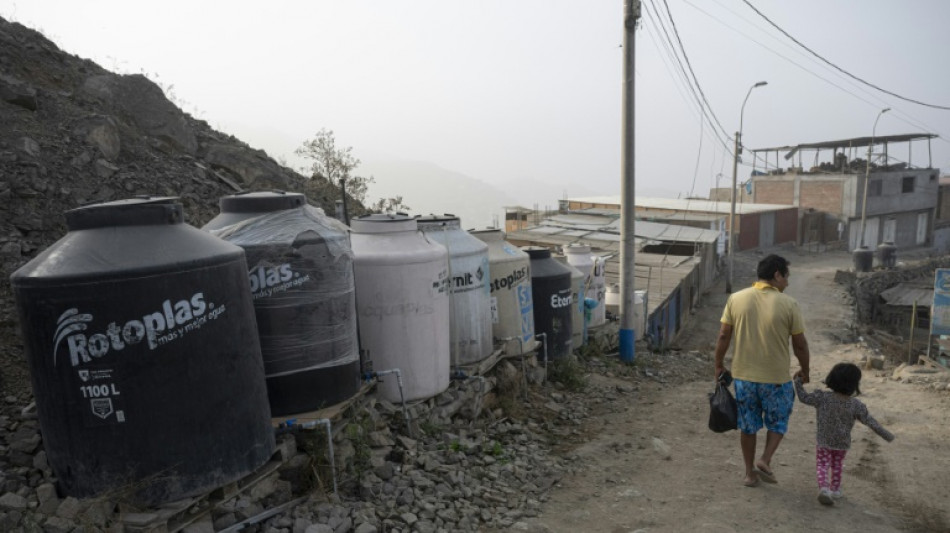
In poor areas of Peru's capital, running water is a dream / Photo: ERNESTO BENAVIDES - AFP

In the bone-dry hills overlooking Lima, the luxury of running water is just a dream for thousands of Peruvians who get theirs delivered by tanker truck.
Peru's capital, home to more than 10 million people, is also the world's second largest city located in a desert, after Cairo.
It has the Pacific Ocean on one side, the Andes on the other and three rivers running through it, plus a water table. But rain is scarce.
More than 635,000 people in Lima lack running water, says the National Institute of Statistics and Computer Science, and many of them live in informal settlements high above the city, in spots not reached by the water and sewer lines.
Blue tanker trucks bring water for free once a week, sometimes less, to parts of San Juan de Miraflores south of the city, and leave it in large drums placed along its dusty streets.
And these containers are anything but hygienic.
"We get stomach cramps and migraines. There are worms in the bottom of the tank," said Catalina Naupa, a 59-year-old resident of San Juan de Miraflores.
In winter sometimes the trucks do not come at all because the streets become so muddy they are unnavigable, said Naupa, who washes her clothes only once a week or even every two weeks to conserve water.
Nicolas Reyes, who works for the city's water utility Sedapal, says it brings in a cubic meter (260 gallons) of water per family per week.
That comes out to about 30 liters (eight gallons) of water per person each day -- far short of the minimum 50-100 liters that the United Nations says people should have access to.
Year after year, Sedapal fears having to ration water as the rainy season comes and it hopes Peru's reservoirs fill, said Jeremy Robert of the Institute for Development Research, in France.
- 'Another world'-
"Climate change is going to affect water levels in the mountains and reduce the flow of rivers," said Antonio Ioris, a professor of geography at Cardiff University in Wales.
But he said dwindling water reserves are not the main problem, insisting that poor people's tenuous access to water is very low on policymakers' list of priorities.
"The situation on the outskirts of Lima stems not only from a lack of urban planning but also from problems in rural areas that force people to migrate to the city," said Ioris, who specializes in the link between population and environmental issues in Latin America.
Along dirt roads in some areas of San Juan de Miraflores, concrete staircases lead to spots that are even harder to access and cannot be reached by the trucks that bring in water.
So these people get by the best they can, and on average pay six times what people connected to the utility grid pay for water, the government says.
In one hilltop area of San Juan de Miraflores, a water drum blocks the last step of a staircase heading up toward another world.
Up on the peak, a two-meter high, 10-kilometer long (two-yard high, six-mile long) concrete barrier -- people call it the "wall of shame" -- separates San Juan de Miraflores from a rich area on the other side. The idea is to keep poor people out.
Through cracks in the wall one can see the lush vegetation of Santiago de Surco, a Lima neighborhood with one of the highest rates of water consumption -- 200 liters per day per person, according to Sedapal.
There on the other side, thick green grass is fed with drinking water and people rest under leafy trees.
"Surco seems like another world," said Cristel Mejia, who runs a soup kitchen on the poor side of the wall.
H.Takahashi--JT