In Nigeria, tech workers and farmers bring AI to the fields / Photo: OLYMPIA DE MAISMONT - AFP

With a few taps on his phone, Dandam Nangor knows exactly what temperature his greenhouse is at, when to water his crops and even the pH of the soil.
Backed by artificial intelligence, it's all designed to make growing his peppers easier -- and perhaps usher in a sort of agriculture 2.0 in Nigeria, where millions work in the sector, from subsistence farmers to, increasingly, young tech workers.
With probes in the soil collecting data, processed by local agri-tech local company Green Eden and sent to his phone, "my production has increased (by) about 400 kilograms," or 20 percent, 34-year-old Nangor, who is also an IT analyst, told AFP during a visit to his greenhouse in Jos.
Farms around the Plateau state capital, sitting at 1,200 metres (4,000 feet) above sea level and known for its mild climate, have long fed the nation, with their fruits and vegetables ending up in markets across Nigeria.
But they haven't been spared from climate change, as increasingly erratic rainfall threatens farmers across west Africa, the majority of whom are smallholders who operate without irrigation.
The stakes are high for the whole country: some 20 percent of Nigeria's GDP comes from agriculture.
"That was the simple problem, the weather. Climate change," said Stephanie Meltus, founder of Green Eden, whose tech has been deployed on more than 70 farms.
"That's what we are trying to solve."
The start-up first found financing from friends and family, before more business and foundations started getting involved -- providing an opportunity to "bridge the gap" between Nigeria's bustling tech scene and its rural hinterlands, said Meltus, a 21-year-old pharmacy student.
- Field to henhouse -
The central city of Jos itself is becoming something of an agri-tech hub.
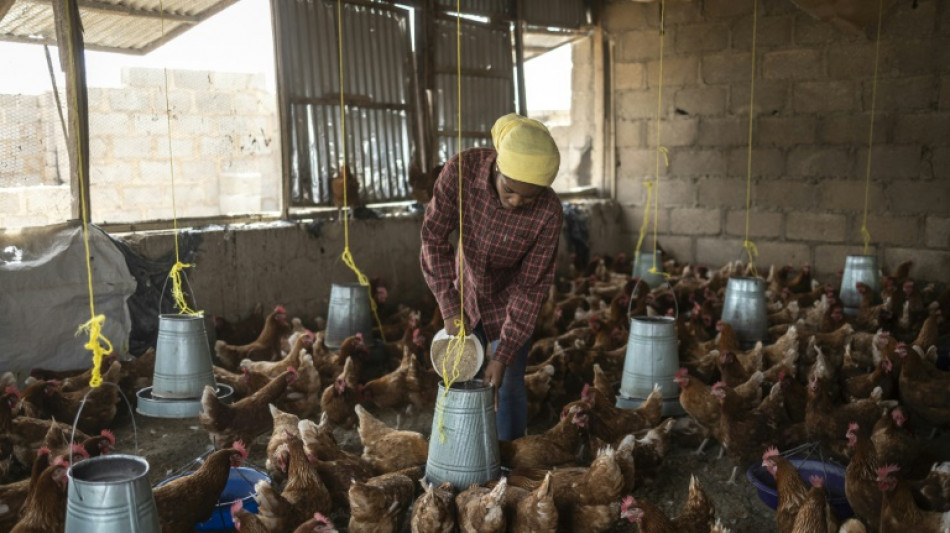
Mercy Atsuku, who raises chickens, told AFP that after adopting a monitoring system from another local start-up, "we barely even record any mortality cases".
The tech, from Anatsor, keeps tabs on temperature, humidity and air and water quality on poultry farms.
Due to climate change, "the weather pattern is uncertain", Anatsor's 24-year-old founder Miriam Agbo said.
"When the temperature is too high, the chickens don't eat," she told AFP.
When its too humid, "the environment becomes damp, they tend to stay together to heat up. And that results in suffocating".
Now, minute shifts in conditions are now sent directly to Atsuku's phone.
"Let's say when the water is contaminated, it's no longer too good for the chickens. I get a notification," she said. "I no longer wake up in the middle of the night just to check on the chickens."
Though the $150 she paid for the system -- three times the monthly minimum wage -- might be out of reach for some, "it has reduced a lot of stress for me".
The new tech is coming online at a key time, said Nuhu Adamu Gworgwor, an agronomy professor at the University of Jos, as climate change and urbanisation drive more and more Nigerians away from agriculture and into cities.
Poor harvests from drought and erratic rains have "driven away people from their fields" -- and many are unlikely to return.
"They could not be able to go to agriculture again," he told AFP.
- Eyes in the sky -
Critics of the broader agri-tech sector worry that innovation is being directed at increasing output, rather than at mitigating farming's own negative effects on the environment.
And artificial intelligence will do little to help growers bogged down by land degradation, a lack of access to financing and poor infrastructure.
Only 40 percent of people in Nigeria have an internet connection -- a rate that plunges in rural areas.
But Gambo Wadams Zakka, an English literature student, still has dreams of putting tech in the fields, as he pursues a start-up that would combine satellite imagery and AI to warn farmers of pest infestations, delivered via text message.
He also wants to monitor market prices, to give farmers more information about when to sell their crops.
"We could give them an SMS alert, like prices of heavy beans is selling at 15,000 naira ($10) per bag... but prices are expected to rise by next week," Zakka said.
For Michael Inyam Itsegok, who has grown potatoes, bananas and cucumbers for 25 years, it's the "perfect" technology, which would help take some of the chance and guesswork out of farming.
"If you don't have an insight of what is coming," he said, "you are left at the mercy of that very thing that has come."
K.Inoue--JT