The Japan Times - Scientists artificially inseminate leopard sharks to boost diversity

EUR -
AED 4.256969
AFN 73.026624
ALL 95.949668
AMD 436.29849
ANG 2.074968
AOA 1062.937298
ARS 1612.956254
AUD 1.648622
AWG 2.089361
AZN 1.97515
BAM 1.955793
BBD 2.330592
BDT 141.989509
BGN 1.981339
BHD 0.437098
BIF 3425.188147
BMD 1.159146
BND 1.479895
BOB 7.995972
BRL 6.159011
BSD 1.157196
BTN 108.180626
BWP 15.778945
BYN 3.510788
BYR 22719.261378
BZD 2.327292
CAD 1.591102
CDF 2637.057544
CHF 0.913917
CLF 0.027244
CLP 1075.745893
CNY 7.982348
CNH 8.005172
COP 4253.385281
CRC 540.49813
CUC 1.159146
CUP 30.717369
CVE 110.264618
CZK 24.515015
DJF 206.059287
DKK 7.48519
DOP 68.689762
DZD 153.294785
EGP 59.995792
ERN 17.38719
ETB 182.369469
FJD 2.566871
FKP 0.868888
GBP 0.86899
GEL 3.147128
GGP 0.868888
GHS 12.613956
GIP 0.868888
GMD 85.201694
GNF 10142.964899
GTQ 8.863969
GYD 242.099162
HKD 9.082199
HNL 30.628894
HRK 7.547552
HTG 151.809475
HUF 393.739159
IDR 19654.711213
ILS 3.60393
IMP 0.868888
INR 108.971952
IQD 1515.894754
IRR 1525001.44174
ISK 144.047519
JEP 0.868888
JMD 181.799371
JOD 0.82188
JPY 184.582853
KES 149.909481
KGS 101.364887
KHR 4623.983998
KMF 494.955743
KPW 1043.265709
KRW 1744.874492
KWD 0.35536
KYD 0.964297
KZT 556.328075
LAK 24848.914008
LBP 103633.441366
LKR 360.978751
LRD 211.759267
LSL 19.520632
LTL 3.422657
LVL 0.701156
LYD 7.407974
MAD 10.813063
MDL 20.15193
MGA 4824.983303
MKD 61.639787
MMK 2432.834089
MNT 4136.040892
MOP 9.340468
MRU 46.32084
MUR 53.912319
MVR 17.920835
MWK 2006.593056
MXN 20.746631
MYR 4.565921
MZN 74.073751
NAD 19.520632
NGN 1572.092184
NIO 42.579853
NOK 11.093021
NPR 173.089401
NZD 1.985179
OMR 0.445696
PAB 1.157196
PEN 4.000686
PGK 4.994983
PHP 69.723065
PKR 323.078682
PLN 4.282755
PYG 7557.973845
QAR 4.231485
RON 5.101986
RSD 117.449594
RUB 96.003268
RWF 1683.694173
SAR 4.352195
SBD 9.33305
SCR 15.877645
SDG 696.647132
SEK 10.831104
SGD 1.486609
SHP 0.86966
SLE 28.486057
SLL 24306.724357
SOS 661.297712
SRD 43.45349
STD 23991.981659
STN 24.499915
SVC 10.124965
SYP 128.330532
SZL 19.526932
THB 38.14522
TJS 11.114462
TMT 4.068602
TND 3.417588
TOP 2.790945
TRY 51.295112
TTD 7.850973
TWD 37.135217
TZS 3008.589588
UAH 50.693025
UGX 4373.984863
USD 1.159146
UYU 46.629839
UZS 14107.951178
VES 527.05282
VND 30499.449254
VUV 137.764445
WST 3.161931
XAF 655.95473
XAG 0.017051
XAU 0.000257
XCD 3.13265
XCG 2.085493
XDR 0.815797
XOF 655.95473
XPF 119.331742
YER 276.576393
ZAR 19.85325
ZMK 10433.709028
ZMW 22.593922
ZWL 373.244535
  • RBGPF

    -13.5000

    69

    -19.57%

  • BCE

    0.0600

    25.79

    +0.23%

  • RIO

    -2.5000

    83.15

    -3.01%

  • AZN

    -5.3300

    183.6

    -2.9%

  • CMSD

    -0.2420

    22.658

    -1.07%

  • NGG

    -3.5400

    81.99

    -4.32%

  • GSK

    -0.5300

    51.84

    -1.02%

  • RELX

    -0.4600

    33.36

    -1.38%

  • RYCEF

    -1.2600

    15.34

    -8.21%

  • CMSC

    -0.2000

    22.65

    -0.88%

  • VOD

    -0.0900

    14.33

    -0.63%

  • BCC

    -1.5600

    68.3

    -2.28%

  • BTI

    -1.3500

    57.37

    -2.35%

  • JRI

    -0.3900

    11.77

    -3.31%

  • BP

    -1.0800

    44.78

    -2.41%

Scientists artificially inseminate leopard sharks to boost diversity
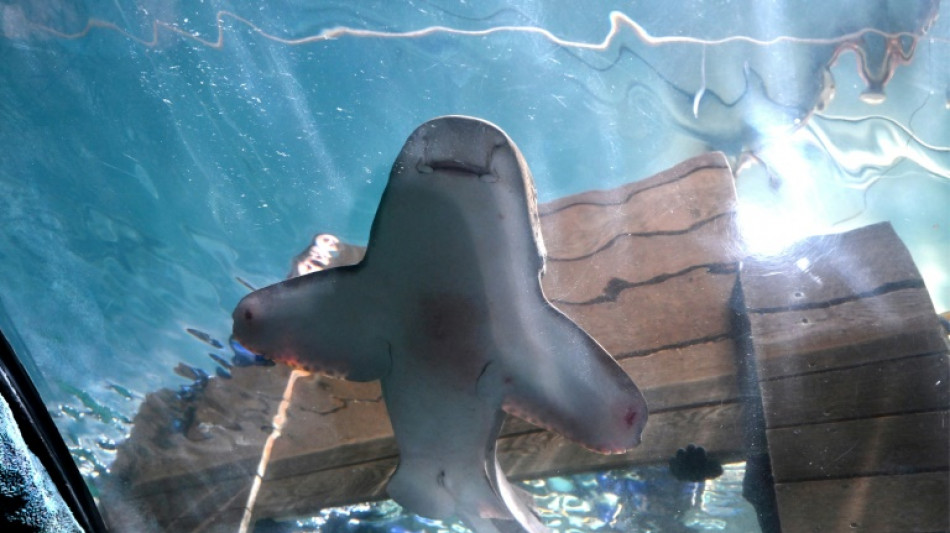
Scientists artificially inseminate leopard sharks to boost diversity / Photo: Saeed KHAN - AFP

Scientists artificially inseminate leopard sharks to boost diversity

A black-and-cream leopard shark enters a hypnotic-like state of relaxation as scientists at Sydney Aquarium carefully roll her onto her back in a small pool.

Text size:

The shark, named Zimba, is one of the first captive leopard sharks in the world to be artificially inseminated with the sperm of wild sharks in an attempt to build populations around the world.

If the process is successful, Zimba's shark pups will be sent to the Raja Ampat region in Indonesia, where the local population is on the brink of extinction due to unsustainable fishing practices and habitat destruction.

Artificial insemination allows sharks that would never normally interact to breed and increase genetic diversity, said SEA LIFE Australia and New Zealand regional coordinator Laura Simmons.

Simmons hopes that eventually the leopard shark population will be "genetically viable and capable of maintaining a self-sustaining population in the wild".

That could take years, she told AFP, but "this is one step closer to where we need to be".

The procedure is one part of a larger worldwide leopard shark breeding programme, known as StAR, that involves more than 60 conservation groups, aquariums and government agencies.

Globally, about 37 percent of oceanic shark and ray species, including the leopard shark, are now listed as either endangered or critically endangered by the International Union for Conservation of Nature, a global database for threatened species.

- 'Species belongs outside' -

Australia's leopard shark populations remain plentiful and of least concern, and scientists hope they can help bolster the numbers in other regions.

Back at the Sydney Aquarium pool, Ocean Park Hong Kong's chief veterinarian Paolo Martelli inserts a metal tube filled with the sperm of wild leopard sharks into Zimba's underside.

The shark is still in a natural state called tonic immobility -- a relaxed condition that allows scientists to work without getting injured.

The whole process takes a matter of minutes and everyone claps and cheers once it is over. Zimba is flipped back onto her stomach and swims around the pool as if nothing happened.

Martelli is using a technique he developed and has successfully used on other species, but this is the first time it has been used on leopard sharks.

"It's not straightforward," he said.

Martelli and his team collected the sperm of wild leopard sharks off the coast of Queensland -- which has a large shark population -- and brought the precious cargo to Sydney.

Only three of four samples taken survived the journey.

"This species belongs in outside habitats, not in a museum," Martelli said.

But as the shark's habitat declines, scientists must give a "helping hand" in protecting and conserving this valuable species, he added.

"It is safe to say that sharks have suffered a lot in the last century."

K.Nakajima--JT