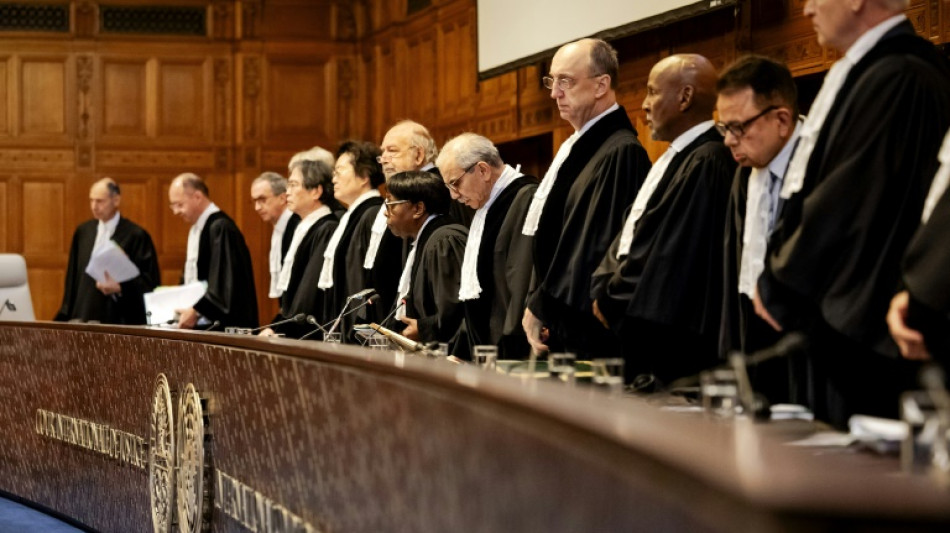
'David v Goliath' battle at ICJ climate hearings / Photo: Robin van Lonkhuijsen - ANP/AFP

Halfway through marathon climate change hearings at the world's top court, battle lines are being drawn between developed countries urging judges to stick to current legal obligations and vulnerable nations pleading for more.
History is being made at the International Court of Justice, with the largest-ever number of countries and institutions seeking to sway judges crafting a legal framework for the global fight against climate change.
Most major economies, including the United States, China, and India, have argued that the court should not tamper with the existing United Nations Framework Convention on Climate Change (UNFCCC).
Speaking in the panelled splendour of the ICJ's Great Hall of Justice, the representative for the US said this framework was "the most current expression of states' consent to be bound by international law in respect of climate change."
Margaret Taylor urged the 15-judge ICJ panel "to ensure that its opinion preserves and promotes the centrality of this regime."
Representatives from fellow top polluters China and India struck a similar chord, as did Australia and Germany.
India was perhaps the most explicit, warning the court against piling on more legal obligations on states.
"The court should avoid the creation of any new or additional obligations beyond those already existing under the climate change regime," said their representative Luther Rangreji.
On the other side of the debate were representatives of tiny island nations, some taking the ICJ floor for the first time in their country's history, many in colourful national dress.
Many of them argued, using powerful examples of loss and devastation, that their homelands were being destroyed by climate change, a phenomenon they had nothing to do with.
"This is a crisis of survival. It is also a crisis of equity," said Fiji's representative, offering searing testimony of people being uprooted from ancestral lands.
"Our people... are unfairly and unjustly footing the bill for a crisis they did not create. They look to this court for clarity, for decisiveness and justice," he added.
"Your legal guidance will resonate across generations, shaping a legacy of accountability, protection, and hope for all people," Luke Daunivalu told the judges.
More than 100 countries and organisations are participating in the hearings that enter their second week on Monday.
After months or even years of deliberation, the ICJ will produce a non-binding advisory opinion -- a fresh blueprint for international climate change law.
- 'In this canoe together' -
Statements from rich countries and top polluters have sparked fury from campaigners. They accuse them of "hiding behind" existing agreements such as the 2015 Paris Agreement, seen by many as insufficient to tackle the problem.
"We're seeing a true David and Goliath battle playing out," said Joie Chowdhury, a senior lawyer at the US- and Swiss-based Center for International Environmental Law.
"Some of the world's biggest polluters, like the US and Australia, have effectively tried to sweep historical conduct and longstanding knowledge of the causes and consequences of climate change under the rug," she said.
At the heart of the issue is money.
The United Nations asked the ICJ to rule on two distinct questions.
First, what were the obligations of countries in the fight against climate change?
Second, what were the consequences for states that have harmed the environment, particularly of the most vulnerable countries?
Developing countries have been left frustrated by the money handed down to combat the effects of climate change -- the most recent example being the $300 billion annually by 2035 pledged at the COP29 in Baku.
The text "encourages" developing countries to "make contributions" that would remain "voluntary".
Many smaller countries put a powerful case before ICJ judges for more equitable contributions that would in some cases be their only lifeline.
One of the more colourful pleas came from John Silk representing the Marshall Islands.
"When I walk our shores, I see more than eroding coastlines, I see the disappearing footprints of generations of Marshallese who lived in harmony on these islands," Silk told the court.
"The Marshallese people have a saying: 'Wa kuk wa jimor', meaning 'We are in this canoe together'."
"Today, I extend this principle to our global community."
T.Kobayashi--JT