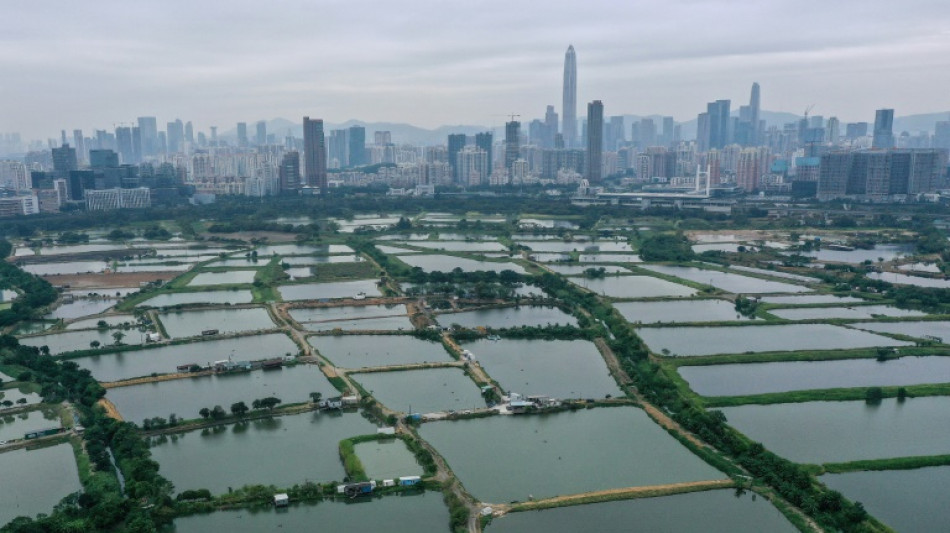
Hong Kong mega development plan to devour villages, wetlands / Photo: Peter PARKS - AFP

For almost half a century, Kwok Hoi-yin's humble cottage on Hong Kong's border with mainland China was surrounded by leagues of fishponds and green fields, buffering the modern highrises of megacity Shenzhen to the north.
In recent years his village has shrunk, nibbled away by roads and bridges as the government claims land for crossborder infrastructure and its Northern Metropolis project, an ambitious plan to urbanise the border area that has proceeded despite concerns from locals and environmentalists.
Kwok's bucolic idyll, near the city's largest and most important wetlands, is long gone.
Instead the view from his window is a grey stone wall, while an army of mosquitoes rises from the dead water remaining under his hut.
"To put it politely we are sacrificing for the greater good, but to put it less politely, we have been sliced off, piece by piece," Kwok, 69, told AFP.
His 100-year-old village, Ha Wan Tsuen, might now be wiped out entirely.
In September the government approved a plan to create an enormous new tech zone that will eventually swallow it up.
"We hope they won't tear down our village -- that's our most genuine but also most impossible wish," Kwok, who has served as Ha Wan Tsuen's elected chief for a decade, said.
"Because it's impossible for us to resist the government -- it would be like a praying mantis trying to stop a chariot."
- 90 percent opposition -
Commonly known as the San Tin Technopole, the planned tech zone is the cherry on top of the Northern Metropolis.
It will be the "core of industry development", according to the government, providing a third of the Metropolis' promised 500,000 new jobs.
The wider project -- which aims to deepen integration with mainland China -- is set to transform 30,000 hectares of land along the border, about a third of Hong Kong's territory.
The Metropolis will house 2.5 million people, the government says.
But those who already call the area home, like Kwok, had little chance to put their concerns about the development directly to the government.
The last chance for ordinary people to speak out was a four-day hearing held by the Town Planning Board in the summer.
A two-month consultation period before the hearing had resulted in a 90 percent opposition rate from about 1,600 submissions -- but the board still gave the project a green light.
An evacuation date for Ha Wan Tsuen has not yet been set, nor has compensation.
The government has also dismissed concerns over the project's environmental impact.
The Technopole will push up against a large protected wetland area, which has been UNESCO-recognised since 1995.
The area around those wetlands -- around 2,600 hectares of fishponds, rivers and marshes -- had been designated by the Hong Kong government as a conservation and buffer zone, to limit development and preserve a complete eco-system.
- 'Wetland damages' -
The Technopole will take over 240 hectares of those zones, the government has admitted.
"Over the past 30 years Hong Kong never had a development plan that would cause wetland damages in such a scale," Wong Suet-mei, a conservation officer of the Hong Kong Bird Watching Society, told AFP.
The government says most of the wetlands that will be affected have already changed beyond recognition.
It says it will establish a wetland conservation park as "compensation", along with other measures such as keeping a 300-metre flight path for birds.
"Based on the previous experience in ecological compensation in other development projects, we are confident that the number of bird numbers will be maintained at the current level or even increase," the Development Bureau told AFP.
Chan Kwok-sun, an aquafarmer whose almost 40-year-old ponds are set to be filled in for the Technopole, remained doubtful.
"No one can farm fish when the ponds are taken, no bird will come when there is no fish for them," Chan told AFP.
The 74-year-old farmer said he welcomed the government's development plan though, as he has witnessed the rise of Shenzhen from "pure darkness like in primitive times" to "a mountain of skyscrapers".
However, he said he would stay among his ponds until the last day possible.
"I live an unfettered life here," Chan said. "It's hard to find it elsewhere."
T.Shimizu--JT