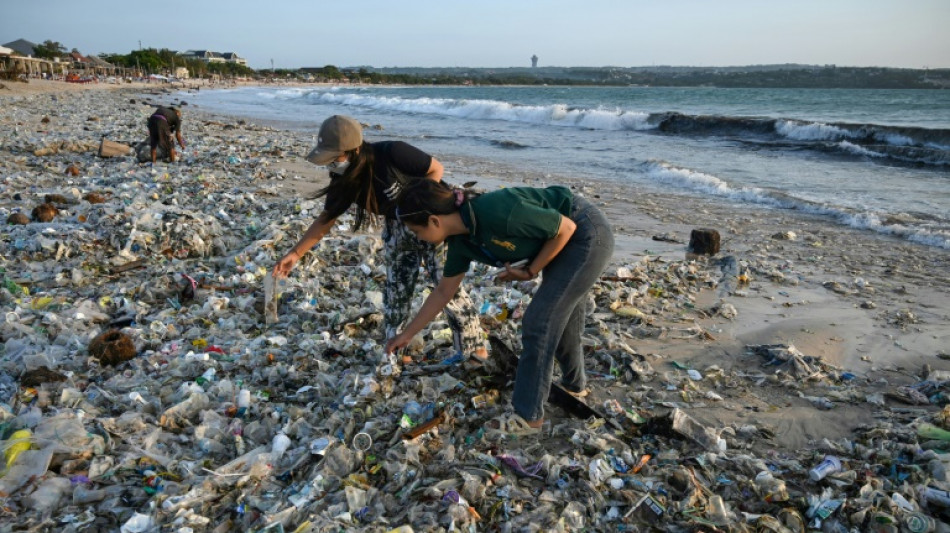
Plastic pollution talks fail to reach landmark deal / Photo: SONNY TUMBELAKA - AFP/File

Deeply divided negotiators failed on Sunday to reach a landmark global treaty to curb plastic pollution, missing a self-imposed deadline, and agreed to extend their talks.
For a week, delegates from nearly 200 nations meeting in South Korea have wrestled with how to stop millions of tonnes of plastic waste entering the environment each year.
Plastic pollution is so ubiquitous that microplastics have been found on the highest mountain peak, in the deepest ocean trench and scattered throughout almost every part of the human body.
Two years ago, countries agreed they would find a way to address the crisis by the end of 2024.
But a week of talks in Busan has failed to resolve deep divisions between "high-ambition" countries seeking a globally binding agreement to limit production and phase out harmful chemicals, and "like-minded", mostly oil-producing nations that want to focus on waste.
A draft text released Sunday afternoon after multiple delays included a wide range of options, reflecting ongoing disagreement.
And chair Luis Vayas Valdivieso acknowledged late Sunday that "a few critical issues still prevent us from reaching a comprehensive agreement."
"These unresolved issues remain challenging and additional time will be needed to address them effectively," he said.
"There is a general agreement to resume the current session at a later date to conclude our negotiations."
Several nations took to the floor to support the call for more time -- but their agreement ended there.
Rwandan delegate Juliet Kabera spoke of "strong concerns about ongoing calls by a small group of countries to remove binding provisions from the text that are indispensable for the treaty to be effective."
She delivered a statement on behalf of dozens of countries, demanding a treaty with targets to reduce production and phase out chemicals of concern.
"A treaty that lacks these elements and only relies on voluntary measures would not be acceptable," she said, inviting supporting delegations to stand up to extensive applause from the plenary room.
- 'Huge gap' -
Saudi Arabia's Abdulrahman Al Gwaiz however pushed back strongly on continued discussion of production or chemicals of concern.
"If you address plastic pollution, there should be no problem with producing plastics, because the problem is the pollution, not the plastics themselves," he said.
Backed by allies including other Arab nations, Russia and Iran, he insisted that every part of a latest draft text should "be open for proposals" if talks continue.
Iran too said there was still a "huge gap" between parties, while Russia warned that agreeing a treaty was "being hampered by ambitions on the part of certain parties that are too high."
The comments raised the prospect that any new talks could follow the pattern seen in Busan, where repeated attempts by the chair to synthesise and streamline text encountered resistance.
Delegations seeking an ambitious treaty earlier warned that a handful of countries was steadfastly blocking progress.
A French minister accused the like-minded group of "continuing obstruction," while Fiji's Sivendra Michael called out a "very minority group" for "blocking the process."
Diplomats have declined to directly name those preventing a deal, but public statements and submissions have shown Saudi Arabia, Iran and Russia have sought to block production cuts and other ambitious goals.
All three delegations declined repeated AFP requests for comment.
Environmental groups warned that another round of talks could be similarly hamstrung if ambitious countries were not willing to push for a vote.
"We need to break out of this cage of consensus that is condemning us to failure, and start to think much more creatively about how we deliver a treaty that the world desperately needs," said Greenpeace's Graham Forbes.
"For too long, a small minority of states have held the negotiation process hostage," added Eirik Lindebjerg of WWF.
"These countries have no intention of finding a meaningful solution to this crisis and yet they continue to prevent the large majority of states who do."
The world's top two plastic producers -- China and the United States -- have stayed relatively quiet in public.
Neither backed Rwanda's statement, though China's delegate warned of "concerns that have not been reflected in a balanced manner."
S.Fujimoto--JT