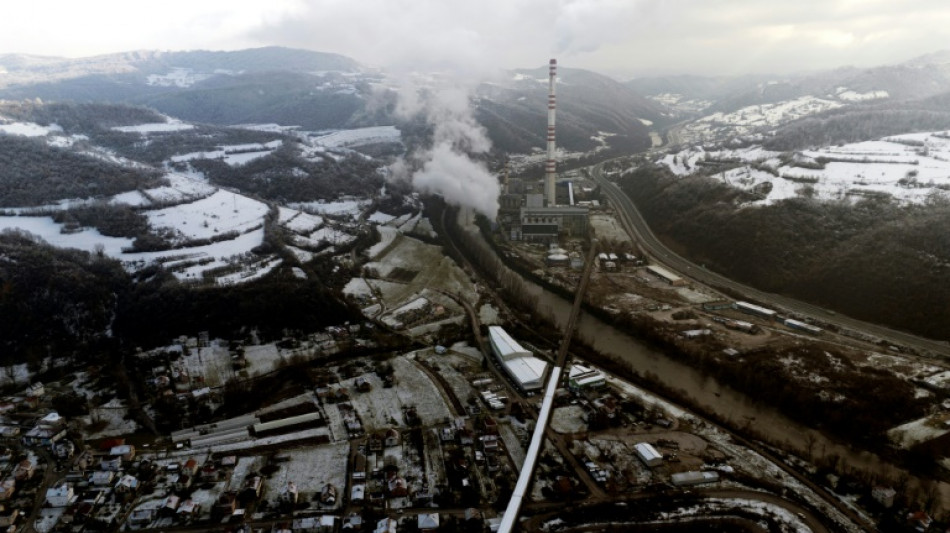
In Bosnia, the path to renewables runs through its coal mines / Photo: ELVIS BARUKCIC - AFP

At 250 metres underground, the dust is thick and oxygen is in short supply at the Mramor mine in northeastern Bosnia.
The facility is the largest underground mine in the country and has long provided the fuel for the nearby Tuzla power station.
But its future -- like that of mines across the country -- is now all but settled, as the Balkan nation prepares to decarbonise the country by 2050.
Until then, mining continues to be done the old-fashioned way in Mramor -- with picks, shovels and dynamite, veteran digger and union representative Senad Sejdic, 52, told AFP.
The work is backbreaking but Sejdic remains hopeful that the anticipated arrival of a modern excavator will make reaching the seam's premium coal an easier task.
"It would allow us to increase the annual haul from 140,000 tonnes to nearly 400,000 and to work in better safety conditions," said Sejdic.
Beyond the economic stakes, Sejdic has as emotional investment: his father was killed in a mining accident in the same area in 1990 that left 180 dead.
Yet the bid to harvest more coal at this site goes against the prevailing current, as the world seeks cleaner energy sources to limit pollution and global climate change caused by carbon emissions.
Coal remains the biggest polluter in Bosnia, where it fuels power plants and homes, with the country burning through approximately 13 million tonnes a year.
"Approximately 3,300 people die prematurely each year in Bosnia due to exposure to air pollution," or nearly 10 percent of all deaths, according to a 2019 World Bank report.
The capital Sarajevo -- where thousands of homes are heated by coal -- was ranked as the most polluted city in the world on Tuesday by the air-quality data platform operated by Swiss company IQAir.
- Power exporter -
Despite its cost to public health, coal remains a lucrative industry in Bosnia.
The government estimates the country has around 2.6 billion tonnes of exploitable coal still underground.
Bosnia also remains the only net exporter of electricity in the Western Balkans.
Nearly 30 percent of its annual production of around 15,000 GWh is sent abroad, according to the national electricity distributor. This earned the country 430 million euros ($453 million) of revenue in 2023, the national statistics office said.
But, like other countries in the region, Bosnia has committed to fully decarbonising its energy sector in the next 25 years.
With the deadline inching closer, the challenge remains stark.
Thermal power plants produce between 55 and 70 percent of Bosnia's electricity at any given time, according to the statistics office.
Hydroelectric plants churn out most of the remaining power used in Bosnia, while just four percent of electricity comes from solar or wind.
"To replace the 2,300 MW produced by thermal power plants, 5,000 MW would be needed from wind turbines or more than 10,000 MW from solar" costing billions of euros in investment, according to Edhem Bicakcic, an energy expert and investor in renewables.
"We very much hope to have access to European funds to carry out this transition," Bicakcic added.
- 'An opportunity' -
To decarbonise the economy, a complex plan has been drawn up that will see the gradual phasing out of its carbon-intensive energy sources.
The public utility company Elektroprivreda BiH will shut two of the six production units on its two coal-powered plants by 2027, said the company's executive director Fahrudin Tanovic.
To continue using its other four blocks from 2028, the company intends to invest more than 170 million euros to install desulphurisation and denitrification systems at its power stations.
"But by 2027 we must in the short term accelerate coal production to ensure sufficient quantities of electricity before acquiring larger renewable energy sites," said Tanovic.
But some still question whether there is the political will to see through the transition process.
For Denis Zisko, an environmental activist with the association Aarhus Centar based in Bosnia, the country's leaders still "lack the political courage" to say openly that mines do not have a future in the country.
"The energy transition is not a problem, it is an opportunity for development," he told AFP.
He said the coal industry will suffer when the European Union introduces its carbon tax -- which is set to be applied gradually to exports from non-EU member Bosnia and across the region in 2026.
But shuttering Bosnia's coal mines and power plants is likely to come with painful costs.
In March, the closure of mining operations at the last functioning pit at the Zenica complex after 144 years left its 600 employees without an income.
To add to their woes, the employees' pensions and taxes had not been covered by the mine for years.
According to official figures, mines across Bosnia face similar dilemmas.
"I have been working in the mine for twenty years," one 47-year-old miner who did not want to give his name told AFP.
"But my contributions have only been paid for four years."
Y.Watanabe--JT