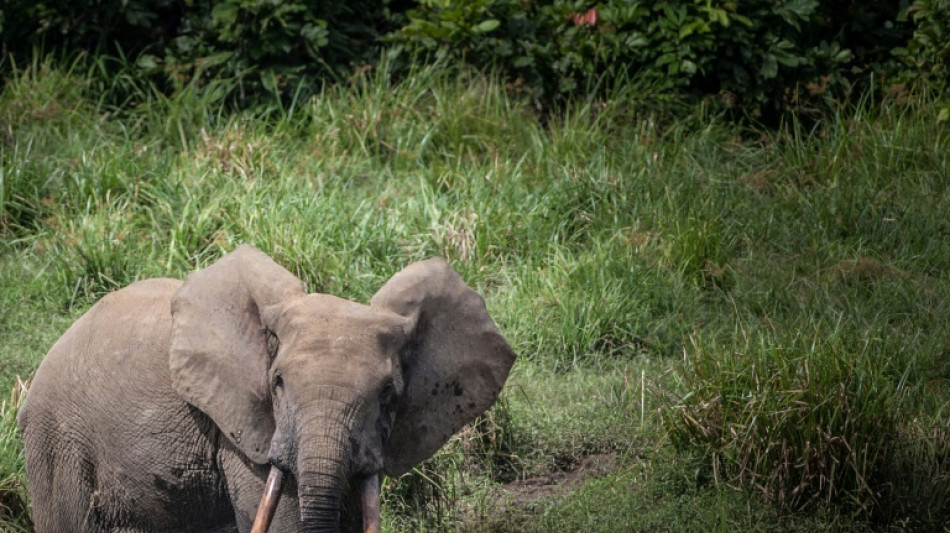
Gabon forest elephant forays into villages spark ire / Photo: Amaury HAUCHARD - AFP

In heavily forested Gabon, elephants are increasingly wandering into villages and destroying crops, angering the local population who demand the power to stop the critically endangered animals in their tracks.
"The solution to get rid of the pachyderms is to kill them," said Kevin Balondoboka, who lives in Bakoussou, a mere scattering of wooden huts in the sprawling, lush forest.
Villagers across the central African country live in fear of close encounters with elephants, whether on the road, going to wash in the river or especially in fields where they grow their crops.
Strict conservation policies have made Gabon "the refuge of forest elephants", Lea-Larissa Moukagni, who heads the human-wildlife conflict programme at the National Agency of National Parks (ANPN) said.
African forest elephants, which inhabit the dense rainforests of west and central Africa, are smaller than their African savanna elephant cousins.
Poaching for ivory and loss of habitat have led to a decline over decades in their numbers and conservation groups now list the African forest elephant as critically endangered.
But that does not stop villagers from viewing the animals as a pervasive problem.
With a population of 95,000 elephants compared to two million inhabitants, the issue is a "real" one, said Aime Serge Mibambani Ndimba, a senior official in the ministry of the environment, climate and -- recently added -- human-wildlife conflict.
- 'Protecting humans or animals?' -
"What are the men in government protecting? Human being or beast?" Mathias Mapiyo, another Bakoussou resident, asked, exasperatedly.
"I don't know what the elephant brings them," he said.
Some worry their livelihoods will be stamped out.
"We provide for our children's needs through agriculture," Viviane Metolo, from the same village, said.
"Now that this agriculture is to benefit the elephant, what will become of us?"
William Moukandja, the head of a special forest brigade, has grown used to the anti-elephant complaints.
"The human-wildlife conflict is now permanent, we find it across the country, where we are seeing devastation from north to south and from east to west," he said.
Moukagni, from the national parks agency, said people's perception that there are more elephants than before was borne out by the figures.
"It is scientifically proven," she said -- but what has changed is that the elephants no longer shy away from villages and even towns.
To protect crops, the agency has experimented with electric fences, not to kill but to "psychologically impact the animal" and repel it.
Experts have looked into why the "Loxodonta cyclotis" -- the African forest elephant's scientific name -- is venturing out from the depths of the forest.
Climate change is affecting the plants and food available to the animals, Moukagni said.
But humans working the land that is the animals' natural habitat is another factor, while poaching deep in the forest also scatters herds, she said.
- 'Responsibility' -
The population of the African forest elephant plummeted 86 percent over 30 years, according to the International Union for Conservation of Nature, which has placed it on its red list of threatened species.
While they are still a long way from extinction in Gabon, Moukagni said the country had a dual responsibility "to keep this species alive for the world and for the sustainability of forests".
Last December, just three months after seizing power in a military coup, transitional President Brice Oligui Nguema publicly sided with "victims of human-wildlife conflict", in a shift from the conservation priorities of the previous government.
"I authorise you to kill these elephants... I am a humanist," he told the crowd to applause, also announcing he had asked for "all those jailed for killing elephants to be released without delay and conditions".
Jeremy Mapangou, a lawyer with the NGO Conservation Justice, said the message to the people was "strong" but added: "When the president said 'shoot them', he was referring to self-defence."
Hunting and catching elephants in Gabon is banned and carries a jail term. Ivory trafficking is also severely punished.
But in cases of self-defence, the killing of an elephant is permitted under certain conditions.
The weapon must comply with the law, the relevant administration must be informed, a report written and the ivory handed over as "state property".
Other measures permit the worst-affected communities to file a complaint and request "administrative hunting" to remove the four-legged troublemakers.
"But how can you file a complaint against an elephant?" Marc Ngondet, Bakoussou village chief, asked.
Mibambani Ndimba, wildlife management chief in the environment ministry, stressed that "the protection of elephants remains a priority".
Known as the "forest gardener", the mammals play a crucial role in the biodiversity and ecosystem of the forests of the Congo Basin, which has the second-biggest carbon absorption capacity in the world after the Amazon.
"We must provide help to Gabon so that we do not get to situations where the population rises up and wants to take justice into its own hands," Mibambani Ndimba said.
Otherwise, "elephant heads will roll".
M.Ito--JT