The Japan Times - Climate finance: who is being asked to pay what at COP29?

EUR -
AED 4.286508
AFN 72.984916
ALL 95.285241
AMD 430.366477
ANG 2.089468
AOA 1071.306459
ARS 1624.159398
AUD 1.615887
AWG 2.103519
AZN 1.989975
BAM 1.949686
BBD 2.350918
BDT 143.280105
BGN 1.948798
BHD 0.440307
BIF 3471.826957
BMD 1.167001
BND 1.486208
BOB 8.065605
BRL 5.840607
BSD 1.167235
BTN 111.83991
BWP 16.440237
BYN 3.260991
BYR 22873.212895
BZD 2.347479
CAD 1.601767
CDF 2619.916164
CHF 0.914695
CLF 0.026532
CLP 1044.236588
CNY 7.918274
CNH 7.919406
COP 4422.617403
CRC 530.41633
CUC 1.167001
CUP 30.925517
CVE 110.516107
CZK 24.310136
DJF 207.399867
DKK 7.474057
DOP 69.66536
DZD 154.566908
EGP 61.710182
ERN 17.50501
ETB 183.744977
FJD 2.5576
FKP 0.86322
GBP 0.871014
GEL 3.127543
GGP 0.86322
GHS 13.315075
GIP 0.86322
GMD 84.661239
GNF 10246.266097
GTQ 8.905077
GYD 244.191156
HKD 9.14053
HNL 31.065356
HRK 7.534976
HTG 152.844834
HUF 357.742294
IDR 20463.706636
ILS 3.387338
IMP 0.86322
INR 111.692585
IQD 1528.770862
IRR 1534605.865331
ISK 143.751524
JEP 0.86322
JMD 184.551306
JOD 0.827368
JPY 184.799242
KES 150.834874
KGS 102.05397
KHR 4682.006532
KMF 492.474011
KPW 1050.266353
KRW 1743.125795
KWD 0.360008
KYD 0.972746
KZT 552.515121
LAK 25621.499127
LBP 105104.562444
LKR 379.64954
LRD 213.853019
LSL 19.243548
LTL 3.445849
LVL 0.705907
LYD 7.386857
MAD 10.746618
MDL 20.063828
MGA 4875.141458
MKD 61.658243
MMK 2450.543907
MNT 4178.01432
MOP 9.41695
MRU 46.668609
MUR 54.734502
MVR 17.961546
MWK 2031.747942
MXN 20.104507
MYR 4.588066
MZN 74.582844
NAD 19.244236
NGN 1598.055872
NIO 42.846436
NOK 10.778384
NPR 178.93947
NZD 1.973573
OMR 0.448703
PAB 1.167215
PEN 4.022661
PGK 4.89323
PHP 71.725003
PKR 325.133884
PLN 4.244673
PYG 7112.69685
QAR 4.2543
RON 5.201311
RSD 117.45276
RUB 85.482272
RWF 1704.987961
SAR 4.327033
SBD 9.354836
SCR 16.183476
SDG 700.787317
SEK 10.922429
SGD 1.489441
SHP 0.871284
SLE 28.766848
SLL 24471.422752
SOS 666.937915
SRD 43.420659
STD 24154.557453
STN 24.798764
SVC 10.212714
SYP 128.987104
SZL 19.244203
THB 37.834353
TJS 10.907457
TMT 4.084502
TND 3.370263
TOP 2.809857
TRY 53.062706
TTD 7.924946
TWD 36.812457
TZS 3028.366626
UAH 51.310947
UGX 4365.199908
USD 1.167001
UYU 46.483049
UZS 14056.523
VES 595.344003
VND 30744.632332
VUV 137.796705
WST 3.160846
XAF 653.892593
XAG 0.013987
XAU 0.000251
XCD 3.153878
XCG 2.103595
XDR 0.811029
XOF 650.607341
XPF 119.331742
YER 278.504878
ZAR 19.212912
ZMK 10504.409041
ZMW 21.972067
ZWL 375.773736
  • RBGPF

    -0.2100

    60.79

    -0.35%

  • CMSC

    0.0898

    23.14

    +0.39%

  • RYCEF

    -0.0700

    15.93

    -0.44%

  • RELX

    -0.1600

    31.46

    -0.51%

  • AZN

    -2.7600

    184.96

    -1.49%

  • BTI

    1.3500

    66.7

    +2.02%

  • NGG

    0.4500

    87.43

    +0.51%

  • BP

    -0.0200

    44.12

    -0.05%

  • GSK

    -0.0300

    50.96

    -0.06%

  • RIO

    -2.4500

    109.59

    -2.24%

  • BCE

    -0.2000

    24.19

    -0.83%

  • CMSD

    0.0400

    23.6

    +0.17%

  • VOD

    -0.0300

    15.48

    -0.19%

  • JRI

    0.0100

    13.14

    +0.08%

  • BCC

    2.4200

    69.4

    +3.49%

Climate finance: who is being asked to pay what at COP29?
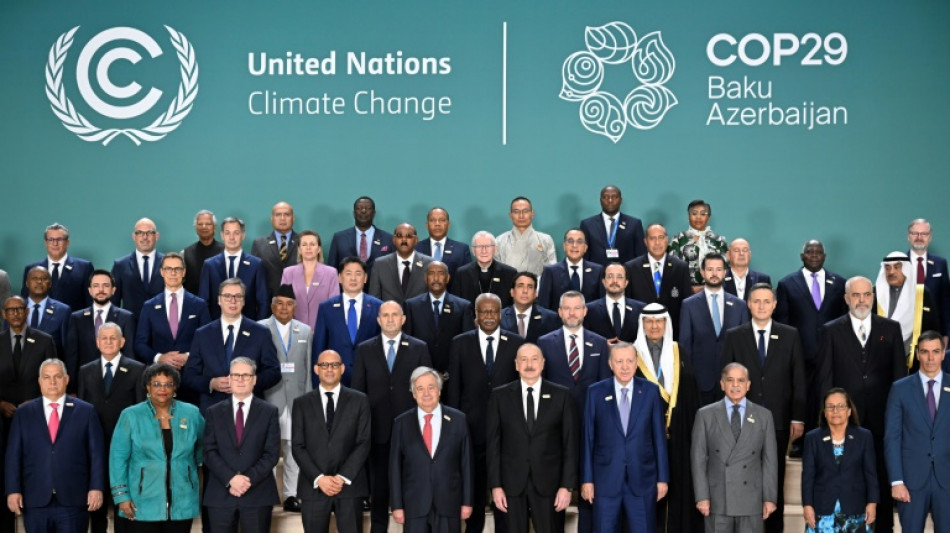
Climate finance: who is being asked to pay what at COP29? / Photo: Alexander NEMENOV - AFP

Climate finance: who is being asked to pay what at COP29?

"You owe us!" screamed a protest banner at the COP29 summit in Azerbaijan, where negotiations over how much rich nations most responsible for climate change should pay poorer ones are getting heated.

Text size:

Striking a deal to provide the $1 trillion annually that experts say is needed by 2030 for developing countries is the top priority at COP29, but getting there will be a slog.

Countries are deeply divided: who should pay what, and how much, are just two of many obstacles standing in the way of an agreement being reached by November 22.

Here's a look at what developing countries need, and who is helping them foot the bill.

- How much is needed? -

A group of leading economists commissioned by the United Nations estimates that developing countries, excluding China, need $2.4 trillion a year in climate finance by 2030.

In a report published Thursday, these experts said two-thirds of this money was required to transition developing economies away from fossil fuels to cleaner forms of energy.

The rest should be divided between adaptation measures to cope with climate change, recovery funds when disaster hits, and conservation of nature.

Of the $2.4 trillion, an estimated $1.4 trillion will need to come from developing countries themselves.

But outside help will be required to cover the remaining $1 trillion.

That could be met by grants or zero-interest loans from foreign governments, private investment flows, or money raised from global taxes, according to the report.

- What should governments pay? -

How much comes directly from governments is the crux of the question for many at COP29, who feel wealthy donors like the United States and European Union are not doing enough.

Amar Bhattacharya, who co-authored the expert climate finance report, said that figure "would be somewhere in the kind of $300 to $400 billion range".

That is at least three times the current commitment -- a tall order for donors facing economic and political crises at home, and the prospect of Donald Trump withdrawing from global climate cooperation.

The cost keeps growing, too.

Developing countries are the least responsible for global warming, but the most exposed to climate shocks, which are accelerating as the planet warms.

By 2035, foreign donors will need to foot $1.3 billion a year to cover developing country needs, the report said.

- How much has been raised? -

Rich nations raised $116 billion in 2022 in climate finance, according to the latest available data from the OECD.

But is money used to make hotels more sustainable, in one stark example, really helping poorer countries adapt to climate change?

What about loans that add to national debt?

Developing countries and campaign groups have called for greater scrutiny of the money that's raised, and efforts have been made to quantify how much each nation gives.

One study done by British think tank ODI ranks progress toward each country's "fair share" based on its carbon footprint, population size and gross national income.

Based on this criteria, Norway led the pack in 2022, followed by France.

The United States -- the world's largest historic emitter -- ranked second to last among 23 nations assessed.

T.Ueda--JT