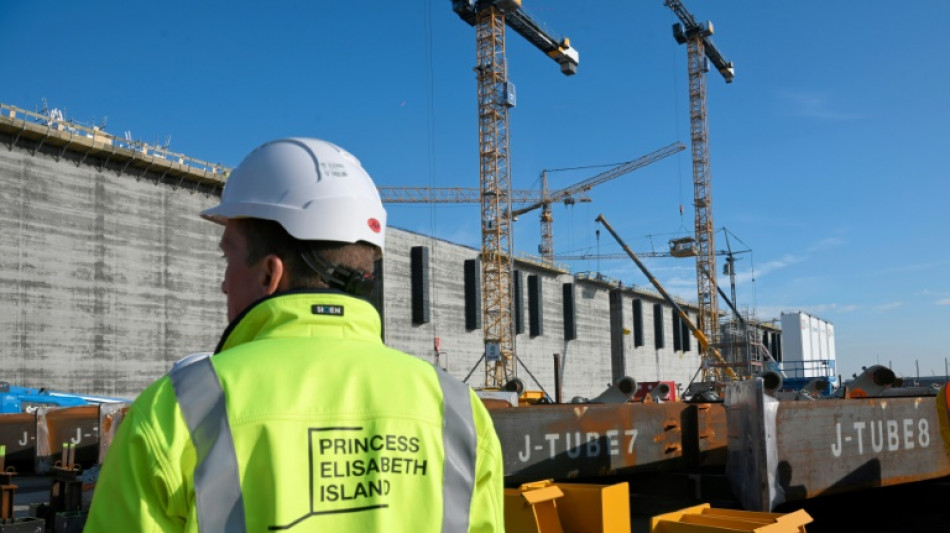
World's first green energy island sails into cost storm / Photo: Nicolas TUCAT - AFP

At a shipyard on the North Sea, workers in luminiscent vests are building dozens of massive, hollow concrete boulders, each the size of an apartment block.
These are to be floated out to sea and sunk to become the foundations of a giant Belgian green energy development -- a world first -- which is itself, however, in choppy waters amid surging costs.
Named after Belgium's Princess Elisabeth, the "energy island" was launched in 2021 to support a huge expansion in wind energy production that would drastically reduce the country's dependence on planet-warming fossil fuels.
But supply chain snags have made costs more than triple to more than seven billion euros ($7.56 billion), according to some estimates, sparking calls for construction to be stopped at a time of growing political pushback against ambitious green targets across Europe.
"This cost increase is a huge worry," Belgium's energy minister Tinne Van der Straeten told AFP.
Just over 10 percent of Belgium's energy supply comes from renewable sources, the government says.
Nuclear, gas and oil provide the bulk of its needs, according to the International Energy Agency.
But Belgium will have to lower its dependence on fossil fuels as a European Union target requires 42.5 percent of the bloc's energy to be renewable by 2030.
"That's why we need transformative projects, huge projects like this," said Van der Straeten, sporting a yellow construction helmet during a visit to the shipyard in Vlissingen, a Dutch port near the Belgian coast.
- 'Multiple sockets' -
Belgium plans to install 3.5 gigawatts of offshore wind capacity in coming years -- enough to cover 30 percent of the country's needs, according to the government.
Building an artificial island is what Belgian grid operator Elia believes is the most efficient way of bringing that energy to shore.
Located 45 kilometres (28 miles) off the coast, the island will host transformers and bundle together undersea cables to bring electricity to land.
It will also connect the Belgian grid with wind-power-producing North Sea neighbours, such as Britain and Denmark, allowing for a more stable energy supply.
The island is like "an extension cord with multiple sockets", said Joannes Laveyne, a researcher at Ghent University.
Proponents say placing it at sea avoids Nimbyism -- "not in my backyard" -- complaints from locals in a densely populated nation, and shortens international connections. Proximity to wind farms reduces energy losses.
The project won the blessing of environmental groups appeased by its green purpose and nature-friendly design. The island will have ledges for seabirds to breed and an artificial reef to boost marine life.
But Russia's invasion of Ukraine in 2022 threw a spanner in the works.
It triggered a European push to wean off Russian gas, which further accelerated the continent's rush to build more renewable plants.
The cost of related works and equipment has since skyrocketed, Elia said.
"In all countries people want to buy the same equipment, and supply can't meet demand," Frederic Dunon, CEO of Elia Transmission Belgium, told AFP.
- 'Throwing away the baby' -
From an initial 2.2 billion euros ($2.4 billion), the island's cost has soared to more than seven billion euros, according to an estimate cited in parliament last week that Elia would not confirm.
That is partly because the EU's green drive has not seen adequate investment in the capacity of firms tasked with building the infrastructure, said Laveyne.
As Elia can pass the cost onto consumers via their utility bills, some have called for a rethink.
A group representing industrial energy consumers said the project should be put on hold.
The controversy comes as far-right gains in several countries have resulted in growing calls for the EU to tame its climate ambitions.
EU chief Ursula von der Leyen has pledged to reconcile "climate protection with a prosperous economy" in her second term.
Van der Straeten said she would like to see the bloc make more money available for projects like the energy island -- which secured a 650-million-euro credit facility from the European Investment Bank last week.
Meanwhile, a cost-benefit assessment has started and the government was seeking additional financing, she added.
But environmentalists are worried that an incoming new government might have different ideas -- and delaying the project would keep the door open for dirtier energy.
Halting wind-power plans because of associated costs was like "throwing away the baby with the bathwater", said Almut Bonhage of environmental organisation Bond Beter Leefmilieu.
M.Fujitav--JT