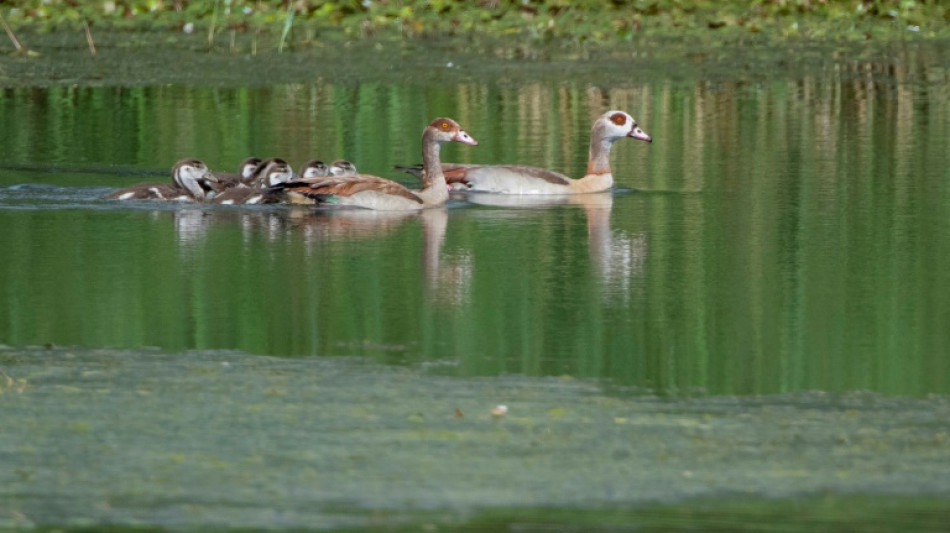
Egyptian geese spread wings in France, threatening biodiversity / Photo: Jean-Christophe VERHAEGEN - AFP/File

They came a long way from sub-Saharan Africa to eastern France -- but now the Egyptian geese are quite at home there and are chasing out local ducks and swans, just one symptom of the world's biodiversity crisis.
Recognisable by the brown eye markings that distinguish them from other geese, the birds are putting their fellow water birds to flight and tormenting holidaymakers with their droppings.
"It is a goose that defends its territory," said Pascal Koensgen, a deputy mayor in the town of Lauterbourg.
"They have been here now for at least 15 years and they're not leaving. And now their numbers are getting bigger."
In summer, the Egyptian geese waddle among the beach towels laid by sun-seekers on the banks of the lake, posing a health hazard as well a threat to local species.
"When 50 to 100 birds show up, they can foul a whole beach in 24 hours," Koensgen said.
"They are invasive. They take up the whole beach and leave their droppings everywhere. It's a real nuisance for our bathers and campers," said Eric Beck, manager of a campsite next to a lake on the outskirts of Lauterbourg.
- 'Ornamental bird' -
Between 1970 and 2000 France had fewer than 50 Egyptian geese across 16 departments, according to the France's state Biodiversity Office (OFB).
But from 2005, their numbers surged. By January 2016 there were around 2,000 of them across 83 departments.
They are most concentrated in northeastern districts around the Rhine and Moselle rivers, close to the borders of Belgium, the Netherlands and Germany where the geese are also numerous.
"It was originally an ornamental bird that people put on artificial lakes and little ponds to make them look pretty," said Jean-Francois Maillard, a specialist in invasive exotic species at the OFB.
Over time, specimens were sold as pets, escaped from zoos or moved in from neighbouring countries, multiplying and spreading.
Their sale has been banned since 2017 when the European Union listed them as an invasive species of concern.
It was "a bit late" for that, as "unfortunately, they were already well established on French territory," said Maillard.
"They steal the nests of other species" such as swans, chasing them out, and behave aggressively towards ducks, threatening the "expulsion of native species", he said.
- Goose-hunting permit -
Locals have tried putting up fences and nets and firing shots to ward them off, but the birds resist everything except an outright cull.
"We have tried everything but nothing works -- except for a rifle, of course," said Koensgen.
Prefects in numerous departments have authorised the shooting of the Egyptian geese.
This year and last in the Bas-Rhin, hunters killed 527 specimens, up from 189 in 2016-2017 and 78 in 2011-2012, according to the department's Hunters' Federation.
"This affords occasional periods of respite and sometimes allows other species to finish their reproduction cycle," said Nicolas Braconnier, the federation's deputy director.
"But it is not going to solve the problem for good."
United Nations experts last year listed 37,000 alien species -- ones introduced into a territory by humans -- worldwide, of which 3,500 they classed as invasive.
"As soon as there is a first case of an unwanted species, you have to act very quickly to control it and avoid it spreading," said Maillard.
Concerning the Egyptian geese, "all it takes is an artificial lake where there is vegetation and a space that suits them, and the species settles in very quickly," warned hunting federation representative Braconnier.
"They defend their offspring very well, so they lose very few of their young. If we want to preserve our local species, this is certainly going to be a real problem."
Y.Hara--JT