September second-warmest on record: EU climate monitor / Photo: Sai Aung MAIN - AFP

Last month was the second-warmest September ever registered globally in an exceptional year "almost certain" to become the hottest on record, the EU climate monitor Copernicus said on Tuesday.
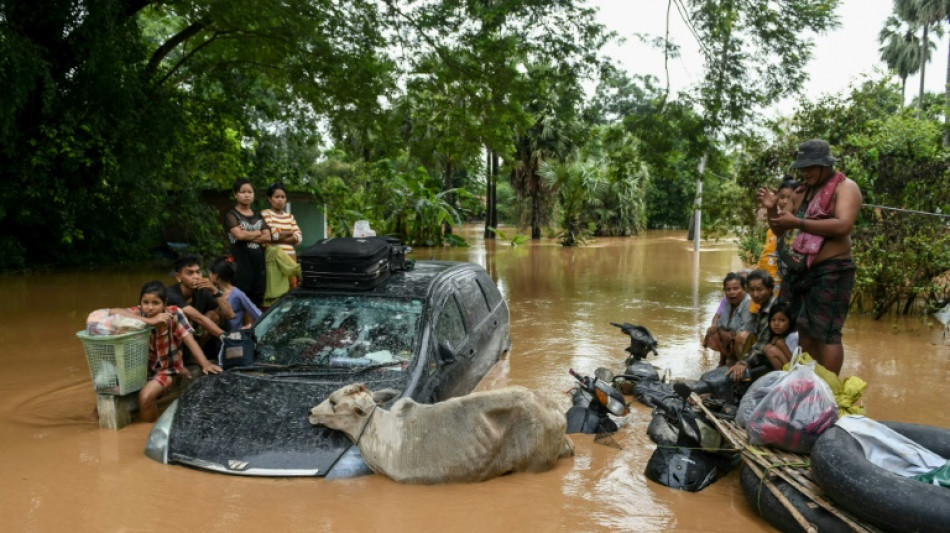
September saw extreme rainfall and destructive storms across the world, events that are occurring with greater severity and frequency as global temperatures rise due to climate change.
The average global temperature last month was second only to September 2023, said Copernicus, which uses billions of measurements from satellites, ships, aircraft and weather stations to aid its calculations.
Last year was the hottest on record, but 2024 looks set to rewrite history yet again.
Global warming isn't just about rising temperatures but the knock-on effect of all that extra heat being trapped in the atmosphere and seas.
Warmer air can hold more water vapour, and warmer oceans mean greater evaporation, affecting rainfall and resulting in more intense downpours and storms.
In September some parts of the world saw "months' worth of rain falling in just a few days", said Samantha Burgess, deputy director of the Copernicus Climate Change Service.
"The extreme rainfall events of this month, something we are observing more and more often, have been made worse by a warmer atmosphere," Burgess said.
"The risk of extreme rainfall will continue to increase with rising temperatures."
In a month of wild weather, Hurricane Helene pounded the southeast United States, Typhoon Krathon slammed into Taiwan and Storm Boris brought floods and devastation to central Europe.
Typhoons Yagi and Bebinca left a trail of destruction in Asia while deadly floods hit Nepal, Japan and west and central Africa.
Copernicus said wetter than average conditions were also witnessed in parts of Africa, Russia, China, Australia and Brazil, while Pakistan was "severely" impacted by the monsoon.
- New highs -
Copernicus said the months January through September 2024 have already set fresh highs "making it almost certain that 2024 is going to be the warmest year on record".
Fourteen of the last 15 months have been at least 1.5 degrees Celsius above average temperatures experienced in the pre-industrial era, taken as the period between 1850-1900.
This doesn't amount to a breach of the Paris climate deal, which strives to limit global warming to well below 2C and preferably 1.5C, because that threshold is measured over decades, not individual years.
But scientists have warned the 1.5C cap is slipping out of reach.
As they stand, international efforts to reduce planet-heating emissions like carbon dioxide would see global temperatures rise as much as 2.9C by 2100, according to the UN Environment Programme.
Greenhouse gas emissions, mainly from the burning of fossil fuels, have risen in recent years, even as scientists say they need to fall by almost half this decade.
Copernicus records go back to 1940 but other sources of climate data such as ice cores, tree rings and coral skeletons allow scientists to expand their conclusions using evidence from much deeper in the past.
Climate scientists say the period being lived through right now is likely the warmest the earth has been for the last 100,000 years, back at the start of the last Ice Age.
S.Yamada--JT