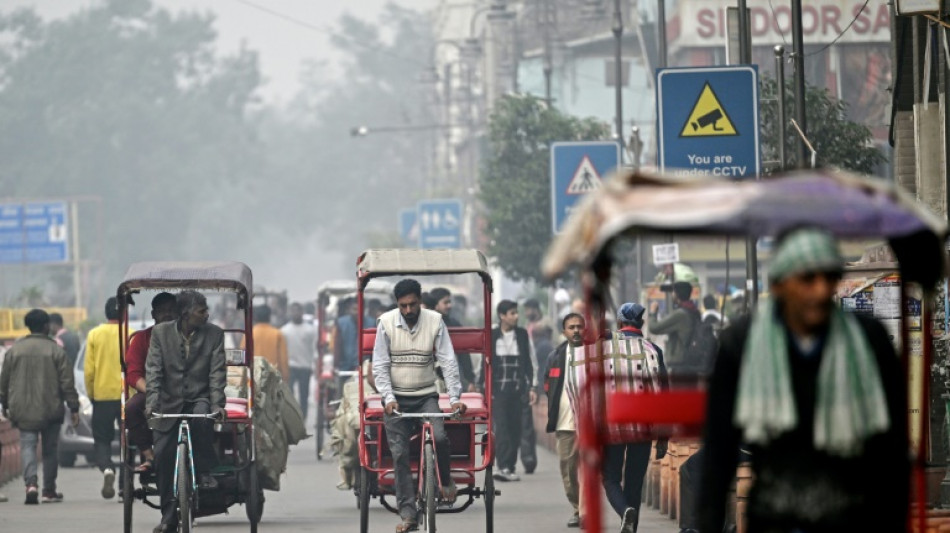
Toxic air divides Delhi between poverty and privilege / Photo: Arun SANKAR - AFP

Environmental change hits the poorest the hardest, experts say, and in India's toxic smog-filled capital that includes the air people breathe.
In Old Delhi, the ancient heart of the capital, 39-year-old Rizwan pedals a rickshaw tricycle, transporting passengers and heavy goods through crowded streets often too narrow for cars, earning about seven dollars on a good day.
There is no escape from Delhi's deadly smog that cloaks the city in a misty winter grey and chokes the lungs of its 30 million residents, making it one of the world's worst capitals for air quality.
"My eyes burn... I am aware of the health risks but what else can I do?" said Rizwan, who uses only one name, panting hard to manoeuvre through traffic-clogged streets.
Levels of fine particulate matter -- cancer-causing microparticles known as PM2.5 pollutants that enter the bloodstream through the lungs -- often hit more than 30 times the World Health Organization's danger limits.
Authorities in Delhi asked people last month to work from home and limit time spent outside to protect themselves from the poisonous air.
But Rizwan said his choice was to work or starve.
"I've left my village to come here, I have to work hard, it is a necessity," he said.
"I am not educated enough to work in an office or do some other job. Either I can pedal a rickshaw or pull a cart."
- 'Thick layer of soot' -
Adjoining Old Delhi is the modern city created when building expanded exponentially early last century.
New Delhi's affluent Gulmohar Park neighbourhood lies just 10 kilometres (six miles) south of the old city walls but it could be a different world given how people there live and cope with the smog.
With an air purifier machine buzzing reassuringly in the background, successful 31-year-old cinematographer Madhav Mathur starts his day by checking pollution levels on a WhatsApp group made by residents.
Mathur, a keen long-distance runner born and brought up in Delhi, said he can no longer exercise outside during winter when pollution is at its worst.
"I have stopped running outside because of the pollution," he said, noting a stark change since he was a boy. "I realised it is harming me more than it is benefitting me."
Mathur lives with his parents and usually works from home. When he does have to venture outside for prolonged periods, such as filming for work, he wears a tight-fitting mask.
It mitigates the worst health risks but Mathur's key challenge is that colours on camera lose their vibrancy because of the "thick layer of soot".
Experts say that those suffering the worst from air pollution are not only those least responsible for it, they are also the least able to cope.
"There is a contrast in the air pollution impact across diverse socio-economic ranges," said Sagnik Dey, professor at the Centre for Atmospheric Sciences at Delhi's Indian Institute of Technology (IIT).
"Poor people cannot afford those personal mitigation measures. They cannot afford masks, a purifier is completely out of reach."
For rickshaw driver Rizwan, wearing a mask tight enough to keep pollution out makes the hard work of pedalling too tough.
- 'Cut down emissions' -
Prolonged exposure can trigger strokes, heart disease, lung cancer and other respiratory diseases, according to the WHO.
The average city resident could die nearly 12 years earlier due to air pollution, a report by the University of Chicago's Energy Policy Institute said in August.
Mathur said he was all too aware of his privilege in being able to afford to escape the smog and "sympathises" with those who can't afford better air.
"I am aware that someone whose economic life is synonymous with being outside, they cannot afford to be indoors, their economic life is going to come to a halt", he said
"I cannot relinquish it... but I think about it, definitely."
Smog in Delhi is caused by a melange of factory and vehicle emissions, exacerbated by seasonal agricultural fires clearing harvest stubble for tilling.
While authorities deploy short-term efforts such as smog guns and sprinklers to dampen down the air, there is little real pressure to tackle the root causes.
Delhi's residents who can't afford to take personal measures to reduce the impact of pollution see it as just one more problem weighing them down.
The IIT's Dey said the only way was for year-round action to ensure all can breathe air that does not harm them.
"Those who can afford a purifier are using it but, ultimately, if we have to really think about the entire population, we must cut down emissions," Dey said.
"That is the only way to protect everyone's health."
S.Ogawa--JT