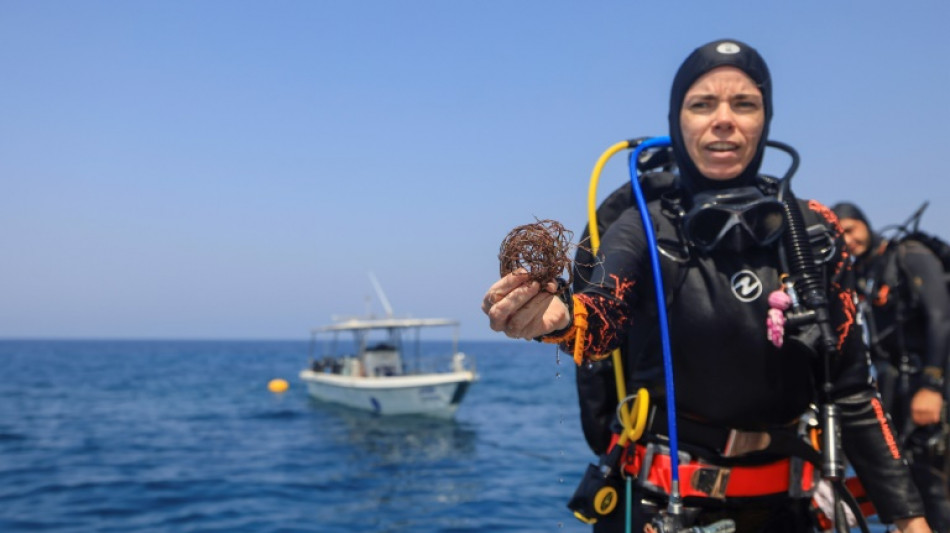
Volunteer divers guard Oman's 'unique' coral reefs / Photo: Karim SAHIB - AFP

On a sailing boat anchored off Oman's pristine Daymaniyat Islands, volunteer divers pull on wetsuits, check their scuba tanks and then take turns plunging into the clear turquoise water.
They are diving for a reason: to remove the massive fishing nets damaging an unusually resilient coral reef system that is seen as more likely than most to survive rising sea temperatures.
The clean-up is one example of how divers and Omani authorities are joining forces to protect the reefs -- which are critical for marine wildlife -- from man-made damage.
"Coral reefs are a refuge for marine habitat and wildlife," said Hammoud al-Nayri of Oman's environmental authority, as he watched the divers.
"To protect marine ecosystems, we must first preserve coral reefs," said the 45-year-old who oversees the Daymaniyat Islands, Oman's only marine reserve.
Most shallow-water corals, battered and bleached white by repeated marine heatwaves, are "unlikely to last the century", the Intergovernmental Panel on Climate Change said last year.
Global warming, as well as dynamite fishing and pollution, wiped out a startling 14 percent of the world's reefs between 2009 and 2018, according to the Global Coral Reef Monitoring Network.
But Oman's relatively cooler waters provide a rare refuge for its reefs, which are among the least studied in the world.
"Oman's reefs are actually considered to be relatively less vulnerable than some regions," said John Burt, associate professor of biology at New York University Abu Dhabi.
"This is largely due to the influence of the monsoon," the marine expert explained.
"During peak summer temperatures, when we would expect to see bleaching related to marine heatwaves in most regions, the Indian Ocean monsoon picks up in southern Oman, cooling water temperatures dramatically."
- 'Huge environmental treasure' -
Oman's reefs may be resilient to warming sea temperatures, but they are not immune.
The sultanate saw its last major bleaching event in the summer of 2021, when sea temperatures were particularly warm, said Burt.
Cyclones, which are becoming more frequent due to climate change, are also a major threat.
Between 2005 and 2010, more than half of corals in Oman were lost because of Super-Cyclone Gonu in 2007, Cyclone Phet in 2010, as well as a large-scale algal bloom in 2008-2009, Burt said.
"We have had over a decade of recovery in the intervening years which has allowed coral to come back to these reefs," Burt said.
To protect the reefs from fishing nets and coral-killing starfish, Hasan Farsi dives in Daymaniyat every week to inspect for damage.
The son of a fisherman, he records the GPS coordinates of damaged coral areas and sends them to the environment ministry to register them as clean-up targets.
He then joins the dozens of volunteers who dive down to remove the sunken nets and crown-of-thorns starfish, which prey on the reefs.
Coral reefs are "a huge environmental treasure", Farsi said from a sailing boat, with extracted nets piled up behind him.
"The coral reefs, because of wrong practices by fishermen, are deteriorating year by year," said the 52-year-old diving instructor.
"Without clean-up campaigns, they would be destroyed completely."
- Reefs database -
Farsi is not alone in his effort.
Jenan Al Asfoor, a diver and trainer, is a central figure in Oman's coral reef conservation.
The 40-year-old heads Reef Check Oman, which is part of the global Reef Check Foundation.
It was established in 2017 with the aim of building a full database of the country's coral reefs, monitoring their health, identifying their main threats, and working with authorities on protection policies.
Over the years, the organisation has conducted several surveys across the country.
"During these surveys, we noticed that we didn't record much bleaching happening... most of the reefs we have surveyed look healthy and in good condition," Asfoor said.
"The uniqueness of corals here, is that while other countries are suffering from high sea temperatures during summer, usually in Oman, we have a cool water temperature all around the year due to the cold water currents travelling from the south of Oman during the monsoon season."
According to Asfoor, Oman's coral reefs have also adapted to high salinity in Oman's northern seas.
"We have a very unique ecosystem happening here, which is not found often anywhere else around the world," she said.
"Our goal in Reef Check Oman is to continue protecting it for generations to come."
T.Sato--JT