Chinese company gives leftover hotpot oil second life as jet fuel / Photo: Hector RETAMAL - AFP

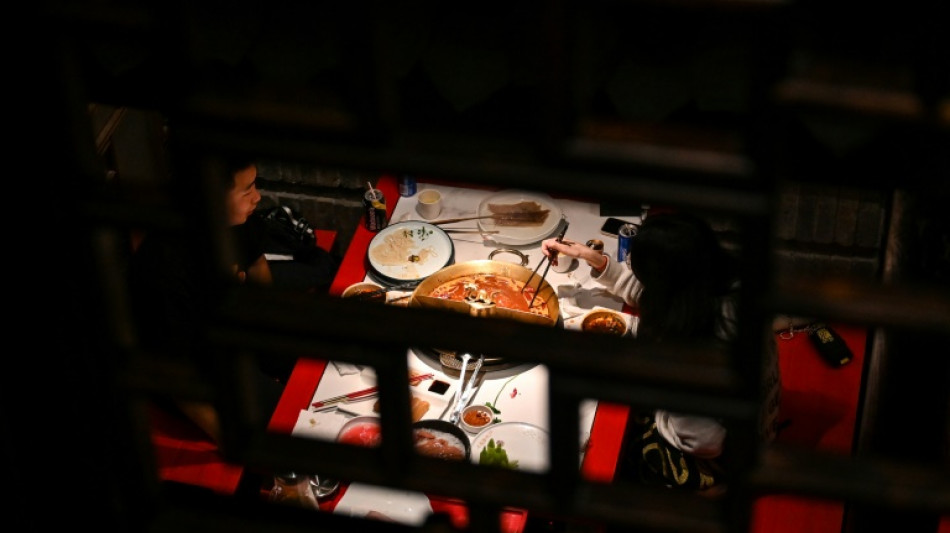
At an upmarket restaurant in the hotpot-loving Chinese city of Chengdu, diners plunge sliced meat and vegetables into cauldrons of spicy, oily broth, largely unaware that their leftovers are set to take on a second life as jet fuel.
With around 150,000 tonnes of used hotpot oil thrown out by restaurants in the city each year, local business Sichuan Jinshang Environmental Protection has found a niche processing the greasy waste and exporting it to be turned into aviation fuel.
"Since the company was incorporated in 2017, our overall volume has been increasing year by year," Ye Bin, the company's general manager, told AFP.
"Our motto is, let oil from the gutter soar in the sky."
Ye said his company was now producing up to 150,000 tonnes of industrial-grade oil annually from a combination of hotpot restaurants and other eateries across Chengdu, including KFC outlets.
On a typical night, collectors hired by Jinshang visit hundreds of these restaurants around the southwestern metropolis.
The process begins right after customers leave, with waiters emptying their hotpot broth -- so rich it is used purely as a cooking medium -- into a special filter that separates oil from water.
Donning thick aprons and elbow-length rubber gloves, collectors then arrive to pick up jerrycans of the scarlet grease.
"It's a great job -- I play mahjong during the day and work at night," one collector named Zheng told AFP as he packed a minivan with containers of the pungent sludge.
That sludge is then ferried to a business park on the city's outskirts where Jinshang's mostly spotless plant is based.
The only trace of the oil there is a faint scent of hotpot at the unloading dock and telltale orange stains at the bottom of some equipment.
The oil is piped into massive vats and undergoes a refining process that removes remaining water and impurities, resulting in a clear, yellow-tinged industrial-grade oil.
That is exported to clients based mainly in Europe, the United States and Singapore, who further process it to make what industry insiders call "sustainable aviation fuel" (SAF).
SAFs are critical to decarbonising the aviation sector, which was responsible for two percent of global energy-related CO2 emissions in 2022, according to the International Energy Agency.
But they are still not widely used -- making up less than 0.1 percent of all aviation fuels consumed -- because of processing costs and the relatively small number of suppliers.
The International Air Transport Association estimates their widespread adoption could "contribute around 65 percent of the reduction in emissions needed by aviation to reach net-zero in 2050".
Jinshang has plans to expand into its own SAF-producing facility soon, using equipment from US firm Honeywell to produce 300,000 tonnes annually.
- Food waste problem -
Jinshang's business model is part of wider efforts in China to tackle the mountains of food waste generated by its population of 1.4 billion.
Around 350 million tonnes of farm produce -- over a quarter of annual output -- goes to waste in the country each year, discarded by restaurants, supermarkets or consumers, according to a 2021 Nature study.
In landfills, rotting food waste emits atmosphere-warming methane gas more quickly than most other materials, according to the US Environmental Protection Agency.
It's a massive headache for Chinese cities and a major threat to global climate goals -- one Beijing has vowed to tackle in a recent methane emissions plan that calls for the construction of innovative food waste processing projects across the country in the next few years.
In Shanghai, municipal waste treatment facilities have turned to the humble black soldier fly to turn tonnes of food waste each year into fertiliser and animal feed.
At the Laogang waste treatment plant, a cavernous sealed room houses 500 million maggots, which chomp their way through up to 2,500 tonnes of food waste each day, according to plant deputy director Wu Yuefeng.
The wriggling grubs excrete a fine, black, dirt-like substance that is repurposed as fertiliser, while the larvae themselves are killed and harvested at peak plumpness to be turned into livestock feed.
Back in Chengdu, the thought that his dinner will have a long, productive afterlife brings comfort to hotpot fan Dong.
"This utilisation and circulation of waste throughout the whole of society is more beneficial," he told AFP.
M.Sugiyama--JT