In a pickle: Baltic herring threatened by warming sea / Photo: Alessandro RAMPAZZO - AFP

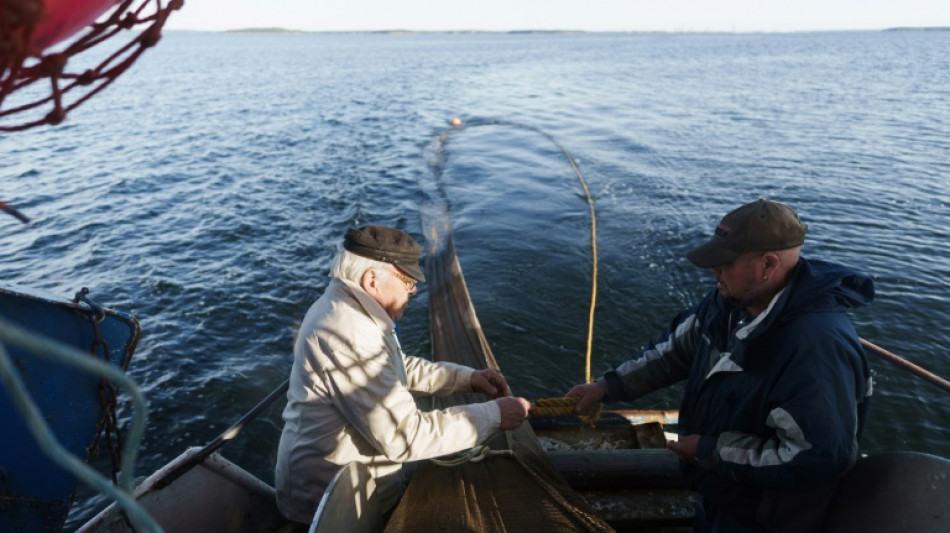
Even aged 84, Holger Sjogren nimbly untangles the knots in his herring net as it was lowered into the murky depths of the Baltic Sea.
"When the trawl bag comes up, the seagulls give us a concert," he said.
Sjogren, a fifth-generation herring fisherman, has been trawling from the waters near Kotka in southeastern Finland for more than five decades.
In the harbour, dozens of customers eagerly await his return to buy his catch straight off the boat.
However, the Baltic, which is enveloped by some of Europe's most industrialised nations, is one of the most heavily polluted marine ecosystems on the planet.
Fishermen in Finland now fear that their trawlers might be mothballed for good.
"Many people are scared that they will have to quit," said Sjogren.
While some experts have called for a reduction in fishing quotas to safeguard the fragile ecosystem, others fear that a halt to fishing could have more adverse effects than positive ones.
In October, the European Union reduced Baltic herring quotas by up to 43 percent for 2024 -- well short of the total ban initially proposed by the European Commission in August.
But with Baltic herring making up approximately 80 percent of Finland's annual catch, fishermen believe they are being punished for a problem they did not cause.
"We take so little herring that it makes no difference to the stock, on the contrary, it revitalises the stock more than it consumes," Sjogren argued.
- Sea turning into a lake -
With stocks plummeting since the 1970s, Baltic herring could face the same fate as many other species that all but disappeared from the region.
The Baltic Sea is remarkably shallow. In size it is comparable to the Black Sea, but holds 20 times less water. That means it is more vulnerable to climate change and human activities.
Rising temperatures and falling salinity due to more rainfall and less inflow from the Atlantic, are threatening numerous species as they strive to adapt.
"The more the Baltic Sea becomes a lake, the worse it will be for marine species," said Jukka Ponni, a research scientist at the Natural Resources Institute Finland (LUKE).
Excessive nutrients from agricultural runoff have caused vegetation to proliferate, resulting in areas with low oxygen levels and harmful algae blooms that blanket the sea during summer.
As the Baltic becomes less of a sea, larger saltwater species such as Baltic cod have been among the earliest casualties.
As recently as the 1980s its population reached record levels, but catches have steadily declined to such an extent that the EU had to slap an emergency ban on cod fishing in 2020.
The immense Atlantic sturgeon, once abundant in the Baltic, vanished due to pollution and the obstruction of its migratory rivers.
- 'Ban may not help' -
While some advocate for significant reductions in fishing quotas to safeguard the remaining populations, others differ.
"It wouldn't have helped the stock even if there had been a total ban. It would even have had the opposite effect," scientist Ponni said.
He believes climate and environmental problems threaten the populations more than fishing.
With the disappearance of Baltic cod, herring have very few natural predators.
This means that without the fishermen thinning out stocks, the populations could become "too dense and the growth of individuals would be reduced as a result" due to food scarcity.
But Matti Ovaska, fisheries officer at the World Wide Fund (WWF), dismissed that argument.
If herring stocks are further depleted due to intensive fishing, there is a risk that other species, such as sprat, may take over and hinder the recovery of herring populations, he said.
"It will be necessary to cut fishing on all herring stocks," Ovaska said.
- Last herring market? -
For almost three centuries, the market square in the centre of Helsinki has bustled every autumn with locals buying herring directly from fishing vessels during the annual herring market.
"I eat herring every week," customer Markku Karjalainen told AFP.
From pickled herring with onion and bay leaves to whole smoked herring, "silakka" -- herring in Finnish -- has been an important part of Nordic culinary tradition for centuries.
But as restrictions mount, Ponni fears for the very future of fishing.
"There is a risk that fishing will cease altogether. No one will invest anymore," Ponni said.
This would be regrettable, Ponni argued, as recent innovations have positioned herring as a substitute for canned tuna.
Despite the restrictions, Sjogren wants to continue fishing as long as he can.
"The EU fisheries policy dictated from Brussels should be completely overhauled and the identity of the fishermen respected," he said.
M.Ito--JT