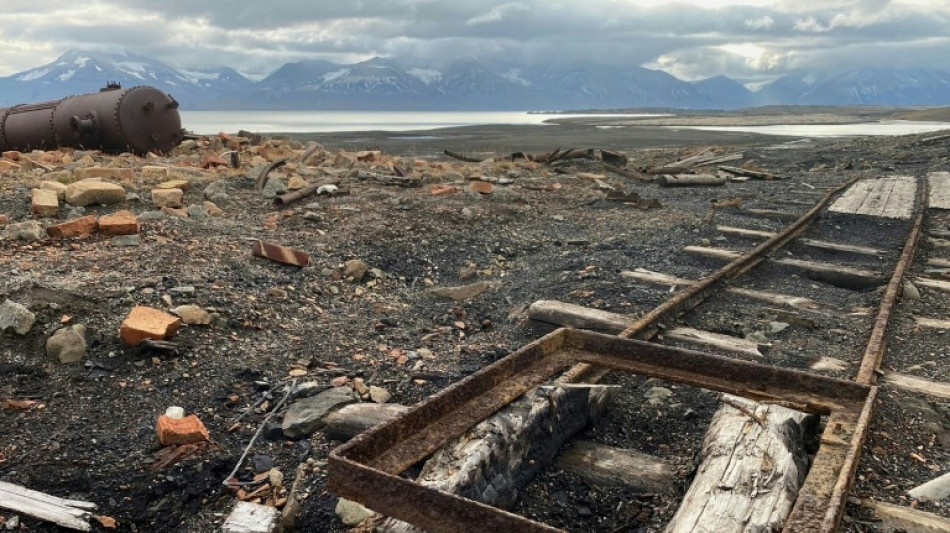
Arctic archipelago turns the page on its mining past / Photo: Viken KANTARCI - AFP

At the old Svea mine in the Arctic, broken railway tracks overgrown with weeds lead nowhere. Of the hundred buildings that once made up the town, there's almost nothing left.
Coal brought fortune to Norway's Svalbard archipelago, but that bonanza became a curse for the remote group of islands, now the most harmful fossil energy for the climate.
Svalbard, today home to 3,000 people and located in the fastest-warming region on the planet, is bit by bit erasing all traces of its mining past.
A 40-minute helicopter flight from the main town of Longyearbyen, the Svea mine and its surrounding settlement have been returned to Mother Nature after a massive, recently-completed restoration project.
"At its peak there were barracks for 300 people, with a canteen, an airfield with 35,000 passengers yearly, a power plant, a workshop, and storage," said Morten Hagen Johansen, in charge of the project at the mine where he was once employed.
The Svea site is the biggest natural restoration ever undertaken in Norway.
Only a handful of man-made objects remain, preserved because they are considered historic.
They include a few dilapidated brick buildings, a rusted track vehicle, and railway tracks that once transported wagons loaded with coal.
The area "was home to many miners who were working here for decades," Hanna Geiran, head of the Norwegian Directorate for Cultural Heritage, told AFP.
"Preserving these artefacts helps to better understand what this place was," she added.
- Avalanches -
The mine was opened by a Swedish company in 1917 and officially closed 100 years later after producing 34 million tonnes of coal.
The site has since been returned to its natural state at a cost of around 1.6 billion kroner (about $140 million) to the Norwegian state.
"The concept is to try to let nature take it back," said Hagen Johansen.
"That means to let creeks run freely. To make sure that avalanches do happen, because that will transport more sediment down and it will make new creeks."
The part of the Barents Sea where the Svalbard archipelago is located is warming up to seven times faster than the rest of the planet, according to a study published in last year.
At Svea, a spectacular landslide recently created a deep crevasse down a hilly slope.
"It is the result of a very heavy rainfall last summer where they got maybe 50-60 millimetres (2-2.3 inches) of rain in just 24 hours," geologist Fredrik Juell Theisen said.
"That was very unusual before climate change started changing the climate up here," he added.
- Russian presence -
The climate backlash is for the archipelago now trying to rid itself of fossil fuels.
Seven other mines located in the hills of Longyearbyen have almost all been closed, with the last one due to shut in 2025.
The town also disconnected its coal plant for good this month in exchange for a less-polluting diesel plant, ahead of a transition to renewable energies at a later stage.
Going forward, Svalbard's economy will rely on tourism and scientific research.
The only coal still being mined on the archipelago will be a vein in Barentsburg, a Russian mining community with just under 500 Russians and Ukrainians, most of them from the Donbas region.
Under the 1920 international treaty that recognises Norway's sovereignty over Svalbard, all signatories are entitled to exploit the region's natural resources equally.
As a result, Russia has for decades maintained a mining community om Svalbard, via the state-run company Trust Arktikugol, in a strategic region belonging to a NATO member.
According to some observers and Russia itself, strict environmental regulations that Norway has introduced in the region -- about two-thirds of Svalbard land is protected in one way or another -- are at least partly aimed at limiting .
It's impossible to know whether such considerations played into Oslo's decision to restore the Svea mine at great cost, said Mats Kirkebirkeland of Norwegian think tank Civita.
"But there's no denying that some of the Norwegian environmental policies and the geostrategic policies on Svalbard are aligned."
T.Shimizu--JT