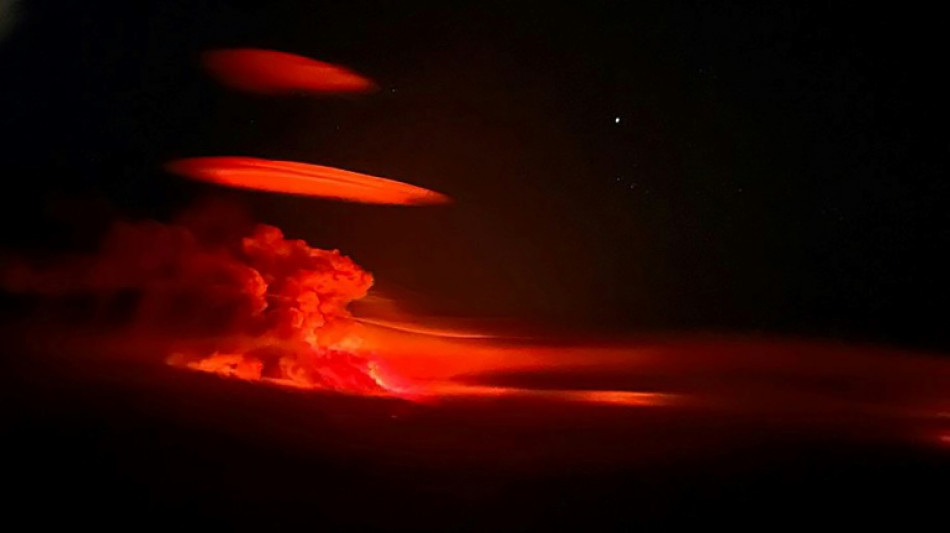
Canada's far north speeds up evacuations as fire nears main city / Photo: Handout - BC Wildfire Service/AFP

Residents of Yellowknife in Canada's far north raced Friday to evacuate ahead of a midday deadline as wildfires bear down on the remote city and other parts of the vast country.
Since authorities in the Northwest Territories issued the city-wide evacuation order late Wednesday, long lines of cars have snaked along the lone highway connecting the area to Alberta province to the south ahead of the 12:00 pm (1800 GMT) limit.
About 1,500 people have so far left Yellowknife, the regional capital, by plane, with an increased number of flights scheduled Friday to evacuate more of the city's 20,000 residents.
The nearest evacuation center is 1,150 kilometers (700 miles) away, in Alberta, where several sites have been set up.
"We're going to keep going until we have the population of Yellowknife out," emergency services official Jennifer Young told a briefing.
Air Canada pilot Chad Blewett, who flew one of the first relief flights out of the lakeside city, told public broadcaster CBC that Yellowknife "is pretty empty already."
The stragglers, he said, were mostly essential workers "building fire breaks and working with airlines (to facilitate evacuations)."
Crews have scrambled to erect defenses as the flames approach Yellowknife, while water bombers have been seen flying low over the city.
Strong winds over the next two days will send the fire, already within just a few kilometers of the city's perimeter, "in directions we don't want," Northwest Territories' fire information officer Mike Westwick said late Thursday.
Several military aircraft have already been dispatched, along with more than 120 soldiers to help beat back the flames.
- Massive evacuation -
In what had already been declared the Northwest Territories' largest-ever evacuation, the emptying of Yellowknife now means half the population of the near-Arctic territory will soon be displaced.
Several towns and Indigenous communities were also already under evacuation orders.
Prime Minister Justin Trudeau interrupted his summer vacation to convene an incident response group late Thursday.
Officials were to provide an update at midday.
In Canada's westernmost province of British Columbia, evacuation orders were also put in place for areas near Kelowna, as a different fire threatened the city of around 150,000.
Officials in Kelowna -- nestled in the Okanagan Valley that is home to some of the country's top wineries -- confirmed overnight that fires in the west of the city had caused "some structural loss."
Nearly 2,500 homes and businesses on its west side were ordered evacuated, while another 4,800 were advised to be ready to leave on a moment's notice.
"The fire remains very active and unpredictable," the British Columbia emergency operations center warned.
- Record-setting wildfire season -
Canada is experiencing a record-setting wildfire season, with official estimates of over 13.7 million hectares (33.9 million acres) already scorched. Four people have died so far.
In addition, the thousands of fires have also emitted an unprecedented amount of carbon dioxide.
Scientists say human-caused global warming is exacerbating natural hazards, making them both more frequent and more deadly.
Adria McPherson,who spoke to CBC while fleeing the fires in Canada's north by car, commented: "It shows how quickly our climate is changing if a place like Yellowknife, so close to the Arctic Circle, is on fire."
The evacuation of Yellowknife is the second time an entire Canadian city has been cleared due to wildfires since 100,000 residents of Fort McMurray in Alberta's oil and gas producing heartland were forced out in 2016.
Earlier this year, suburbs of Halifax on the Atlantic coast were also evacuated.
The Yellowknife evacuation comes amid heightened awareness about the deadly speed of wildfires, after a town on the Hawaiian island of Maui was razed by a fast-moving inferno, killing more than 100 people.
Waves of thick smoke from Canada have also intermittently descended on the United States, prompting several air alert warnings in large swaths of the country's center and east.
K.Yamaguchi--JT