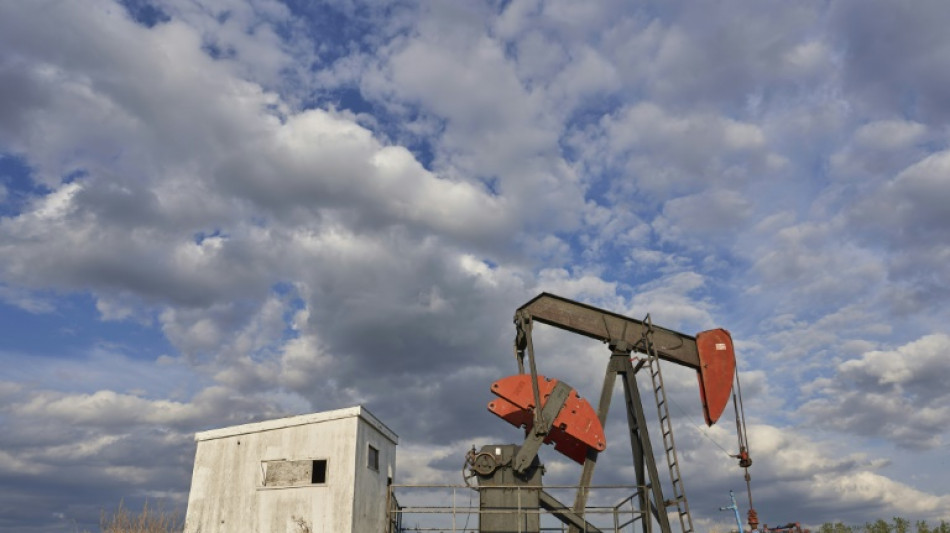
In Canada, deserted oil wells are environmental time bombs / Photo: Geoff Robins - AFP

With its flaking red paint, broken pressure gauge and cranks fallen to the ground, an oil well sits forsaken in western Canada, like tens of thousands of others that have been out of service for decades -- but never plugged.
Activists and experts say the existence of these inactive oil and gas installations -- often dug hundreds of meters (yards) below the surface in Alberta province -- is a ticking ecological time bomb for the vast country.
"Every single one of them is simply steel and concrete. They erode and break down," said Regan Boychuk, the founder of Reclaim Alberta, a group advocating for the clean-up of such wells.
"Every one of these holes needs to be managed, monitored for eternity because of the danger of leaks," he told AFP.
Each one of these wells also emits methane, a potent greenhouse gas that, over a 20-year period, is "86 times more impactful compared to a molecule of carbon dioxide," stresses McGill University professor Mary Kang, who has written a study on the issue.
It's a source of pollution that she believes is likely underestimated and "has a much bigger uncertainty range compared to other methane emission sources," Kang notes.
More than 120,000 oil and gas wells are inactive but not sealed off in Alberta and Saskatchewan provinces, home to more than 90 percent of Canada's wells, according to government data released in 2022.
The oldest of these has not been used since World War I.
Overall, according to that government data, these installations have emitted an average of 16,000 tonnes of methane per year over a century -- the equivalent of 545,000 tonnes of carbon dioxide annually, or what about 237,000 vehicles emit in one year.
- Work postponed indefinitely -
Most of the wells were built sometime between the dawn of the oil and gas era in the 1860s and the end of the 1940s. In some provinces of Canada, which has the world's fourth largest proven oil reserves, they are not even registered.
After decades of industrial expansion, Alberta -- home to most of the country's oil resources, mainly in the form of oil sands -- saw the number of inactive wells increase rapidly since 2010, particularly after crude prices dropped off in 2014.
Under the polluter-pay principle enshrined in Canadian law, energy companies must pay for the plugging of wells and cleanup of the surrounding area, but there is thus far no deadline for that work to be completed.
This allows oil and gas firms to postpone the work indefinitely, or to transfer their inactive wells to smaller companies.
When these companies file for bankruptcy, the environmental burden for orphaned wells falls to provincial authorities -- and creates another bureaucratic nightmare.
Over roughly a decade, the number of orphaned wells in Alberta exploded, from 700 in 2010 to almost 10,000 in 2023.
The government in Ottawa says the cost of cleaning them up will soar from CAN $361 million (US $272 million) in 2020 to $1.1 billion in 2025.
While the Orphan Well Association in Alberta plans to get the job done over the next 10 to 12 years, some say the monumental task has been wildly misjudged.
"There are tens of thousands that fit the common sense definition, but only a few thousand are officially designated," Boychuk says.
- Polluted soil -
Albert Hummel, a farmer in southern Alberta, had seven abandoned wells on his land. But he's one of the lucky ones -- some of them were finally sealed off and "reclaimed," or restored to their original state. There are two left to handle.
"It's a slow process, it takes time," says Hummel, who lost the royalties he was earning for the use of his land once the oil company in question went out of business in 2019.
Once the soil is contaminated, it takes decades for the pollutants to evaporate. Only then can cleanup work begin.
After the ground is purified, the wells must be plugged with cement, each layer of soil carefully replaced, and the area leveled off with the surrounding fields for it to be considered "reclaimed."
Right in the middle of one of Hummel's fields, the remains of a well have prevented the farmer from using part of that land -- "it's just straight loss of production," he says, pointing to the pipes emerging from the earth.
In an effort to offset the loss and render the area at least partially useful, one small company has offered to install solar panels until the ground can be decontaminated.
"It just gives nature more time for the grass to come back, for contaminants to evaporate," says Daryl Bennett from the RenuWell project.
"It'll give a little more time to clean up the land and reclaim it, and it's producing renewable energy too."
But such solutions represent a drop in the bucket when compared to the overall cleanup at hand.
"Emissions from this legacy infrastructure, they're not going to go away," says Kang.
"It's something we're going to have to manage for years and decades to come."
Y.Kato--JT