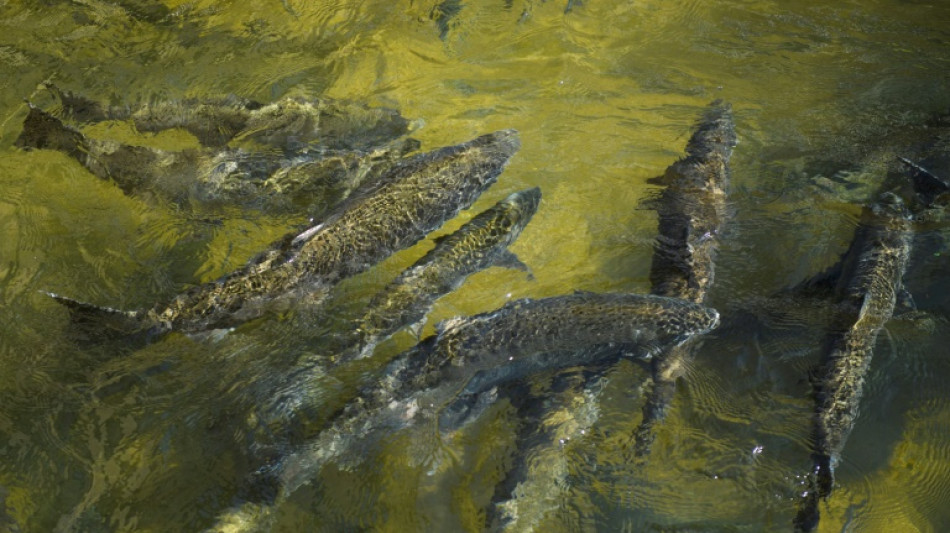
Drought scuppers salmon fishing season in California / Photo: Patrick T. FALLON - AFP/File

Gazing out at San Francisco harbor from her wooden fishing boat, Sarah Bates looks glum.
In happier times, she would head out to sea every morning. But for much of this year, she has remained hopelessly docked, due to a ban on salmon fishing as a result of California's drought.
"Salmon is my main fishery and it's 90 per cent of my income," says the 46-year-old.
In force since April along the entire coast of the Golden State, and parts of neighboring Oregon, the moratorium will last until the end of the salmon fishing season in September.
It was brought in as the number of salmon expected to return to the region's rivers has plummeted close to historic lows.
The decades-long drought gripping the American West, aggravated by climate change, has seen the levels of California's rivers drop, and their waters grow warmer.
With many dams already constructed on these waterways, these inhospitable conditions mean salmon are struggling to swim upstream to reproduce, and their offspring often die before reaching the ocean.
The ban is a significant blow to California, where salmon fishing generates $1.4 billion per year, and supports 23,000 jobs, according to the Golden State Salmon Association.
On the San Francisco harbor front, several restaurants have been forced to import salmon from further afield, including Canada, in order to keep the popular fish on their menus.
"Salmon is king... that's what people want," says Craig Hanson, a 60-year-old chartered boat operator specializing in sport fishing.
"They're also a very spectacular fish to catch... the salmon is going to fight you to the end."
- 'Marine heat waves' -
In summers past, Hanson would take his boat out every day. This season, the sailor weighs anchor only four times a week
He blames a lack of enthusiasm among customers for fishing halibut or striped bass.
Despite the loss of income, Hanson approves of the ban if it helps the future of the industry, and is optimistic that salmon can rebound soon thanks to recent months of heavy rain and snow.
Yet many fishermen fear another ban next year.
"The Chinook salmon that are fished here in California typically have a three- or four-year life cycle," explains Nate Mantua, a scientist with the National Oceanic and Atmospheric Administration (NOAA).
"So when things happen to them in freshwater, as eggs or juveniles, we see it impacting the fishery two or three years later."
The decline in salmon numbers has been precipitous for at least a decade.
Low river water levels -- which authorities have tried to work around, by trucking baby salmon down to the ocean -- are only part of the problem.
Between 2014 and 2016, the Pacific reached temperatures never before seen off the west coast of North America.
"Marine heat waves" created "really poor growth and survival conditions for salmon", says Mantua.
Deprived of cold ocean currents that bring essential nutrients, the fish fell prey to other hungry species.
"It's not just a California problem. It's really the entire Pacific, except for a few exceptions," such as certain Alaskan species, he adds.
- 'Climate shocks' -
But in California, "our fish were already predisposed to being vulnerable to any kind of climate shocks," says Mantua.
This is because the state -- with a giant 40-million population, and a sprawling agricultural sector essential for feeding the United States -- has relentlessly developed its rivers, in order to support its cities and farms.
Due to countless dams and canals, salmon have lost 80 percent of the habitats in which they can spawn.
Water management, and the priority afforded to farmers in central California, is now a major source of grievance for fishermen.
In San Francisco, many are calling for water to be re-diverted into rivers, rather than supplying producers of water-intensive crops like almonds, pistachios and walnuts -- which are often grown for export.
"When it comes down to it, water is more important for the fish than it is for nuts," says Ben Zeiger, a 23-year-old deckhand working on a local sport-fishing boat.
Salmon fishers are waiting to receive financial compensation from federal authorities for this year's fishing ban.
But their priority is efforts to improve salmon habitats.
Along northern California's Klamath River, a giant project has just begun to demolish four hydroelectric dams, potentially reopening 400 miles of river for migratory fish.
"If we don't fix the water policy, we're going to be here again" in future drought years, says Bates, back on the wharf.
"Climate change is happening. And it's happening faster than I think any of us expected."
H.Nakamura--JT