Kenya launches bid to save wild bongos from extinction

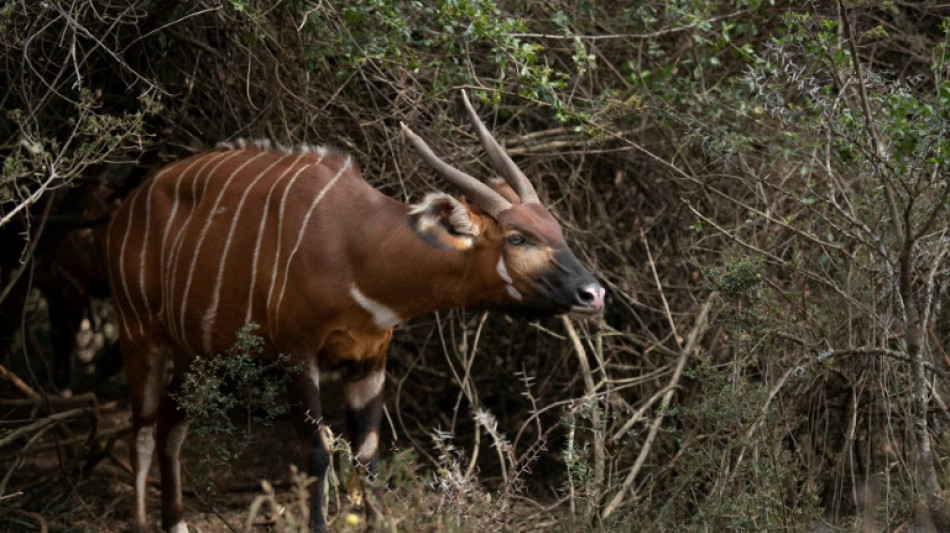
The first mountain bongos have been released into a sanctuary beneath Mount Kenya under a world-leading programme to save the extremely rare forest antelopes from certain extinction in the wild.
Two young males on Wednesday joined two other bongos released the day before into the wooded foothills of Africa's second-highest peak, where the iconic antelopes have not been seen in nearly 30 years.
Kenya is the last place where the majestic animals are still found in their native habitat.
Bongos once existed in great numbers but today fewer than 100 are believed to roam Kenya's equatorial forests, and the species is classified as critically endangered.
As wild populations have collapsed, conservationists in Kenya have bred bongos with the aim of returning a select few to nature and giving the vanishing antelopes a shot at survival.
This "rewilding" strategy is daring and difficult -- captive bongos must be totally weaned off humans and the painstaking work of preparing antelopes for the wild has taken nearly 20 years.
"Finally, these bongos are being rewilded," Kenya's minister of tourism and wildlife, Najib Balala, said at the opening of the Mawingu Mountain Bongo Sanctuary near the central town of Nanyuki.
"What a celebration. What a success."
- Endangered and neglected -
Elusive and handsome –- boasting distinctive spiral horns and striking striped coats -– mountain bongos were a sought-after trophy for colonial-era wildlife hunters.
In the latter half of the 20th century, habitat loss, diseases introduced by cattle and poaching for bushmeat further decimated their number.
The last wild bongo sighting in the highlands around Mount Kenya -— one of their historic rangelands, along with the Aberdares and the Eburu and Mau Forests –- was a carcass found in 1994.
A decade later, with their extinction looming, a selection of captive bongos were brought from zoos in the United States and placed in a rewilding programme run by the Mount Kenya Wildlife Conservancy.
The first batch were essentially tame, total strangers to Kenya's climate and entirely dependent on humans for food and water, said Isaac Lekolool, the head of veterinary services at the Kenya Wildlife Service (KWS).
But with each subsequent generation came independence and natural instinct for the wild.
Those carefully selected for rewilding were young and healthy, confident at foraging alone, and very wary of human disturbance.
"It has been a journey of 18 years, and today it has come to fruition," said Lekolool.
A fifth bongo is expected to be released later Wednesday, officials said, making three males and two females among the first reintroduced to the 776-acre (314-hectare) sanctuary.
Every six months, a further five bongos will be released to diversify the mating pool and strengthen numbers.
Offspring subsequently born and reared in the wild could be translocated to other bongo habitats elsewhere in Kenya to bolster populations there.
KWS envisions a bongo population of at least 750 across the country by 2050.
Balala said the bongo was among the most neglected of Africa's endangered mammals, despite numbers well below that of higher-profile animals like elephants, rhinos and lions.
"These are the ones we have ignored for a long time, and now, we are putting emphasis on them," he said.
M.Saito--JT