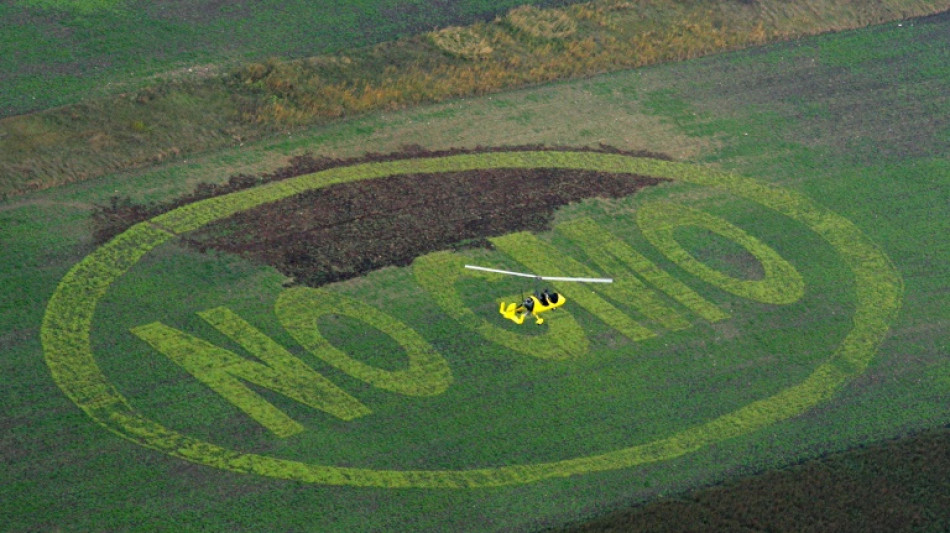
Brussels looks to relax curbs on genetically modified crops / Photo: DIETER NAGL - AFP

The European Commission will on Wednesday put forward a proposal to ease current restrictions on genetically modified crops, which is already being denounced by environmental groups and leftwing lawmakers.
The plan could create a new frontline in the EU's Green Deal, elements of which centre-right European lawmakers are already seeking to stall, arguing they would harm farmers.
The commission says the rules on GMOs (genetically modified organisms) need to be relaxed to grow crops that require fewer pesticides, are better adapted to climate change and need less water.
It wants to allow gene editing within a plant's existing DNA -- which is different from transgenic techniques that introduce a foreign DNA strands and create a distinct species.
"Plants produced by new genomic techniques can support sustainability," EU health commissioner Stella Kyriakides said in April.
"We are designing a regulatory framework that will strongly signal to farmers, researchers and industry that this is the way forward in the EU," she said.
In this area, the commission wants to reduce the tough restrictions that apply to GMOs, which include authorisations, labelling and monitoring.
The text of the project, seen by AFP, calls for the existing GMO rules to not apply to genetically edited crops where the modifications could have come about naturally or through traditional blending procedures of plant species.
Such new crops would be considered "equivalent" to conventional varieties, subject to conditions on the type and number of mutations, a publicly accessible listing, and labelling for the sale of seeds.
No produce coming from these new genomic techniques (NGT) will be able to carry the "bio" label however, and those with herbicide properties would be excluded from the light-touch regulatory approach.
Those that are pesticide resistant would remain in the restrictive regime governing GMOs.
Brussels currently has received 90 authorisation requests for NGT crops, a third of which are in advanced research stages.
A few have reached the level of testing in open fields, such as corn in Belgium and potatoes in Sweden.
- 'Boost productivity' -
Powerful agri-groups such as Copa-Cogeca have been calling for simplified rules to speed up sales of their products.
Some EU member countries and lawmakers in the European Parliament's centre-right EPP grouping back that stance.
"We need to boost productivity and take into account the limited level of natural resources," Spain's agriculture minister Luis Planas said in mid-June, ahead of his country taking over the EU's rotating presidency.
He is looking to weigh this lifting of controls on NGTs against another EU text that aims to reduce the use of pesticides in European farming, but which has become bogged down in arguments over a feared reduction in crop yields.
The EPP, which is the biggest grouping in the parliament, is fiercely opposed to reduced pesticide use, and also a nature restoration law also being negotiated that seeks to repair damaged ecosystems.
Pascal Canfin, a lawmaker from the liberal Renew group who heads the parliament's environment committee, said the commission's NGT proposal could provide terms for a compromise.
"It is strongly backed by the EPP and offers a landing ground, with biotech solutions and natural solutions -- the restoration of ecosystems -- in parallel," he said.
However leftwing lawmakers are against a "GMO deregulation" and are demanding a systematic risk analysis, compulsory labelling, and the means to detect and trace such products.
Environmental groups are also opposed.
Greenpeace denounced it as "GMO deregulation" through the back-door that "ignores potential dangers to the environment, bees and pollinators and human health" and will obscure from consumers what they are eating.
M.Saito--JT