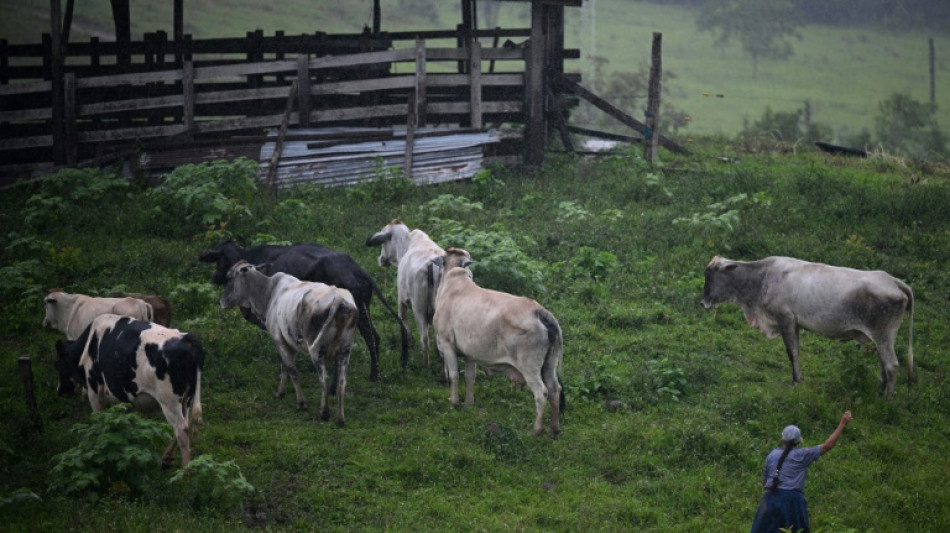
Turning over a new leaf, Colombian ranchers plant trees / Photo: Raul ARBOLEDA - AFP

In Colombia's southern Guaviare department, on the doorstep of the Amazon, cattle ranchers are engaged in a practice that belies their jungle-wrecking reputation. They plant trees.
Under an experiment started in 2020, dozens of Guaviare farmers have moved their cattle to smaller enclosures and implemented rotational pasture, returning vast swathes of land to nature and replanting lost forest.
"The forest is cared for because we are no longer cutting down trees," milk farmer Olga Martinez, 65, told AFP.
The area was populated in the late 20th century by an influx of settlers attracted by the promise of "a land without men for men without land."
Martinez herself first arrived in Guaviare some 45 years ago, when the landscape was "mountainous jungle."
She and others soon changed that, clearing vast tracts of rainforest for pasture and cropland.
From the air, it is clear to see the human expansion taking huge bites out of the thick vegetation surrounding San Jose de Guaviare, the departmental capital.
But a change is taking root.
Martinez and 34 other Guaviare farmers have signed up to a conservation program managed by France's ONF government forest agency and its local branch, ONF Andina.
Since last year, she has planted some 1,200 trees on her 55-hectare (135 acre) property without having to give up a single head of cattle.
The benefits have been manyfold.
"The cows give more milk, they have gained weight, the calves are beautiful," she said of the new practice of feeding cows in one pen until the grass is exhausted, then move them to the next and so on while the first recovers.
"That filled me with joy. The cattle in those large pastures do nothing but run. They don't even eat" because they trample the grass, she said.
- From deforestation to reforestation -
Cattle farmers like Martinez receive trees to plant as part of the project called Terramaz, as well as advice and equipment to get the most out of their herds.
While ranches in Guaviare are used to supporting about 0.8 cattle per hectare, participants in the Terramaz program have increased the ratio to 3.5 head per hectare, according to the ONF -- still considered ample roaming space.
So far, the project has reclaimed 915 hectares of farmland.
Colombia has about 30 million head of cattle earning 1.7 percent of its GDP -- double what coffee generates, according to industry statistics.
"Extensive livestock farming is one of the main drivers of deforestation in our department," said Xismena Martinez of the Guaviare governor's office.
"The model consisted of cutting the forest to plant pasture... it is a very profitable activity," she said.
The department lost some 25,000 hectares of forest in 2021, according to official statistics.
Rainforests are often called the "lungs of the Earth," soaking up planet-warming CO2 and expelling life-giving oxygen. Their protection is crucial in the battle to combat climate change.
- 'They walk less' -
Nelcy Rodriguez, 49, is another project volunteer who has seen her herd's productivity increase.
"Because they walk less," she said, her 10 cows now give about 55-60 liters (14.5-15.8 gallons) of milk per day compared to 40 liters before.
About 15 hectares of Rodriguez's 48-hectare farm have been reforested.
The Guaviare area -- remote and largely forgotten -- has long been popular with farmers of illegal coca -- the main ingredient in cocaine of which Colombia is the world's biggest exporter.
But as the so-called war on drugs ramped up, coca plantations were targeted by an aggressive glyphosate fumigation campaign, and many farmers turned to cattle.
"I used to plant coca," said Rodriguez, and used the money to buy cows.
"When there was no more coca, I had my cows and I started farming."
She and many others have undergone a complete mind shift along the journey, said Rodriguez.
Nowadays, "one is sorry to fell a tree," she said. "On the contrary, we are working hard to reforest."
T.Shimizu--JT