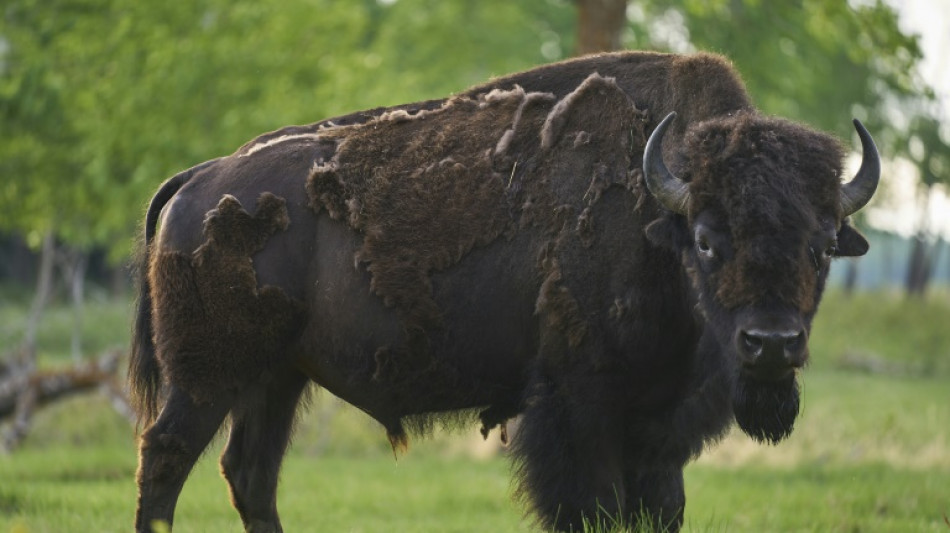
Bison reintroduced to Canada's Banff thrive again / Photo: Geoff Robins - AFP

Wild bison that once numbered in the tens of millions in North America before being hunted almost to extinction are once again thriving in a pocket of western Canada.
Appearing from a distance as specks against the backdrop of the Rocky Mountains, these animals are also restoring balance at the top of a fragile ecosystem.
North America's largest land mammal -- growing to 900 kilograms (2,000 pounds) and 1.8 meters (six feet) high at the shoulders -- suffered a dramatic decline in late 19th century due to hunting and habitat loss as settlers pushed westward.
They were reintroduced to what is now Banff National Park in 2017.
"The moment the bison set foot on that landscape, it felt to me that I brought them home," says Wes Olson, who accompanied the first 16 bison to be released there.
Transferred by helicopter from a biosphere reserve near Edmonton, Alberta, the population has exploded and new births are expected to push their numbers to 100 by year's end.
A Parks Canada report published this week concluded that the reintroduction was a success, and it suggested that due to their robust growth rate, this bison subpopulation -- one of only five that occupy a mere 0.5 percent of their original range in North America -- may no longer be considered endangered within a decade.
As soon as they arrived, Olson says, the ancient ecosystem was suddenly reactivated and the bison appeared to feel right at home, while other forest creatures quickly and "intrinsically" reestablished a symbiotic relationship.
Squirrels with puffy cheeks can be seen busily collecting hairs shed by the burly beasts, says the 69-year-old former park warden.
One hundreds species of insects colonize its nutrient-rich dung.
Birds also get in on the action. They take turns sitting on bisons' backs and plucking bits of fur to make nests, as well as bugs or seeds trapped in it to eat. Warmer and more comfortable fur-lined nests lead to better outcomes for the chicks.
- Great Plains 'landscape engineers' -
A "keystone species" of the Great Plains, a broad expanse of flatlands that stretch across 13 Canadian provinces and US states, from Alberta to Texas, wild bison, by way of their grazing, have shaped this environment.
These "landscape engineers" are on the move as they graze rather than focus on the same patch of land, with their role somewhat like that of elephants in Africa, explains Marie-Eve Marchand of the International Buffalo Relations Institute.
And with herds mobile like that, grasslands are able to regenerate and better store carbon and water, according to a study by the University of Alberta. Other studies also found that the presence of bison makes them more resilient to drought.
Between 30 and 60 million bison once roamed North America. At the end of the 19th century, there were only a few hundred left.
Their decline had a devastating impact also on Indigenous tribes that relied on the animals for food, as well as clothing, shelter and religious worship.
Their return to Banff, an ancestral gathering place of local tribes, has helped revive "parts of our language, culture and deep, deep spirituality that the first peoples of this place had with the land," says Marchand.
- Indigenous future includes bison -
"At one point," says Violet Meguinis of the Tsuut'ina First Nation of southern Alberta, "bison was our main source of food."
"Bringing them back and releasing them in the wild is significant for us," she says.
Several Indigenous communities have been working in recent years to reintroduce bison to their ancestral lands and are eager to do more, including the Tsuut'ina, which started by raising a domestic herd of 400 bison about 100 kilometers (60 miles) east of Banff.
Clayton Whitney has cared for the animals for eight years, helping to "bring them back from extinction," work that he considers to be a privilege given how important bison are to the community.
The tribe comes together to butcher a few each year for their meat and hides as their ancestors did, while the simple act of moving the herd from paddock to paddock to mimic their movements in the wild has stirred growth of plants used for Indigenous traditional medicines, he says.
The entire community takes part in the ritual slaughter, with elders passing on their knowledge of how to properly skin the animal, and leave none of it to waste.
"We depend on (the bison) as much as it depends on us," says Meguinis.
"We want this land to be there for them, we want the bison to be here because then that preserves our own future," she sums up.
K.Yamaguchi--JT