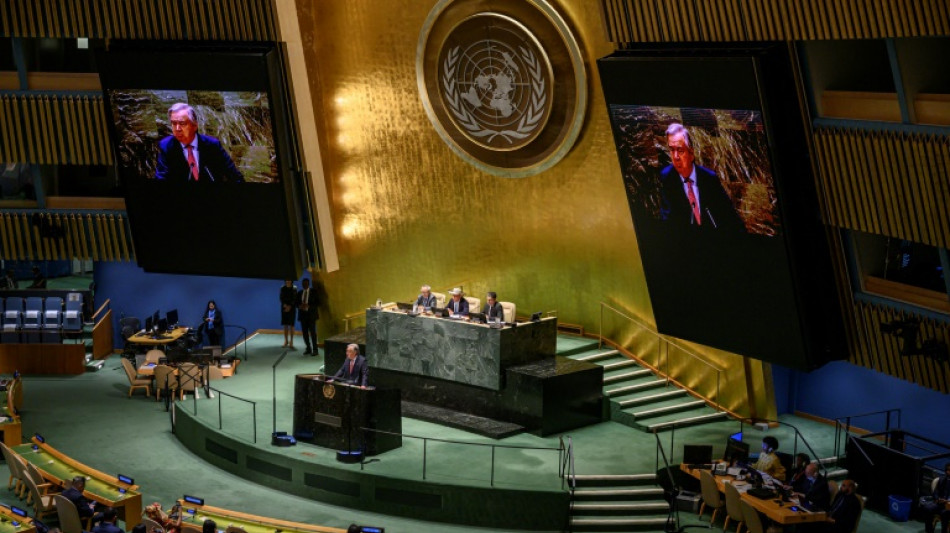
UN to finally adopt high seas treaty / Photo: Ed JONES - AFP

The world's first international treaty to protect the high seas is due to be adopted Monday at the United Nations, a historic environmental accord designed to protect remote ecosystems vital to mankind.
"It will be a huge accomplishment, one that we've already celebrated with the finalization of the text in March. But the adoption formalizes that, and really sets the pathway for the next steps," Liz Karan, of the NGO Pew Charitable Trusts, told AFP.
The landmark treaty will establish a legal framework to extend swathes of environmental protections to international waters, which make up more than 60 percent of the world's oceans.
Following more than 15 years of discussions, including four years of formal negotiations, UN member states finally agreed on the text for the treaty in March after a flurry of final, marathon talks.
The text, since frozen, has been pored over by the UN's lawyers and translators to make sure it matches in the body's six official languages.
"Healthy oceans, from coastal waters to remote high seas and deep seabed areas, are integral to human health, wellbeing, and survival," a group of scientists noted in The Lancet journal.
Scientists have increasingly come to realize the importance of oceans, which produce most of the oxygen we breathe, limit climate change by absorbing CO2, and host rich areas of biodiversity, often at the microscopic level.
But with so much of the world's oceans lying outside of individual countries' exclusive economic zones, and thus the jurisdiction of any single state, providing protection for the so-called "high seas" requires international cooperation.
- Marine reserves -
The result is that they've been long ignored in many environmental fights, as the spotlight has been on coastal areas and a few emblematic species.
A key tool in the treaty will be the ability to create protected marine areas in international waters.
Currently, only about one percent of the high seas are protected by any sort of conservation measures.
The treaty is seen as crucial to countries protecting 30 percent of the world's oceans and lands by 2030, as agreed by world governments in a separate historic accord reached in Montreal in December.
If the treaty is adopted "then the race to ratification will begin" and the 30 percent target "will remain within reach," said Chris Thorne of Greenpeace.
The treaty, officially known as the treaty on "Biodiversity Beyond National Jurisdiction" or BBNJ, also introduces requirements to carry out environmental impact studies for proposed activities to be carried out in international waters.
Such activities, while not listed in the text, would include anything from fishing and maritime transport to more controversial pursuits, like deep-sea mining or even geo-engineering programs aimed at fighting global warming.
The treaty also establishes principles for sharing the benefits of "marine genetic resources" (MGR) collected by scientific research in international waters -- a sticking point that almost derailed last-minute negotiations in March.
Developing countries, which often don't have the money to finance such expeditions, fought for benefit-sharing rights, hoping to not get left behind by what many see as a huge future market in the commercialization of MGR, especially by pharmaceutical and cosmetic companies searching for "miracle molecules."
Once the text it adopted, it remains to be seen how many countries will decide to come on board.
NGOs believe that the threshold of 60 ratifications required for it to enter into force should be reachable since the High Ambition Coalition for the BBNJ -- which pushed for the treaty -- counts some 50 or so countries as members, including those of the European Union, as well as Chile, Mexico, India and Japan.
But 60 is far from the universal adoption -- the UN has 193 member states -- that defenders of the ocean are pushing for.
"After adoption, swift ratification and implementation are crucial!" the High Seas Alliance said on Twitter.
Y.Watanabe--JT