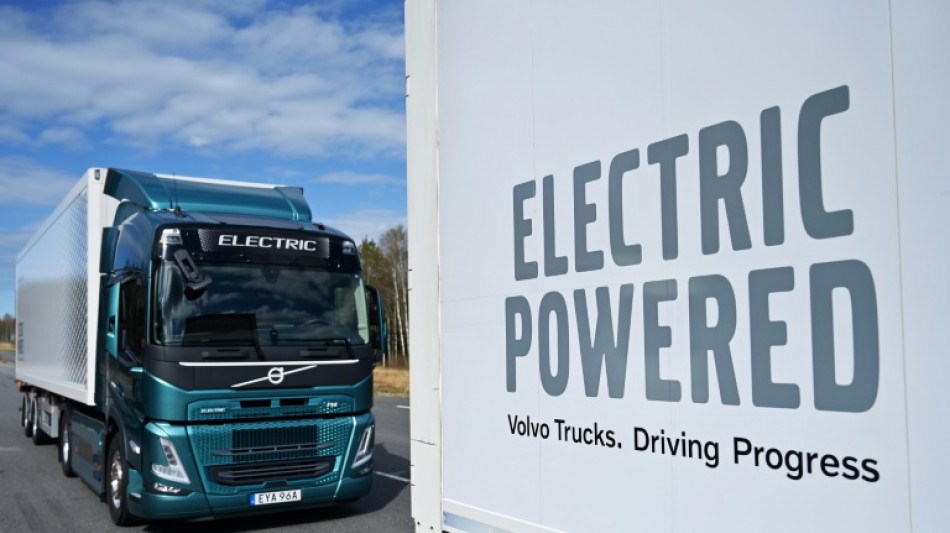
Electric trucks pick up speed despite bumpy road / Photo: Sergei GAPON - AFP/File

Using a motorised arm, a worker at Volvo's factory near Gothenburg slowly guides massive black blocks alongside a chassis, the three tonnes of batteries soon to power an electric truck.
"This is where the difference lies," explains Sandra Finer, vice president of operations at the Swedish site.
On the assembly line, "we use the same people, the same equipment and the same process, (but)... when we build the electric truck we dock the electric module instead of an engine for the diesel trucks."
Electric heavy trucks are now mass produced in Europe, North America and China and have been rolled out faster than expected -- though it will still be a while before they overtake polluting diesel trucks in number.
"It is a really exciting moment we're living in regarding electric trucks," Felipe Rodriguez, an independent expert at analysis group International Council on Clean Transportation (ICCT), told AFP.
"Just four or five years ago, people would have said 'You're crazy, that's not going to happen. Diesel is king, it can't be beaten'," he said.
Electric heavy trucks require massive amounts of energy to propel their heavy loads, raising questions about their range and recharging capabilities.
They need charging terminals dozens of times more powerful than those made for electric cars.
The electric trucks are also more expensive, currently costing between two to three times more than a traditional diesel model, according to industry experts.
However, those prices are expected to go down and the higher up-front price can be offset by cheaper running costs using electricity, as well as different country-specific incentives.
- Race to launch -
Spurred by increasingly strict EU regulations aimed at reducing CO2 emissions as well as massive Chinese state support for its national manufacturers, the sector is determined to press ahead.
There has been "a reckoning in the industry that they will not be able to hold on to their diesel engines forever," Rodriguez said.
"There is now a race to really develop and launch these electric trucks on the market."
In 2022, electric trucks accounted for a tiny portion of heavy trucks on the world's main markets -- just one or two percent, with 40,000 to 50,000 units sold worldwide, most of them in China, according to data from trade experts.
But the main Western truck makers -- Germany's Daimler and Man, Sweden's Volvo and its French subsidiary Renault Trucks, and the other Swedish manufacturer Scania -- have invested heavily.
US manufacturer Tesla, which has been hugely successful with its electric cars, also aims to break into the e-trucks sector, with its "Semi" model promising a range of up to 800 kilometres (500 miles).
The global truck market is sizable, estimated at more than $200 billion per year with almost six million units sold.
"In 2030, 50 percent of the volume that we sell for Volvo Trucks should be zero emissions ... and in 2040, everything that we sell should be zero emissions," Roger Alm, head of Volvo Group's trucks division, told AFP.
That more or less corresponds to the level necessary to achieve the objectives of the Paris Agreement to decarbonise road transport, according to the ICCT.
Diesel long-haul trucks emit around one kilo of CO2 per kilometre, the ICTT estimates.
With Europe's current electricity mix, which still comprises a significant amount of coal and gas, the carbon footprint of an electric truck is two-thirds lower than that of a diesel truck.
- Spreading around the world -
Electric trucks are expected to account for 90 percent of the truck market by 2040, according to ICCT.
"It has started to really take off and grow in the Northern parts of Europe and in North America," Alm said.
"Now it's moving into the southern parts of Europe and we also have new markets in Africa, for example, Australia, Brazil, so it’s expanding country by country."
Together with other manufacturers, Volvo, the world's second-biggest truck builder, has agreed to take part in a vast European project to increase the number of truck charging stations, currently one of the weak points holding back their adoption.
To quickly recharge an electric truck charging stations need a capacity of five megawatt hours, Rodriguez noted.
That is equivalent to the production provided by one modern wind turbine at full capacity, and 50 to 100 times more powerful than a charging station for an electric car.
H.Takahashi--JT