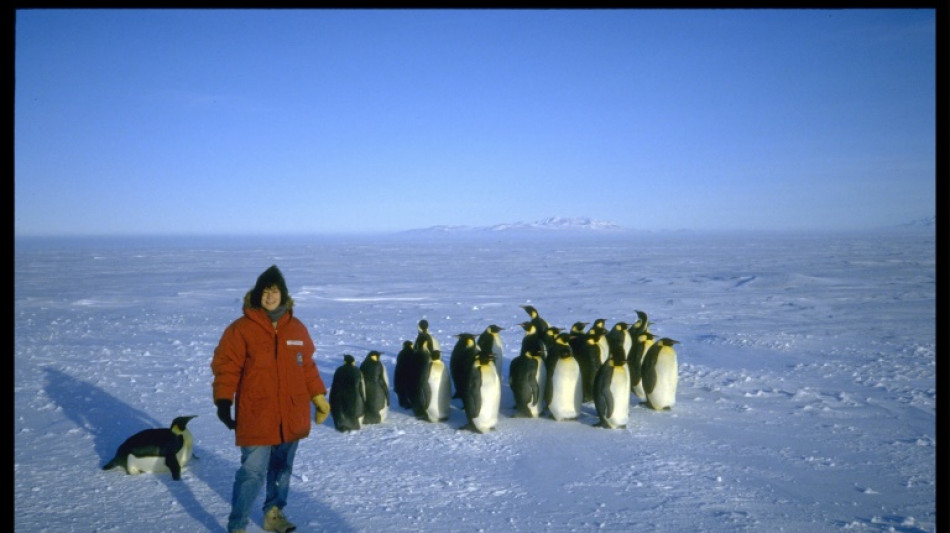
Leading ozone scientist says more climate surprises likely / Photo: Handout - Susan SOLOMON/AFP/File

Susan Solomon, a leading scientist in the fight to tackle the Antarctic ozone hole, says people are now getting worried enough to spur climate action.
The former expert for the UN's Intergovernmental Panel on Climate Change said the organisation's final instalment of a major series of reports, released Monday, would not be the "last word" on warming.
IPCC warned that climate change impacts are hitting faster than expected and the key 1.5 degree-Celsius warming limit could be reached in the early 2030s.
Solomon, a professor at MIT, said in an interview that more surprises were likely in store.
Her own research had delivered a recent "shocker" that Australia's massive 2019-20 wildfires combined with lingering remnants of the chlorofluorocarbons (CFCs) still in the atmosphere to erode the ozone layer -- Earth's protective shield from damaging ultraviolet radiation.
The following interview has been edited for length and flow:
Q: Did it feel like a crisis when the ozone hole was discovered?
A: It was a huge moment. The only thing you could compare it to would be if a piece of Greenland suddenly fell off into the sea and people were waiting for the three metres of sea level rise to show up on their doorstep.
All of a sudden you had 50 percent less ozone over Antarctica at certain times of year. And we did not know why.
I was 29 years old when the British Antarctic Survey discovered the ozone hole in 1985.
In 1986, I led the national ozone expedition to Antarctica. We made measurements of everything that we could think of: ozone itself, but also chlorine monoxide, chlorine dioxide, all of the ozone eating molecules and we were able to show that they were completely out of whack.
My idea was that maybe the reason this was happening was because of polar stratospheric clouds and surface chemistry. That turned out to be right.
Q: The Montreal Protocol (phasing out CFCs and other ozone depleting molecules) was signed in 1987. What enabled governments to act so quickly?
A: Three P's -- It was personal to people, because skin cancer and cataracts are scary. And it was perceptible because you could see these dramatic images on TV. It could easily be explained. And practical solutions were found pretty quickly.
Had we not stopped making these molecules, you would have massive ozone depletion worldwide. Overall, it has been a remarkable science, policy, and public success story.
Q: Why has climate change not had the same urgency?
A: People are beginning to get concerned enough about climate change, particularly the young. That is a tremendous spur to politicians.
The biggest problem is that people believe the solutions are not practical, but it's not at all true. People have to recognise how much more it's going to cost us if we don't do anything.
It's also too easy to tie climate change up with the culture wars, or whatever your social issue of the moment is.
We didn't have that with the ozone.
I was once in an IPCC meeting about chlorofluorocarbons with a delegate from a Middle Eastern country that produces a lot of oil. I asked him if his government had any concerns and he said: "No, we don't really care what's in the air conditioner, as long as it makes it cold".
The chemical companies could make other compounds. The problem with the fossil fuel companies is they're not going to be the ones to make solar panels.
Q: What are the key unanswered questions on climate change?
A: There's a lot of work going on now on understanding how storm tracks are going to change. Are we going to have more extreme Arctic air cold snaps? It might not be the issue you expected, but it's an issue.
Melting of the polar ice sheets -- how fast is that going to happen? There's a lot of uncertainty. It affects people on coastlines and island states all around the world.
The impact on the food and water supply -- there are open questions on both.
Things that involve the crossover between biology and physics are often the most difficult to understand. There's a 30 percent decline in the insect population worldwide going on right now. We really don't know why.
It's a great time to be a climate scientist, but on the other hand, it seems to me that every year something important and scary is happening.
K.Tanaka--JT