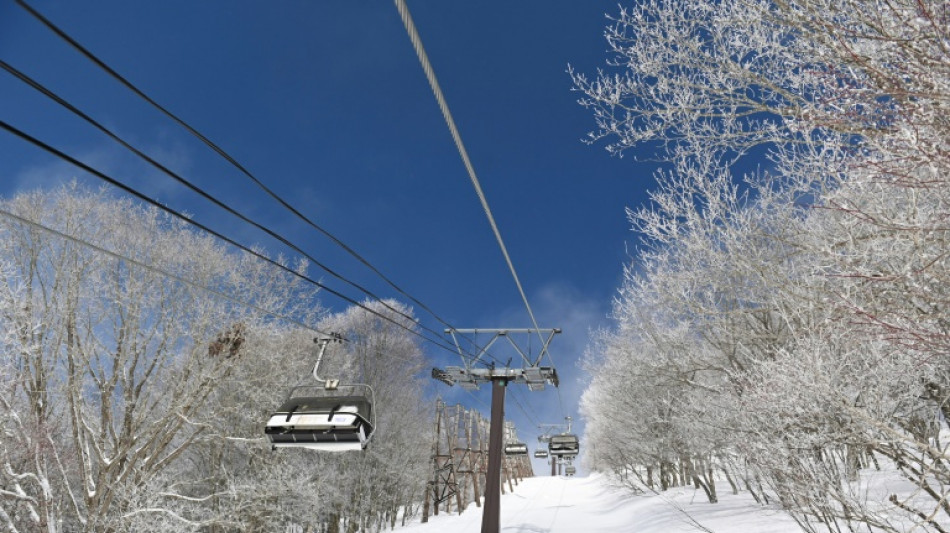
Disaster to destination: Fukushima woos tourists with snow / Photo: Kazuhiro NOGI - AFP

Tourist Benjamin Tuffy's family spent their winter holidays in Japan's picture-perfect snow. But they weren't at the country's famed ski resorts in Hokkaido or Nagano -- they picked Fukushima.
It's a choice officials hope is becoming increasingly popular as they market the region's snow resorts and try to shed the stigma that lingers more than a decade after the 2011 nuclear disaster.
Fukushima's ski industry was already struggling with warm winters and a decline in domestic visitors when a tsunami triggered the worst nuclear disaster since Chernobyl.
Officials worked hard to attract foreign visitors despite the disaster, but then the pandemic struck and border closures kept tourists away for more than two years.
Tourism resumed normally in October, and Fukushima is again aggressively promoting its attractions, including at industry expos in Sydney and Melbourne.
Tuffy, a 40-year-old Australian, chose the region's Bandai Resort for a holiday along with his wife and two children.
He told AFP that the resort's location, about 100 kilometres (62 miles) from the coast, had helped assuage any concerns.
"You have some distance, you've got mountains and you've got range, you've got a lot of clean air and clean life over here," he said as he removed his snowboarding gear.
"We are aware, but we're not concerned. It was more like understanding the situation."
It has been 12 years since the three reactors at the Fukushima Daiichi plant went into meltdown after an earthquake-triggered tsunami that left 18,500 dead or missing.
Evacuation orders were once in place for a 20-kilometre (12-mile) radius around the plant, but most of the prefecture was never affected by radiation.
And after extensive decontamination, just 2.4 percent of the region remains off-limits.
But "Fukushima's popularity remains low among foreign tourists, 43rd among 47 prefectures in Japan", said Go Morimoto, managing director of the Bandai Resort.
- 'Unlikely' tourism comeback -
In pre-Covid 2019, nearly 50 percent of inbound tourists visited Tokyo, 30 percent went to Kyoto and eight percent visited far northern Hokkaido, according to the Japan National Tourism Organization.
Just 0.3 percent went to Fukushima, which is only 90 minutes from Tokyo by bullet train.
The US investment fund that once owned the Bandai Resort decided to sell in 2015, convinced "it was simply unlikely that tourism would make a comeback", Morimoto said.
Still, inspired by the success of snow destinations like Nagano's Hakuba and Niseko in Hokkaido, Fukushima has tried to promote its plentiful white stuff.
"Japan's powder snow, popularly known as 'Japow' is a world-class tourism resource," said Morimoto.
"Niseko and Hakuba have benefitted from it, but Fukushima, not so much, despite the potential."
It was the main draw for Anne Cathcart, 68, on her third trip to Fukushima. But she acknowledged some reservations before her first visit.
"I thought 'Ermm Fukushima? I've heard of that, the nuclear disaster'," the Australian said.
But she found the region's snow "so amazing", that she has been back multiple times.
"It's never disappointed," she said.
- Instagram-savvy visitors -
The influx is a welcome relief for locals like Miwako Abe, who has run a souvenir shop for around three decades in Ouchijuku, an ancient rest stop for travellers.
"At one point I didn't know what to do, because we didn't see anyone at all here," the 59-year-old said as tourists snapped selfies by a row of traditional thatched houses under heavy snow.
The area is particularly popular with tourists from areas of Asia with little or no snow.
"I see more people from Taiwan... They buy stamps at my shop and send postcards," Abe said.
It is something of a vindication for regional authorities in a battle they waged to keep alive a small railway running through a picturesque gorge.
The Tadami line was badly affected by torrential rains just four months after the nuclear disaster.
But a report suggested just 49 people a day were using the flood-affected part of the route before the disaster, and operator JR East planned to scrap it.
Local authorities were convinced it could draw tourists and agreed on a scheme to invest if JR East kept the route.
It reopened in full only last October and has been flooded with Instagram-savvy visitors, said Tetsuya Sato of the Yanaizu Tourism Association.
"As soon as the line resumed, the carriages were full of passengers, even on weekdays," said Sato, whose association website is now available in English, Chinese and Thai.
"We never expected this trend, but we are so happy."
S.Fujimoto--JT