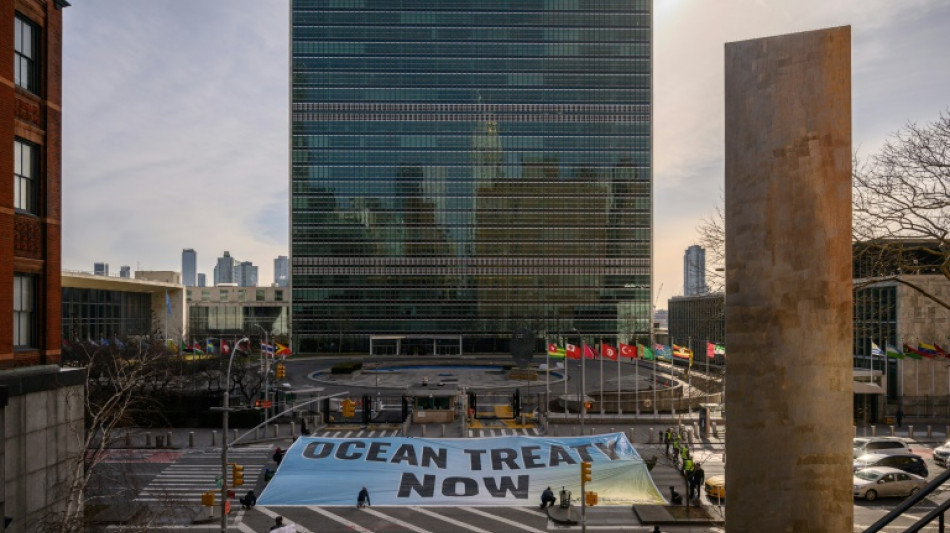
UN states agree 'historic' deal to protect high seas / Photo: Ed JONES - AFP/File

UN member states finally agreed Saturday to a text on the first international treaty after years of negotiations to protect the high seas, a fragile and vital treasure that covers nearly half the planet.
"The ship has reached the shore," conference chair Rena Lee announced at the UN headquarters in New York shortly before 9:30 pm (0230 GMT Sunday), to loud and lengthy applause from delegates.
The exact wording of the text was not immediately released but activists hailed it as a breakthrough moment for the protection of biodiversity after more than 15 years of discussions.
The treaty is seen as essential to conserving 30 percent of the world's land and ocean by 2030, as agreed by world governments in a historic accord signed in Montreal in December.
"This is a historic day for conservation and a sign that in a divided world, protecting nature and people can triumph over geopolitics," said Greenpeace's Laura Meller.
Following two weeks of intense talks, including a marathon overnight session Friday into Saturday, delegates finalized a text that now cannot be significantly altered.
"There will be no reopening or discussions of substance," Lee told negotiators.
The agreement will be formally adopted at a later date once it has been vetted by lawyers and translated into the United Nations' six official languages, she announced.
UN Secretary-General Antonio Guterres commended the delegates, according to a spokesperson who said the agreement was a "victory for multilateralism and for global efforts to counter the destructive trends facing ocean health, now and for generations to come."
- 'Critical role' -
The high seas begin at the border of countries' exclusive economic zones, which extend up to 200 nautical miles (370 kilometers) from coastlines. They thus fall under the jurisdiction of no country.
Even though the high seas comprise more than 60 percent of the world's oceans and nearly half the planet's surface, they have long drawn far less attention than coastal waters and a few iconic species.
Ocean ecosystems create half the oxygen humans breathe and limit global warming by absorbing much of the carbon dioxide emitted by human activities.
But they are threatened by climate change, pollution and overfishing.
Only about one percent of the high seas are currently protected.
When the new treaty comes into force it will allow the creation of marine protected areas in these international waters.
"High seas marine protected areas can play a critical role in building resilience to the impact of climate change," said Liz Karan of The Pew Charitable Trusts, which called the agreement a "momentous achievement."
The treaty will also oblige countries to conduct environmental impact assessments of proposed activities on the high seas.
A highly sensitive chapter on the sharing of potential benefits of newly discovered marine resources was one of the focal points of tensions before it was finally overcome as the scheduled talks, due to end Friday, overran by a day.
- 'Profits' -
Developing countries, without the means to afford costly research, had fought not to be excluded from the expected windfall from the commercialization of potential substances discovered in the international waters.
Eventual profits are likely from the pharmaceutical, chemical or cosmetic use of newly discovered marine substances that belong to no one.
As in other international forums, notably climate negotiations, the debate ended up being a question of ensuring equity between the poorer global South and richer North, observers noted.
In a move seen as an attempt to build trust between rich and poor countries, the European Union pledged 40 million euros ($42 million) in New York to facilitate the ratification of the treaty and its early implementation.
The EU also announced $860 million for research, monitoring and conservation of oceans in 2023 at the Our Ocean conference in Panama that ended Friday. Panama said a total of $19 billion was pledged by countries.
In 2017, the UN General Assembly adopted a resolution calling on nations to establish a high seas treaty.
It originally planned four negotiating sessions but had to pass two resolutions to ensure two additional sessions.
"We can now finally move from talk to real change at sea," said Greenpeace's Meller.
K.Okada--JT