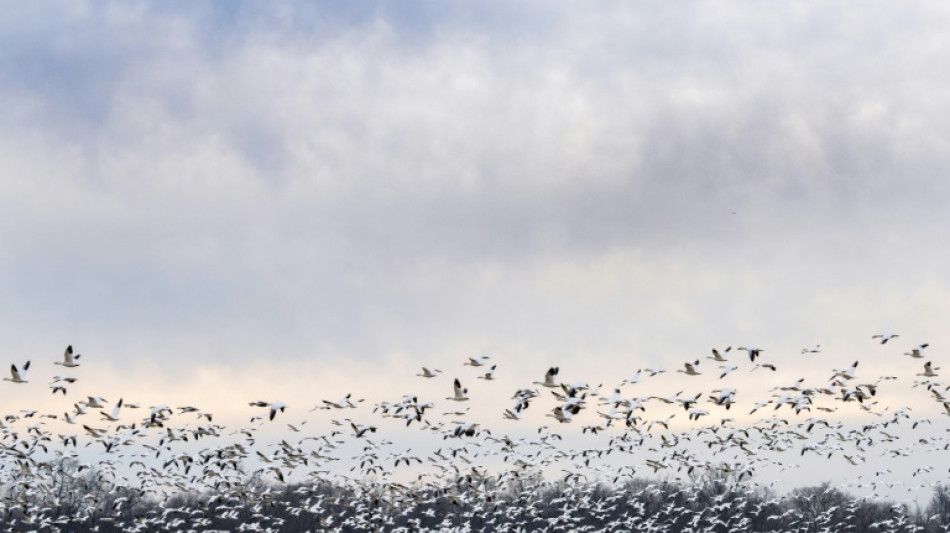
Bird flu detected in mammals but risk to humans low: experts / Photo: Jim WATSON - AFP/File

Experts have warned that the recent detection of bird flu in mammals including foxes, otters, minks, seals and even grizzly bears is concerning but emphasised that the virus would have to significantly mutate to spread between humans.
Since late 2021, Europe has been gripped by its worst-ever outbreak of bird flu, with North and South America also experiencing severe outbreaks.
This has led to the culling of tens of millions of domestic poultry worldwide, many with the H5N1 strain. The global outbreak is also responsible for the deaths of tens of thousands of wild birds.
Tom Peacock, a virologist at the Imperial College London, told AFP that it constitutes a "panzootic" -- a pandemic among animals, in this case birds.
"We are not fully sure why it's happening now but we think this might be driven by a slightly different strain of H5N1 which is spreading very effectively in wild, migratory birds," Peacock said.
It is rare that bird flu jumps over into mammals -- and rarer still that humans catch the potentially deadly virus.
On Thursday, the UK Health Security Agency said that a fox had recently tested positive for H5N1.
It joins eight foxes and otters which tested positive in the UK last year, all of which had a PB2 mutation.
Peacock said that this mutation "allows the virus to replicate better in mammalian cells".
But further mutations would be "required for the virus to cause a flu pandemic" in humans, he added.
France announced last week that a cat had been put down after testing positive for H5N1.
And last month, the US state of Montana's parks service said three grizzly bears with bird flu had been euthanised.
All of these mammals were suspected to have eaten infected birds.
Paul Wigley, a professor of animal microbial ecosystems at the UK's Bristol University, said that while "there is no transmission within mammalian populations, the risk to humans remains low".
- 'Potential to cause pandemic'? -
However two recent larger scale infections have raised concerns that bird flu has the potential to spread between mammals.
One was an outbreak of H5N1 with the PB2 mutation at a Spanish farm in October that led to the culling of more than 50,000 minks.
Research published in the journal Eurosurveillance last month said its findings "indicate that an onward transmission of the virus to other minks may have taken place in the affected farm".
Transmission between the minks has not been confirmed, with further research ongoing.
The mass death of some 2,500 endangered seals found along Russia's Caspian Sea coast last month has also raised concern.
A researcher at Russia's Dagestan State University, Alimurad Gadzhiyev, said last week that early samples from the seals "tested positive for bird flu", adding that they were still studying whether the virus caused the die-off.
Peacock warned there have been mixed reports from Russia about the seals, which could have contracted the virus by eating infected seabirds.
But if the seals did give bird flu to each other it "would be yet another very concerning development", he added.
"The mink outbreaks, the increased number of infections of scavenger mammals and the potential seal outbreak would all point to this virus having the potential to cause a pandemic" in humans, he said.
- 'Mixing point' -
David Heymann, an infectious disease specialist at the London School of Hygiene and Tropical Medicine, urged caution.
More bird flu cases could be being detected in mammals because countries have ramped up testing, he said.
"This may have been going on for years and nothing has really occurred," he told AFP.
But it was always concerning when a flu virus enters mammals "because they're often the mixing point of influenza viruses, or they create an environment where mutations can occur and then can become adapted in humans", he added.
Even if that did occur, he said there were excellent surveillance systems in Europe and North America, and that H5N1 has been heavily researched since it first emerged in China and Hong Kong in 1996.
If H5N1 did mutate into a strain that could circulate among humans, the current seasonal flu vaccine could be fairly easily updated to include it, he said.
The UK Health Security Agency said "there is no evidence of sustained human to human transmission" of bird flu.
Over the last two decades, there have been 868 confirmed H5N1 cases in humans with 457 deaths, according to the World Health Organization. There were four confirmed cases and one death last year.
Last month, Ecuador reported South America's first case of the A(H5) bird flu virus in a human -- a nine-year-old girl who was in contact with backyard poultry.
The experts called for continued surveillance of avian influenza in wild birds, poultry and mammals, in order for humans to limit their exposure.
S.Yamamoto--JT