Star visibility eroding rapidly as night sky gets brighter: study / Photo: Mariana SUAREZ - AFP

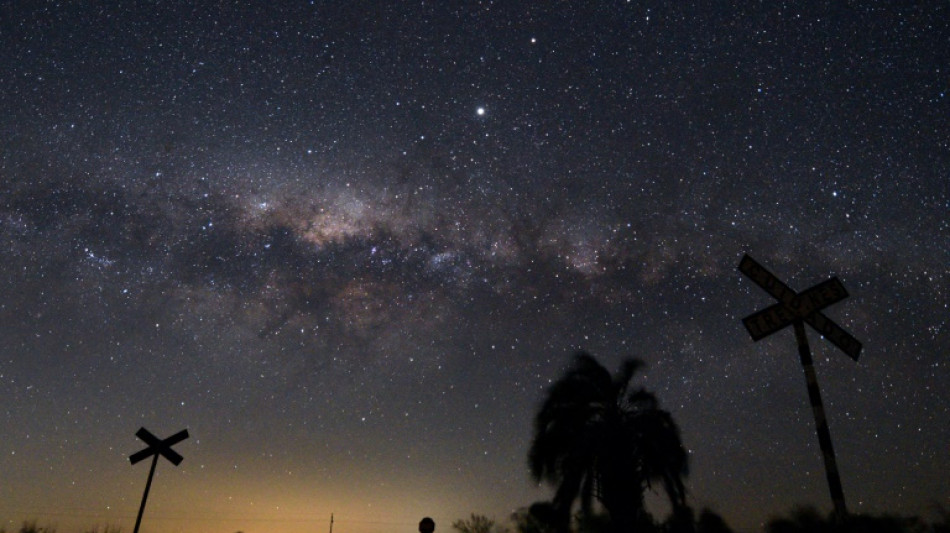
Light pollution is growing rapidly and in some places the number of stars visible to the naked eye in the night sky is being reduced by more than half in less than 20 years, according to a study released Thursday.
The researchers, whose findings were published in the journal Science, said the increase in light pollution -- skyglow -- that they found was much larger than that measured by satellite observations of Earth at night.
For the study of the change in global sky brightness from artificial light, the researchers used stellar observations from 2011 to 2022 submitted by more than 51,000 "citizen scientists" around the world.
Participants in the "Globe at Night" project run by the US National Optical-Infrared Astronomy Research Laboratory were given star maps and asked to compare them to the night sky at their location.
The change in the number of visible stars reported was equivalent to a 9.6 percent per year annual increase in sky brightness, averaged over the locations of the participants, the researchers said.
Over an 18-year period, given such star brightness change, a location with 250 visible stars would see that number reduced to 100.
Most of the naked-eye star observations came from Europe and the United States said Christopher Kyba, one of the authors of the study, but there was also good participation in Uruguay, South Africa and Japan.
"The global trend in skyglow that we measure likely underestimates the trend in countries with the most rapid increases in economic development, because the rate of change in light emission is highest there," the researchers said.
The study coincided with the replacement of many outdoor lights with light-emitting diodes (LEDs), but the researchers said the impact on skyglow from the transition to LEDs is unclear.
"Some researchers have predicted that it will be beneficial; others, that it could be harmful because of spectral changes or a rebound effect, in which the high luminous efficacy of LEDs leads to more or brighter lights being installed or longer hours of operation," they said.
According to the study, the global LED market share for new general lighting grew from under one percent in 2011 to 47 percent in 2019.
"The visibility of stars is deteriorating rapidly, despite (or perhaps because of) the introduction of LEDs in outdoor lighting applications," the researchers said.
"Existing lighting policies are not preventing increases in skyglow, at least on continental and global scales."
- 'Confronted with the cosmos' -
Kyba, a physicist at the German Research Center for Geoscience, told AFP that while the team was able to evaluate erosion of star visibility due to skyglow, not a lot of research has been done on its ecological impact.
"There's tons of research on light shining directly on animals and plants," he said. "But it's really hard to do experiments on the impact of skyglow.
"You're not going to do something like just turn off New York City and see what happens in the East River."
Science aside, light pollution has changed the character of the night sky.
"For all of human history, when people went outside at nighttime, they were sort of confronted with the cosmos, at least on clear nights with no moon," Kyba said.
"You'd walk outside and there's the stars, there's the Milky Way. It's there and it's shining down on you," he said.
"And now that's like a really unusual experience," he said. "It surely makes a difference to us as people that we don't have this experience that used to be a very universal experience."
The Globe at Night campaign hosts an interactive data map at globeatnight.org and is seeking volunteers to collect more observations in 2023.
H.Nakamura--JT