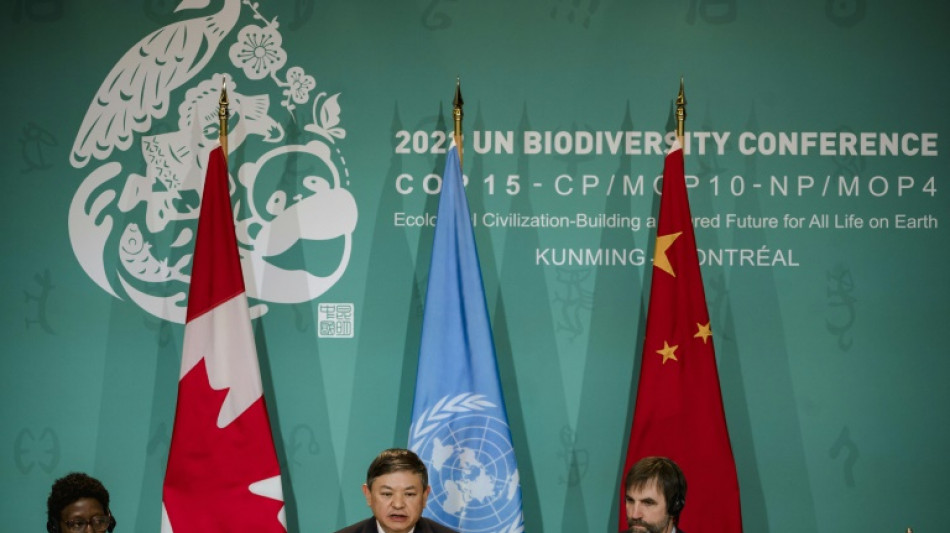
At UN summit, new hope for deal to save nature / Photo: ANDREJ IVANOV - AFP

Top officials at high-stakes UN biodiversity negotiations said Saturday they were confident of securing a major deal to save the natural world from destruction.
Observers had warned the COP15 talks aimed at sealing a "peace pact for nature" risked collapse due to disagreement over how much the rich world should pay to save ecosystems in developing countries.
But the Chinese chair of the conference said Saturday he was "greatly confident" delegates would reach a deal and his Canadian counterpart said "tremendous" progress had been made.
"I am greatly confident that we can ... keep our ambitions as well as achieve consensus," China's Environment Minister Huang Runqiu told reporters in Montreal, where the COP15 meeting is being held.
His Canadian counterpart Steven Guilbeault echoed his statement, saying: "We've made tremendous progress... I don't know about how many of us thought we could get there."
French President Emmanuel Macron tweeted: "With just a few days to go before the end of the COP 15 Biodiversity Conference in Montreal, my message to our partners is: now is not the time for small decisions, let's go big!
"Let's work together to achieve the most ambitious agreement possible. The world is depending on it."
The negotiations officially run until December 19, but could run longer if needed.
China holds the presidency of COP15, but its strict Covid rules prevented it from hosting, leaving that task to Canada in deep winter.
At stake is the future of the planet: whether humanity can roll back the habitat destruction, pollution and climate crisis that threaten an estimated one million plant and animal species with extinction.
The text is meant to be a roadmap for nations through 2030. The last 10-year plan, signed in Japan in 2010, failed to achieve any of its objectives, a failure blamed widely on its lack of monitoring mechanisms.
Major draft goals now include a cornerstone pledge to protect 30 percent of the world's land and oceans by 2030.
That ambitious objective is being compared to the Paris deal commitment to hold long-term planetary warming to 1.5 degrees Celsius -- or at least to 2.0 degrees.
- Money matters -
The more than 20 targets under discussion include reducing environmentally destructive farming subsidies, requiring businesses to assess and report on their biodiversity impacts, and tackling the scourge of invasive species.
Representatives of Indigenous communities, who safeguard 80 percent of the world's remaining biodiversity, want their rights to practice stewardship of their lands to be enshrined in the final agreement.
The issue of how much money the rich countries -- collectively known as the Global North -- will send to the Global South, home to most of the world's biodiversity, has emerged as the biggest sticking point.
Developing countries say developed nations grew rich by exploiting their resources and the South should be paid to preserve its ecosystems.
Several countries have announced new commitments either at the COP or recently, with Europe emerging as a key leader. The European Union has committed seven billion euros ($7.4 billion) for the period until 2027, double its prior pledge.
But these commitments are still well short of what observers say is needed, and what developing countries are seeking.
Brazil has led that charge, proposing flows of $100 billion annually, compared to the roughly $10 billion at present.
Whether international aid is delivered via a new fund, an existing mechanism called the Global Environment Facility (GEF), or a halfway solution involving a new "trust fund" within the GEF is still up for debate.
With the clock ticking, over 3,000 scientists have written an open letter to policymakers, calling for immediate action to stop the destruction of critical ecosystems.
"We owe this to ourselves and to future generations -- we can't wait any longer," they said.
Beyond the moral implications, there is the question of self-interest: $44 trillion of economic value generation -- more than half the world's total GDP -- depends on nature and its services.
M.Fujitav--JT