The Japan Times - Study Finds Psilocybin Makes Brain Activity More Responsive to Immediate Experience

EUR -
AED 4.108168
AFN 72.148217
ALL 91.224557
AMD 404.306976
ANG 2.002109
AOA 1026.902892
ARS 1692.783013
AUD 1.604278
AWG 2.013536
AZN 1.908484
BAM 1.954701
BBD 2.252443
BDT 138.063583
BGN 1.955178
BHD 0.422462
BIF 3350.299393
BMD 1.118631
BND 1.434123
BOB 13.101222
BRL 5.639799
BSD 1.118376
BTN 106.474591
BWP 15.362604
BYN 3.379233
BYR 21925.16464
BZD 2.249165
CAD 1.590212
CDF 2586.823091
CHF 0.931064
CLF 0.028006
CLP 1102.253845
CNY 7.486717
CNH 7.488406
COP 3576.18452
CRC 509.715599
CUC 1.118631
CUP 26.839904
CVE 111.187819
CZK 24.3627
DJF 198.802693
DKK 7.475228
DOP 68.515884
DZD 150.493199
EGP 59.37088
ERN 16.779463
ETB 180.245186
FJD 2.533195
FKP 0.844185
GBP 0.845959
GEL 2.873625
GGP 0.844185
GHS 13.048845
GIP 0.844185
GMD 82.778496
GNF 9843.951331
GTQ 8.546193
GYD 233.871147
HKD 8.778724
HNL 30.146831
HRK 7.531291
HTG 146.440438
HUF 364.005815
IDR 20062.588345
ILS 3.465071
IMP 0.844185
INR 106.439571
IQD 1692.488475
IRR 2002908.53494
ISK 136.406117
JEP 0.844185
JMD 177.600112
JOD 0.79311
JPY 176.709031
KES 145.176057
KGS 97.824032
KHR 4555.064203
KMF 494.434614
KPW 1006.767721
KRW 1502.120167
KWD 0.348621
KYD 0.93193
KZT 505.280332
LAK 25169.194137
LBP 100173.392196
LKR 370.145128
LRD 191.006682
LSL 18.446445
LTL 3.303026
LVL 0.676649
LYD 7.192967
MAD 10.903281
MDL 20.016758
MGA 5033.839242
MKD 61.747821
MMK 2349.156586
MNT 4026.712131
MOP 9.040356
MRU 44.99106
MUR 53.258749
MVR 17.293781
MWK 1948.655224
MXN 20.665743
MYR 4.5686
MZN 71.491881
NAD 18.445911
NGN 1487.83487
NIO 41.221499
NOK 10.628453
NPR 170.359708
NZD 1.996219
OMR 0.430096
PAB 1.118336
PEN 3.837464
PGK 4.979865
PHP 70.391528
PKR 309.899937
PLN 4.371431
PYG 6381.325385
QAR 4.071393
RON 5.335759
RSD 117.437228
RUB 93.544289
RWF 1649.980502
SAR 4.186331
SBD 9.03638
SCR 15.589692
SDG 672.850833
SEK 11.177197
SGD 1.436372
SHP 0.844027
SLE 27.596743
SLL 23457.134508
SOS 639.293998
SRD 42.185838
STD 23153.400067
STN 24.581913
SVC 9.78554
SYP 14544.437946
SZL 18.446011
THB 37.624586
TJS 10.321872
TMT 3.915208
TND 3.695395
TOP 2.693394
TRY 55.272888
TTD 7.605756
TWD 36.023384
TZS 2942.002538
UAH 50.26443
UGX 4518.478871
USD 1.118631
UYU 44.954716
UZS 13369.314115
VES 979.586828
VND 28969.183096
VUV 133.533968
WST 3.119424
XAF 655.957
XAG 0.020072
XAU 0.000271845551
XCD 3.023156
XCG 2.015584
XDR 0.79093
XOF 655.957
XPF 119.331742
YER 264.227418
ZAR 18.55624
ZMK 10069.020888
ZMW 22.225804
ZWL 360.198677
SSP 6430.476289
MXV 2.333644
  • RYCEF

    0.1000

    19.81

    +0.5%

  • VOD

    -0.2500

    16.33

    -1.53%

  • CMSC

    -0.2800

    20.12

    -1.39%

  • RBGPF

    -2.0000

    65

    -3.08%

  • RIO

    -0.2500

    94.16

    -0.27%

  • BTI

    -1.2000

    54.85

    -2.19%

  • NGG

    -0.3000

    74.94

    -0.4%

  • GSK

    -0.3500

    49.35

    -0.71%

  • BCE

    -0.4200

    20.14

    -2.09%

  • CMSD

    -0.3400

    19.93

    -1.71%

  • BP

    -0.9100

    43.52

    -2.09%

  • RELX

    0.1700

    33.24

    +0.51%

  • BCC

    -0.6200

    75.97

    -0.82%

  • AZN

    -1.9400

    164.21

    -1.18%

  • JRI

    0.0000

    10.77

    0%

Study Finds Psilocybin Makes Brain Activity More Responsive to Immediate Experience


Study Finds Psilocybin Makes Brain Activity More Responsive to Immediate Experience

A neuroimaging study found that psilocybin loosened conventional brain-network boundaries while strengthening patterns linked to what participants were doing at the time.

Text size:

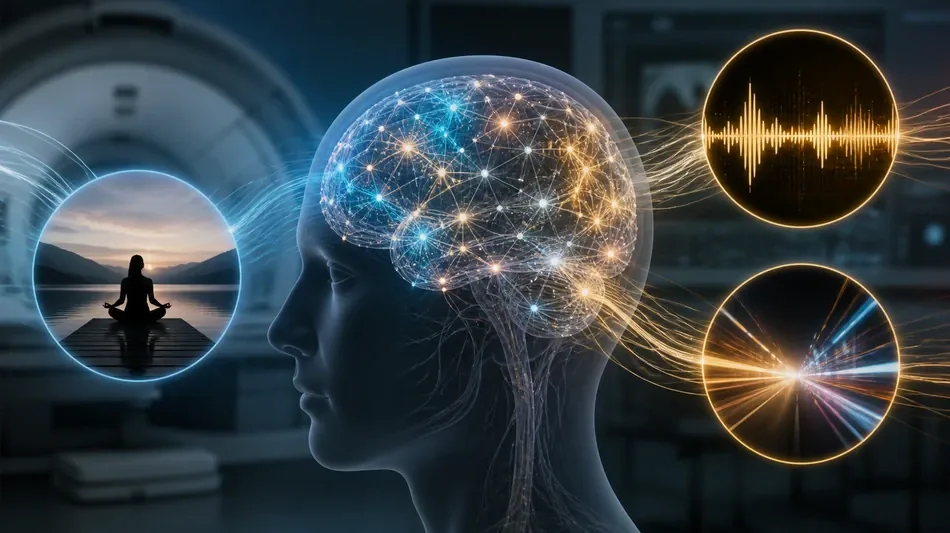
A large neuroimaging study of psilocybin has found an organized pattern within the increased variability commonly associated with psychedelic drugs. The research, published in Nature, indicates that the substance can reduce distinctions between established brain networks while making neural responses to immediate activities more recognizable.

Researchers monitored changes across 332 brain regions using functional magnetic resonance imaging and electroencephalography. The study involved 62 people who had not previously used psychedelics. Each participant took a 19-milligram oral capsule of psilocybin and then meditated, listened to music or watched a film.

Artificial-intelligence analysis identified different neural patterns associated with each activity. The patterns became clearer as the reported intensity of the psychedelic experience increased. The result suggests that greater unpredictability in overall brain signaling does not necessarily mean a person’s immediate environment has less influence. Instead, the activity underway appeared to leave a more distinct neurological signature.

Self-reports were consistent with the biological measurements. Participants whose brain activity showed the clearest activity-specific patterns also tended to describe stronger immersion and a greater sense of unity with their surroundings. Some reported that the boundary between themselves and the environment felt less distinct.

Lead author Devon Stoliker of Monash University’s School of Psychological Sciences in Melbourne said networks involved in processing internal and external experience became less separate under psilocybin but reorganized into patterns reflecting what participants were experiencing.

The findings add detail to the broad description of psychedelics as making the brain chaotic and may help explain reports of oneness during psilocybin experiences. They may also be relevant to psychedelic-assisted treatment, where the circumstances of a session are considered important.

Senior author Adeel Razi, a Monash professor, said context should not be treated as background to the drug’s effects. The results support careful attention to the setting and to what a person does and experiences during a therapeutic session. The study does not establish a treatment outcome, but it provides evidence that the immediate environment is reflected in brain organization during the drug’s effects.

H.Takahashi--JT