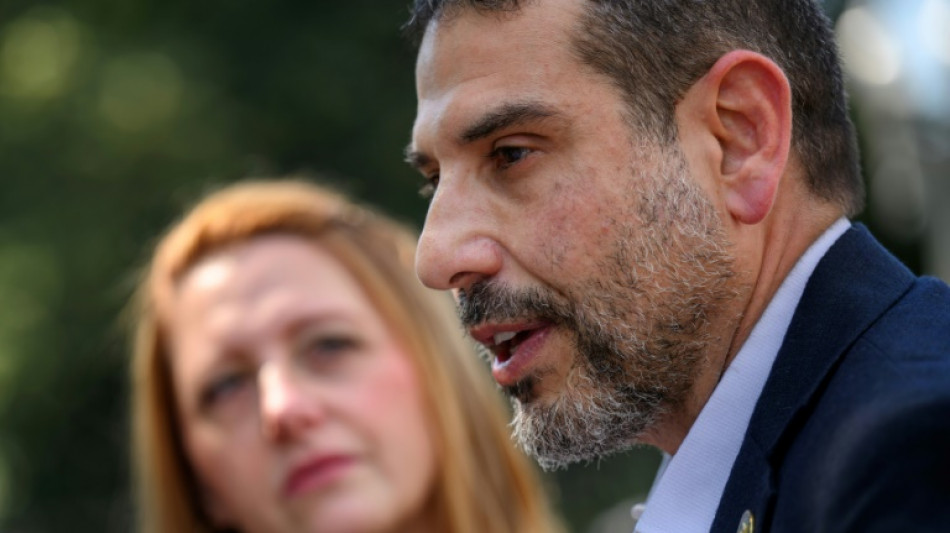
US health workers sound alarm on Gaza medical crisis / Photo: Drew ANGERER - AFP

Patients in Gaza's few standing hospitals are dying in droves from infections resulting from a lack of protective gear and soap, even when they survive their horrific blast injuries.
And health workers are facing agonizing decisions, like giving up on a seven-year-old boy with extensive burns because bandages are in short supply and he'd have probably died anyway.
These are just some of the horrors witnessed by American doctors and nurses returning from the besieged Palestinian territory, who are now on a mission to spread the word about what they saw and apply pressure on Israel to allow in more life-saving supplies.
"Whether or not a ceasefire happens, we have to get humanitarian aid. And we have to get it in sufficient volumes to meet the demands," Adam Hamawy, a former US army combat surgeon, tells AFP in an interview after a medical mission to Gaza's European Hospital last month.
"You could give all you want, you can donate," says the reconstructive plastic surgeon from New Jersey. "But if these borders don't open up to allow that aid to get in, then it's just useless."
Hamawy has volunteered in war torn and natural disaster-hit countries for the past 30 years, from the siege of Sarajevo to the Haiti earthquake.
"But the level of civilian casualties that I experienced was beyond anything I'd seen before," says the 54-year-old, who helped save the life of Senator Tammy Duckworth when she lost both of her legs to a rocket-propelled grenade (RPG) attack on the helicopter she was flying in Iraq.
"Most of our patients were children under the age of 14," he stressed. "This has nothing to do with your political views."
- Rampant infections -
Hamawy and other medics told AFP they are convinced that for now their energy is better spent lobbying the halls of power to stop the war and require Israel to comply with international law by letting in more aid.
Israel denies allegations of international law violations during its invasion, launched in response to Hamas' attacks and hostage-taking on October 7.
On a hot June afternoon in the capital Washington, Monica Johnston, a 44-year-old ICU nurse from Portland, Oregon said she conveyed specific lists of what was needed in meetings she had held with White House officials and lawmakers on Capitol Hill.
Unlike Hamawy, her journey to Gaza was her very first medical mission.
"I don't watch the news, I don't take part in anything political," she said. But last fall, she received an email from the American Burn Association with an urgent call for help. "Anytime I hear the word 'help,' my ears perk up, my heart starts pumping, and I feel I need to do that."
A 19-member team organized by the Palestinian American Medical Association set off with packed suitcases, bidding farewell to their families.
On the ground, they faced daunting challenges: not enough health workers, as well as a severe scarcity of vital medicines and even basic hygiene supplies, which led to the rampant spread of infections.
Johnston's voice cracks with emotion as she recalls the decision to stop treating a seven-year-old boy's extensive burns, prioritizing resources for patients with a better chance of survival.
"Two days later, he started developing maggots in his wounds, and then the feeling of responsibility that I caused this," she says. He was buried in his bandages because his body was totally infested.
- Families wiped out -
Whole families often arrived together, explained Ammar Ghanem, a 54-year-old ICU doctor from Michigan. This stemmed from the common practice of extended relatives living in multistory buildings, making them more vulnerable to bombings.
A case in point was a cheerful 12-year-old boy who used to volunteer at the hospital, a source of inspiration for the medics. But for several days, he stopped coming.
When he finally returned, Ghanem learned tragic news: thirty members of the boy's extended family had been killed in a single bombing, and he himself had to help pull their bodies from the rubble.
Initially the team felt relatively safe, but that changed abruptly after the Rafah crossing was closed. This triggered deep anxiety in their Palestinian colleagues, who expressed a sense of deja vu from Israel's past incursion into northern Gaza and the multiple evacuations they'd been through.
Though they were penciled in for a two-week mission, they were left stranded for days until an intervention from the US embassy -- a harrowing time for their partners and children back home.
Now home, they grapple with survivor's guilt, thinking of patients and colleagues left back in Gaza. They also feel grateful for small things, from clean surgical gloves to filling meals.
"What makes me feel better is feeling that I'm making a difference by relaying this message and telling people what I witnessed -- I think that's as important as what we did over there," says Hamawy.
S.Yamamoto--JT