The Japan Times - Low-cost MRI paired with AI produces high-quality results

EUR -
AED 4.269702
AFN 72.666666
ALL 95.260322
AMD 428.749104
ANG 2.081615
AOA 1067.280635
ARS 1618.048283
AUD 1.625819
AWG 2.095613
AZN 1.973299
BAM 1.942359
BBD 2.352381
BDT 142.741629
BGN 1.941474
BHD 0.440492
BIF 3477.310806
BMD 1.162615
BND 1.487184
BOB 8.035293
BRL 5.795868
BSD 1.167961
BTN 111.419592
BWP 16.45061
BYN 3.26309
BYR 22787.250632
BZD 2.34899
CAD 1.598845
CDF 2610.070034
CHF 0.91399
CLF 0.026408
CLP 1039.354478
CNY 7.888458
CNH 7.917384
COP 4405.984667
CRC 530.764581
CUC 1.162615
CUP 30.809293
CVE 110.099362
CZK 24.329285
DJF 207.976725
DKK 7.47287
DOP 69.225826
DZD 154.489127
EGP 61.50952
ERN 17.439222
ETB 182.363768
FJD 2.560893
FKP 0.862532
GBP 0.871793
GEL 3.115785
GGP 0.862532
GHS 13.265218
GIP 0.862532
GMD 84.290693
GNF 10241.232768
GTQ 8.871609
GYD 243.273435
HKD 9.102913
HNL 31.06085
HRK 7.53467
HTG 152.941905
HUF 359.846142
IDR 20476.321138
ILS 3.390011
IMP 0.862532
INR 111.536791
IQD 1523.025425
IRR 1528838.499267
ISK 143.606367
JEP 0.862532
JMD 184.665377
JOD 0.824253
JPY 184.384314
KES 150.384099
KGS 101.670914
KHR 4686.108851
KMF 490.623434
KPW 1046.355475
KRW 1744.887872
KWD 0.358783
KYD 0.96909
KZT 550.438655
LAK 25525.208238
LBP 104098.2272
LKR 378.222739
LRD 213.049163
LSL 19.171177
LTL 3.4329
LVL 0.703254
LYD 7.413348
MAD 10.706229
MDL 20.076487
MGA 4891.692363
MKD 61.608162
MMK 2441.072592
MNT 4161.549479
MOP 9.38156
MRU 46.671573
MUR 54.840338
MVR 17.914888
MWK 2024.805532
MXN 20.208548
MYR 4.592246
MZN 74.302631
NAD 19.171292
NGN 1592.247938
NIO 42.981856
NOK 10.867955
NPR 179.058484
NZD 1.98899
OMR 0.447021
PAB 1.162828
PEN 4.007521
PGK 4.898068
PHP 71.763542
PKR 325.299537
PLN 4.249299
PYG 7117.093192
QAR 4.238314
RON 5.204327
RSD 117.392729
RUB 85.21972
RWF 1708.301864
SAR 4.364628
SBD 9.319679
SCR 15.973189
SDG 698.149212
SEK 10.969329
SGD 1.488281
SHP 0.868009
SLE 28.658358
SLL 24379.454086
SOS 667.5205
SRD 43.257409
STD 24063.779633
STN 24.438512
SVC 10.174332
SYP 128.506664
SZL 19.157798
THB 37.961669
TJS 10.866465
TMT 4.069152
TND 3.357653
TOP 2.799297
TRY 52.9521
TTD 7.895163
TWD 36.678138
TZS 3037.322324
UAH 51.345513
UGX 4348.794585
USD 1.162615
UYU 46.308356
UZS 14003.695518
VES 593.106577
VND 30640.132488
VUV 137.096067
WST 3.145569
XAF 654.310736
XAG 0.014876
XAU 0.000255
XCD 3.142025
XCG 2.095689
XDR 0.813753
XOF 654.310736
XPF 119.331742
YER 277.457645
ZAR 19.38162
ZMK 10464.909712
ZMW 21.986681
ZWL 374.3615
  • RBGPF

    0.8900

    61.68

    +1.44%

  • BTI

    1.3500

    66.7

    +2.02%

  • CMSC

    0.0898

    23.14

    +0.39%

  • RIO

    -2.4500

    109.59

    -2.24%

  • BCE

    -0.2000

    24.19

    -0.83%

  • NGG

    0.4500

    87.43

    +0.51%

  • GSK

    -0.0300

    50.96

    -0.06%

  • AZN

    -2.7600

    184.96

    -1.49%

  • RYCEF

    -0.1300

    15.9

    -0.82%

  • BP

    -0.0200

    44.12

    -0.05%

  • VOD

    -0.0300

    15.48

    -0.19%

  • RELX

    -0.1600

    31.46

    -0.51%

  • JRI

    0.0100

    13.14

    +0.08%

  • BCC

    2.4200

    69.4

    +3.49%

  • CMSD

    0.0400

    23.6

    +0.17%

Low-cost MRI paired with AI produces high-quality results
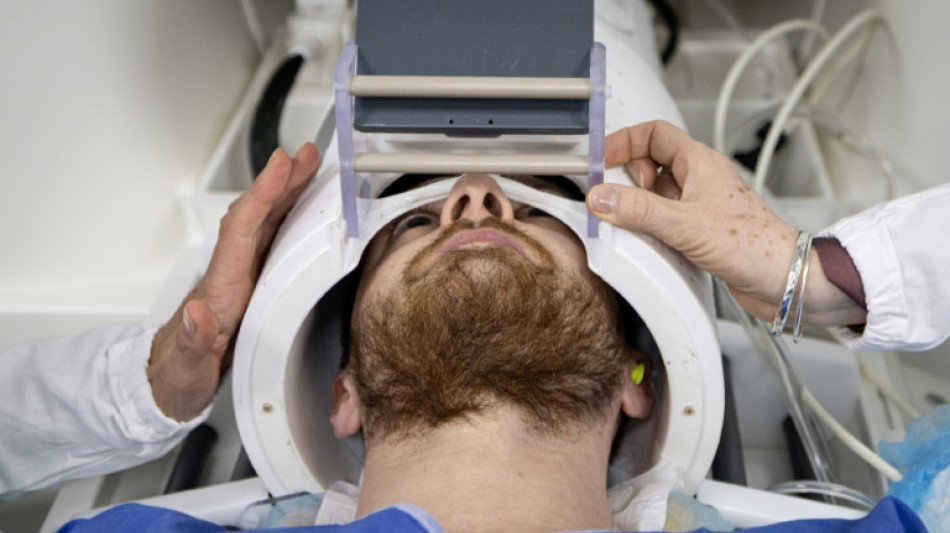
Low-cost MRI paired with AI produces high-quality results / Photo: ALAIN JOCARD - AFP/File

Low-cost MRI paired with AI produces high-quality results

A magnetic resonance imaging device built with off-the-shelf parts and paired with AI matched the performance of high-end MRI machines, according to a study published Thursday that could pave the way for greater access to the life-saving tools.

Text size:

First introduced five decades ago, MRI scanners are now a cornerstone of modern medicine, vital for diagnosing a wide range of conditions -- including strokes, tumors, and spinal conditions -- while avoiding exposing patients to radiation.

But they remain hard to come by in developing countries: Africa has less than one MRI machine per million people, while the figures in the United States and Japan are 40 and 55 per million, respectively.

To tackle the problem, Yujiao Zhao and colleagues at the University of Hong Kong built a simplified, low-powered MRI machine using store-bought hardware that cost around $22,000, and published their findings in the prestigious journal Science.

MRI uses a strong magnetic field and radio waves to align and manipulate the body's hydrogen atoms, producing detailed images of internal structures and organs.

The strength of magnets is measured in units called teslas (T), with conventional MRIs requiring powerful electromagnets that have wires bathed in supercooled liquid helium to generate magnetic fields of 1.5T to 7T.

These machines demand high electricity inputs, far exceeding what standard wall outlets can provide, and must be housed in radio frequency-shielded rooms to prevent equipment interference. Current clinical use MRIs cost upwards of million dollars.

By contrast, the Hong Kong research team's full body MRI machine used a helium-free 0.05T magnet and required just 1800 watts -- comparable to a hair dryer, meaning it could use a standard socket. What's more, it did not require radio shielding.

To compensate for the reduced image detail and higher levels of radio interference, the researchers integrated their system with a deep learning algorithm trained on a vast dataset of high-resolution images of human anatomical structures.

They then tested their machine on 30 healthy adult volunteers, performing scans over their bodies from their brains down to their knees.

The results from their so-called "ultra low field" MRI were found to be on par with conventional MRI scanners 60 times more powerful.

"These advances pave the way for affordable, patient centric, and deep learning–powered ULF MRI scanners, addressing unmet clinical needs in diverse healthcare settings worldwide," Zhao and colleagues wrote.

In an accompanying comment piece, researchers Udunna Anazodo and Stefan du Plessis wrote the approach was "promising" but added several challenges needed to be addressed before it can be widely applied.

"Concerted effort must be taken to develop the skills needed to ensure local production and maintenance of these devices and their proper use," in countries with low resources, they said. Radiologists would also need to be retrained to appropriately interpret the images.

M.Ito--JT