The Japan Times - US woman with rare double uterus gives birth to twin girls

EUR -
AED 4.304583
AFN 77.35264
ALL 96.52995
AMD 447.121148
ANG 2.098382
AOA 1074.739085
ARS 1700.295745
AUD 1.77205
AWG 2.10963
AZN 1.951986
BAM 1.956813
BBD 2.361973
BDT 143.417272
BGN 1.954795
BHD 0.441802
BIF 3475.028836
BMD 1.172016
BND 1.514083
BOB 8.103504
BRL 6.462507
BSD 1.172732
BTN 105.807008
BWP 15.497482
BYN 3.440754
BYR 22971.522831
BZD 2.358611
CAD 1.614254
CDF 2653.44578
CHF 0.931281
CLF 0.027228
CLP 1068.140949
CNY 8.252461
CNH 8.242282
COP 4528.331759
CRC 584.314823
CUC 1.172016
CUP 31.058436
CVE 110.696669
CZK 24.355711
DJF 208.290901
DKK 7.471312
DOP 73.309109
DZD 151.712908
EGP 55.702434
ERN 17.580247
ETB 182.38528
FJD 2.677178
FKP 0.875346
GBP 0.876188
GEL 3.15861
GGP 0.875346
GHS 13.507516
GIP 0.875346
GMD 86.143623
GNF 10178.962996
GTQ 8.981839
GYD 245.356383
HKD 9.118968
HNL 30.888642
HRK 7.536415
HTG 153.592754
HUF 387.489159
IDR 19580.87918
ILS 3.760772
IMP 0.875346
INR 105.745596
IQD 1536.227704
IRR 49371.193797
ISK 147.966909
JEP 0.875346
JMD 187.641099
JOD 0.830939
JPY 182.426123
KES 151.069751
KGS 102.493298
KHR 4696.430212
KMF 491.074698
KPW 1054.807791
KRW 1730.382704
KWD 0.359704
KYD 0.977206
KZT 605.05309
LAK 25396.116553
LBP 105017.674577
LKR 362.837754
LRD 207.575382
LSL 19.662894
LTL 3.46066
LVL 0.708941
LYD 6.356425
MAD 10.748591
MDL 19.777234
MGA 5273.93154
MKD 61.55534
MMK 2461.301448
MNT 4157.848963
MOP 9.399425
MRU 46.814223
MUR 53.959537
MVR 18.107747
MWK 2033.530348
MXN 21.091122
MYR 4.788907
MZN 74.895718
NAD 19.662894
NGN 1707.24072
NIO 43.153251
NOK 11.909442
NPR 169.287599
NZD 2.030044
OMR 0.450677
PAB 1.172752
PEN 3.948527
PGK 5.054723
PHP 68.664935
PKR 328.58543
PLN 4.202312
PYG 7829.218306
QAR 4.276604
RON 5.090894
RSD 117.39265
RUB 93.692725
RWF 1707.383502
SAR 4.396062
SBD 9.528747
SCR 15.94784
SDG 704.967835
SEK 10.887916
SGD 1.51196
SHP 0.879316
SLE 28.247832
SLL 24576.603683
SOS 669.046204
SRD 45.331256
STD 24258.374657
STN 24.513207
SVC 10.261529
SYP 12960.586339
SZL 19.668177
THB 36.789934
TJS 10.83012
TMT 4.102058
TND 3.427774
TOP 2.821935
TRY 50.083775
TTD 7.957321
TWD 36.977472
TZS 2918.321285
UAH 49.532187
UGX 4189.257131
USD 1.172016
UYU 45.95476
UZS 14142.619905
VES 323.747516
VND 30853.333598
VUV 142.251043
WST 3.263731
XAF 656.296607
XAG 0.017923
XAU 0.00027
XCD 3.167433
XCG 2.113494
XDR 0.814481
XOF 656.310614
XPF 119.331742
YER 279.349871
ZAR 19.62688
ZMK 10549.554705
ZMW 26.67983
ZWL 377.388825
  • RYCEF

    0.6100

    15.38

    +3.97%

  • CMSC

    0.0200

    23.28

    +0.09%

  • RBGPF

    -1.7900

    80.22

    -2.23%

  • NGG

    -0.5680

    76.592

    -0.74%

  • BP

    -1.0420

    33.428

    -3.12%

  • AZN

    1.1150

    90.975

    +1.23%

  • RELX

    0.1700

    40.73

    +0.42%

  • RIO

    0.5300

    77.72

    +0.68%

  • BTI

    0.0450

    57.215

    +0.08%

  • GSK

    -0.2600

    48.45

    -0.54%

  • SCS

    0.0200

    16.14

    +0.12%

  • VOD

    0.0200

    12.83

    +0.16%

  • CMSD

    0.0200

    23.3

    +0.09%

  • JRI

    -0.0120

    13.418

    -0.09%

  • BCC

    1.2600

    77.55

    +1.62%

  • BCE

    -0.2550

    22.895

    -1.11%

US woman with rare double uterus gives birth to twin girls
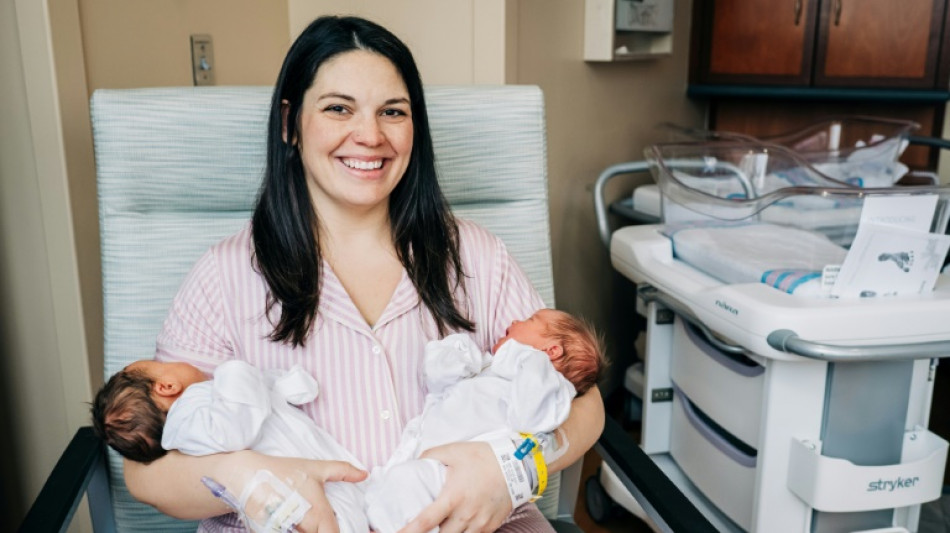
US woman with rare double uterus gives birth to twin girls / Photo: ANDREA MABRY - University of Alabama Birmingham/AFP

US woman with rare double uterus gives birth to twin girls

A 32-year-old woman from Alabama who was born with two uteruses and became pregnant in both gave birth to twin girls on different days, she announced on Friday.

Text size:

"Our miracle babies were born!" Kelsey Hatcher, who is documenting her story on her Instagram account "doubleuhatchlings," wrote in a post.

She added that the girls "decided they were rare enough statistically that they should just go ahead and have their own birthdays too."

The first one, named Roxi Layla, was born on Tuesday at 7:49 pm (0149 GMT Wednesday). She was joined by Rebel Laken on Wednesday at 6:09 am. Each weighed over seven pounds (3.2 kilos).

Doctors had estimated a Christmas due date. But following 20 hours of combined labor after Hatcher was induced at 39 weeks, the sisters arrived just in time to be at home for the holidays with their siblings.

The mother and daughters have been discharged from the hospital, with Hatcher promising to share details about the delivery in future.

Hatcher knew from the age of 17 that she had "uterus didelphys," a rare congenital condition thought to affect about 0.3 percent of females. In such cases, each uterus has only one ovary and one fallopian tube.

It was during a routine eight-week ultrasound visit in May that Hatcher, a massage therapist and then-mother-of-three, learned not only that she was having twins this time, but that a fetus was present in each of her uteruses.

"As soon as she (the technician) moved the wand to the other uterus, I gasped," Kelsey recalled, according to a statement by University of Alabama at Birmingham Hospital.

"Sure enough, there was another baby. We just could not believe it."

Pregnancies in both uteruses are exceedingly rare, according to Shweta Patel, the obstetrician-gynecologist who cared for Hatcher at UAB's Women & Infants Center.

Patel was Hatcher's doctor during her third pregnancy. "But that was only one baby -- two babies in two uteri were a true medical surprise," she said in the statement, noting she received additional help from UAB experts in high-risk obstetrics.

Richard Davis, professor at the hospital's Division of Maternal-Fetal Medicine, said the congenital anomaly of Hatcher's dicavitary twin pregnancy meant her babies were not forced to share a single, cramped womb, a condition that would have made pre-term birth a high possibility.

"With Kelsey's babies, they each had their own womb, sac, placenta and umbilical cord, allowing them extra space to grow and develop," Davis said in the statement, which was accompanied by a hospital-produced video about Hatcher's pregnancy and delivery.

Hatcher said she was told the odds of a double pregnancy in double wombs were one in 50 million -- with the last widely known case in Bangladesh in 2019, when Arifa Sultana, then 20, gave birth to healthy babies 26 days apart.

Y.Kato--JT