What we know so far about surging respiratory illnesses in China / Photo: Jade Gao - AFP

Cases of respiratory illnesses have been surging in northern China, particularly among children, sparking speculation online of a new pandemic threat four years after Covid-19 first emerged in the country.
However Chinese health authorities have said the rising infections are a mix of already known viruses and are linked to the country's first full cold season after strict Covid restrictions were lifted last December.
And while emphasising that the full situation remains unclear, experts say there is little to suggest the cases were caused by a new virus.
Here is what we know so far.
- What and where? -
On November 13, China's National Health Commission reported a surge of respiratory illnesses, mostly in children.
Chinese authorities have attributed the rising cases to the end of Covid restrictions, the arrival of the cold season, and the circulation of known pathogens including influenza, mycoplasma pneumonia, respiratory syncytial virus (RSV) and SARS-CoV-2 -- the virus that causes Covid.
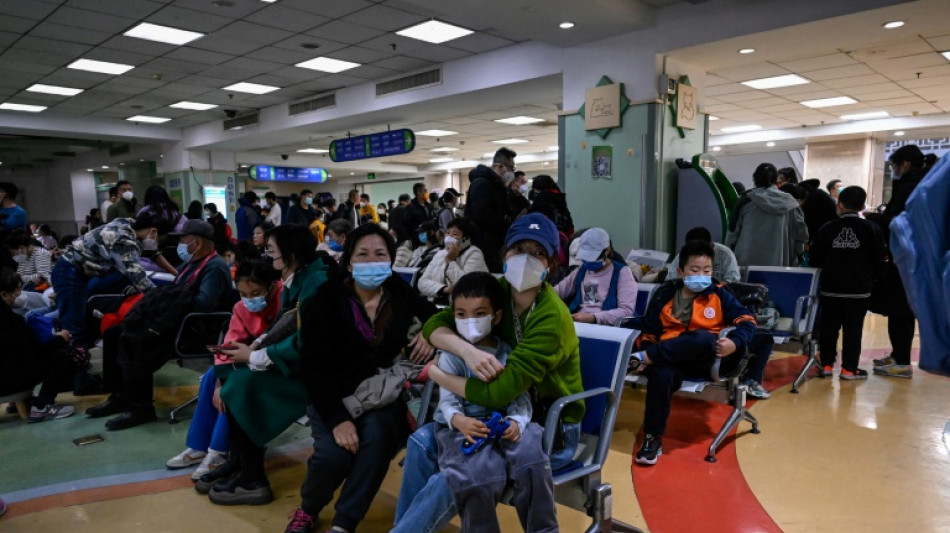
On Monday, the public disease surveillance system ProMED -- which once issued an early warning about mysterious pneumonia cases that turned out to be Covid -- reported that some Chinese hospitals were "overwhelmed with sick children" due to a pneumonia outbreak.
This outbreak was said to be mainly in the capital Beijing, but also in the northeastern Liaoning province and other areas in China.
Symptoms included fever, lung inflammation without a cough, and pulmonary nodules -- lumps on lungs that are usually the result of a past infection. No deaths have been reported.
At a children's hospital in Beijing on Thursday, several parents told AFP their children had mycoplasma pneumonia, which is a common cause of pneumonia in children that is readily treated with antibiotics.
- What do China and WHO say? -
The report triggered memories of the pandemic, with social media users fearing "a new virus coming from China," or a "new Covid".
On Wednesday, the World Health Organization -- which repeatedly criticised Beijing for a lack of transparency throughout the Covid pandemic -- requested more information from China about children suffering from "undiagnosed pneumonia".
Beijing responded on Thursday, saying "there has been no detection of any unusual or novel pathogens," according to a WHO statement.
The WHO has requested more information, noting that China closely monitors trends in viruses such as the flu, RSV and SARS-CoV-2.
China also started monitoring mycoplasma pneumonia for the first time in mid-October, the WHO added.
The WHO said that "there is limited detailed information available to fully characterise the overall risk of these reported cases of respiratory illness in children."
However an increase in such illnesses was to be expected with the arrival of winter, it added.
- What do the experts think? -
Several experts pointed to winter's arrival, the end of Covid restrictions, and a lack of prior immunity in children as likely being behind the surging infections.
"Since China experienced a far longer and harsher lockdown than essentially any other country on Earth, it was anticipated that those 'lockdown exit' waves could be substantial in China," said Francois Balloux of University College London.
Unless there is new evidence suggesting otherwise, "there is no reason to suspect the emergence of a novel pathogen," he added.
Paul Hunter of the UK's University of East Anglia emphasised that "at present there is too little information to make a definitive diagnosis".
However "overall, this does not sound to me like an epidemic due to a novel virus," he added.
"If it was, I would expect to see many more infections in adults. The few infections reported in adults suggest existing immunity from a prior exposure."
Catherine Bennett of Australia's Deakin University pointed out that "young children in school in China will have spent up to half their life without the usual exposure to common pathogens, and so do not have the same levels of immunity".
- Are there any recommendations? -
The WHO recommended that people in the affected areas follow the normal rules to avoid respiratory illnesses.
These include getting vaccinated, isolating if symptoms emerge, and getting tested or wearing masks if necessary.
Based on the current information, the WHO advised against any travel restrictions involving China.
T.Ikeda--JT