The Japan Times - 'AI doctor' better at predicting patient outcomes, including death

EUR -
AED 4.317084
AFN 76.997356
ALL 96.772679
AMD 448.484765
ANG 2.104379
AOA 1077.811061
ARS 1705.16984
AUD 1.777599
AWG 2.118598
AZN 1.997293
BAM 1.96202
BBD 2.365789
BDT 143.537113
BGN 1.95721
BHD 0.443114
BIF 3486.136225
BMD 1.175366
BND 1.517941
BOB 8.11642
BRL 6.484376
BSD 1.174574
BTN 106.230259
BWP 15.513522
BYN 3.468448
BYR 23037.17802
BZD 2.362459
CAD 1.619708
CDF 2662.204223
CHF 0.933735
CLF 0.027503
CLP 1078.92775
CNY 8.278398
CNH 8.272264
COP 4548.549756
CRC 585.230441
CUC 1.175366
CUP 31.147205
CVE 110.596296
CZK 24.390018
DJF 208.885855
DKK 7.47121
DOP 73.753874
DZD 152.169912
EGP 55.943667
ERN 17.630493
ETB 182.417981
FJD 2.688055
FKP 0.875536
GBP 0.877558
GEL 3.167589
GGP 0.875536
GHS 13.546118
GIP 0.875536
GMD 86.383254
GNF 10211.000115
GTQ 8.996253
GYD 245.748635
HKD 9.144931
HNL 30.802548
HRK 7.537975
HTG 153.854487
HUF 389.138488
IDR 19623.561891
ILS 3.796309
IMP 0.875536
INR 106.212145
IQD 1539.729755
IRR 49494.671681
ISK 148.002177
JEP 0.875536
JMD 187.95587
JOD 0.833354
JPY 182.772385
KES 151.503116
KGS 102.785973
KHR 4707.342355
KMF 492.478703
KPW 1057.843016
KRW 1733.971015
KWD 0.360579
KYD 0.978862
KZT 604.159647
LAK 25452.555365
LBP 105254.045802
LKR 363.78556
LRD 208.480545
LSL 19.664333
LTL 3.47055
LVL 0.710967
LYD 6.370834
MAD 10.759008
MDL 19.820995
MGA 5306.778389
MKD 61.578378
MMK 2468.526963
MNT 4170.69852
MOP 9.411637
MRU 46.744401
MUR 54.126061
MVR 18.15952
MWK 2041.611105
MXN 21.17769
MYR 4.805483
MZN 75.105107
NAD 19.664059
NGN 1708.183786
NIO 43.147931
NOK 11.986873
NPR 169.964264
NZD 2.033002
OMR 0.451932
PAB 1.174609
PEN 3.954516
PGK 4.992074
PHP 68.880576
PKR 329.456197
PLN 4.215745
PYG 7889.710429
QAR 4.279523
RON 5.091632
RSD 117.382677
RUB 94.614951
RWF 1704.281027
SAR 4.40863
SBD 9.594986
SCR 17.330842
SDG 706.979855
SEK 10.920927
SGD 1.516929
SHP 0.881829
SLE 28.321188
SLL 24646.846373
SOS 671.719965
SRD 45.460843
STD 24327.707813
STN 24.917764
SVC 10.278016
SYP 12996.208108
SZL 19.663502
THB 36.953675
TJS 10.841556
TMT 4.113782
TND 3.41297
TOP 2.83
TRY 50.21529
TTD 7.967921
TWD 36.998763
TZS 2901.921575
UAH 49.855936
UGX 4187.078229
USD 1.175366
UYU 45.762744
UZS 14245.438181
VES 324.672821
VND 30953.269549
VUV 142.604509
WST 3.280482
XAF 658.015092
XAG 0.017592
XAU 0.000271
XCD 3.176486
XCG 2.116966
XDR 0.816263
XOF 655.333471
XPF 119.331742
YER 280.14851
ZAR 19.686779
ZMK 10579.713449
ZMW 26.927336
ZWL 378.467445
  • SCS

    0.0200

    16.14

    +0.12%

  • RBGPF

    0.4100

    82.01

    +0.5%

  • BCC

    0.2650

    76.105

    +0.35%

  • NGG

    1.3500

    77.12

    +1.75%

  • RELX

    -0.2700

    40.55

    -0.67%

  • GSK

    0.1400

    48.92

    +0.29%

  • RIO

    1.2300

    77.22

    +1.59%

  • AZN

    -0.9300

    90.42

    -1.03%

  • CMSD

    -0.1000

    23.28

    -0.43%

  • RYCEF

    -0.0300

    14.77

    -0.2%

  • JRI

    -0.0730

    13.437

    -0.54%

  • BCE

    -0.1500

    23.18

    -0.65%

  • CMSC

    -0.0500

    23.29

    -0.21%

  • VOD

    0.0950

    12.795

    +0.74%

  • BTI

    -0.1300

    57.16

    -0.23%

  • BP

    0.5500

    34.31

    +1.6%

'AI doctor' better at predicting patient outcomes, including death
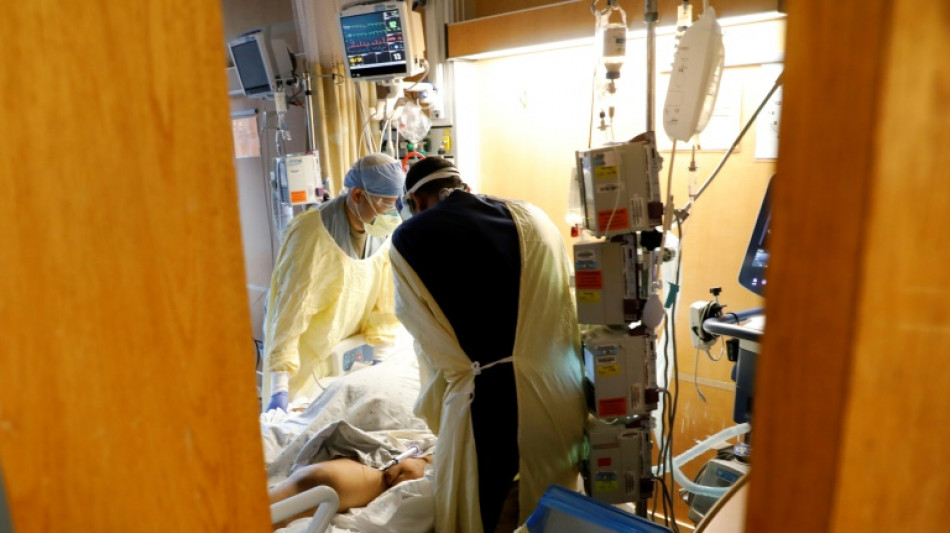
'AI doctor' better at predicting patient outcomes, including death / Photo: JEFF KOWALSKY - AFP/File

'AI doctor' better at predicting patient outcomes, including death

Artificial intelligence has proven itself useful in reading medical imaging and even shown it can pass doctors' licensing exams.

Text size:

Now, a new AI tool has demonstrated the ability to read physicians' notes and accurately anticipate patients' risk of death, readmission to hospital, and other outcomes important to their care.

Designed by a team at NYU Grossman School of Medicine, the software is currently in use at the university's affiliated hospitals throughout New York, with the hope that it will become a standard part of health care.

A study on its predictive value was published Wednesday in the journal Nature.

Lead author Eric Oermann, an NYU neurosurgeon and computer scientist, told AFP that while non-AI predictive models have been around in medicine for a long time, they were hardly used in practice because the data they needed requires cumbersome reorganization and formatting.

But "one thing that's common in medicine everywhere, is physicians write notes about what they've seen in clinic, what they've discussed with patients," he said.

"So our basic insight was, can we start with medical notes as our source of data, and then build predictive models on top of it?"

The large language model, called NYUTron, was trained on millions of clinical notes from the health records of 387,000 people who received care within NYU Langone hospitals between January 2011 and May 2020.

These included any records written by doctors, such as patient progress notes, radiology reports and discharge instructions, resulting in a 4.1-billion-word corpus.

One of the key challenges for the software was interpreting the natural language that physicians write in, which varies greatly among individuals, including in the abbreviations they choose.

By looking back at records of what happened, researchers were able to calculate how often the software's predictions turned out to be accurate.

They also tested the tool in live environments, training it on the records from, for example, a hospital in Manhattan then seeing how it fared in a Brooklyn hospital, with different patient demographics.

- Not a substitute for humans -

Overall, NYUTron identified an unnerving 95 percent of people who died in hospital before they were discharged, and 80 percent of patients who would be readmitted within 30 days.

It outperformed most doctors on its predictions, as well as the non-AI computer models used today.

But, to the team's surprise, "the most senior physician who's actually a very famous physician, he had superhuman performance, better than the model," said Oermann.

"The sweet spot for technology and medicine isn't that it's going to always deliver necessarily superhuman results, but it's going to really bring up that baseline."

NYUTron also correctly estimated 79 percent of patients' actual length of stay, 87 percent of cases where patients were denied coverage by insurance, and 89 percent of cases where a patient's primary disease was accompanied by additional conditions.

AI will never be a substitute for the physician-patient relationship, said Oermann. Rather, they will help "provide more information for physicians seamlessly at the point-of-care so they can make more informed decisions."

M.Ito--JT