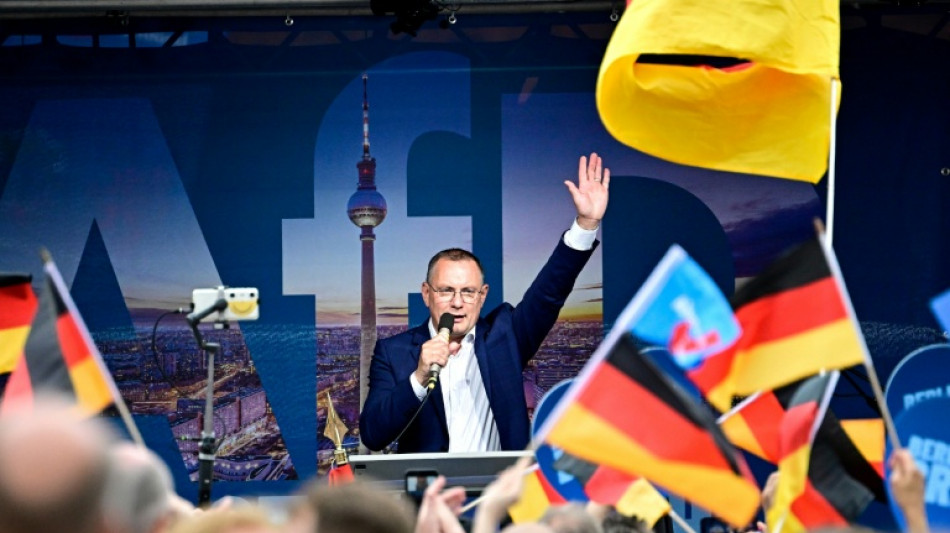
Mass protests expected as German far-right AfD meets / Photo: Tobias SCHWARZ - AFP/File

German police are bracing to guard an annual congress of the far-right AfD party this weekend against tens of thousands of antifascist demonstrators who are determined to shut it down.
The standoff in the city of Erfurt, Thuringia state, comes as the opposition Alternative for Germany party is soaring in national opinion polls ahead of all other parties.
Inside the conference hall from Saturday, AfD co-leaders Alice Weidel and Tino Chrupalla will seek to be reelected at the helm of the anti-immigration party.
Outside on the streets, up to 50,000 demonstrators from all over Germany are expected to stage rallies and sit-in blockades meant to prevent AfD delegates from even reaching the venue.
Up to 2,500 of the protesters are expected to come prepared for violence, according to internal police documents obtained by news weekly Der Spiegel.
The AfD's rapid rise has unnerved many Germans, who feel they have a special duty to fight far-right politics given Germany's dark Nazi past.
Some have seen a deliberate provocation in the AfD holding its Erfurt conference on the 100th anniversary of a Nazi conference in nearby Weimar, a charge the AfD denies.
"This is an extremely dangerous party," Noa Sander, spokesperson for the anti-AfD "Resistance" protest alliance, told AFP ahead of the conference in Erfurt, a city of about 220,000 people.
"The AfD wants mass deportations and ethnic cleansing," Sander charged in reference to the party's "remigration" demands.
"It should be banned. We intend to do this by blockading their party conference and standing in the way of the AfD, its policies and members wherever they appear, making sure they have no place in society."
Some in the AfD have appeared to relish the prospect of a tense confrontation.
"The countdown to civil war in Erfurt is ticking," AfD lawmaker Beatrix von Storch wrote on X this week, telling her party's foes: "You only have violence. We have arguments."
- 'Danger to us all' -
German Chancellor Friedrich Merz has made it his mission to reverse the rise of the AfD, which has so far been locked out of power as all other parties have refused to cooperate with it.
The AfD says it is a conservative force occupying the space once held by Merz's Christian Democrats before former chancellor Angela Merkel a decade ago allowed millions of refugees and asylum seekers into Germany.
But critics say the party is dangerous and have called for it to be banned, pointing to AfD politicians downplaying Nazi crimes and links to banned right-wing extremist groups.
This year the AfD is eyeing power for the first time as state elections loom in Germany's ex-communist east, its electoral heartland. Polls indicate it could win an absolute majority in September polls in Saxony-Anhalt state.
Nationwide, the party has been at or near the top of polls since shortly after elections held last year, when the AfD came in second with 20 percent.
"I would never have thought that a radical right party could be the strongest in Germany within my lifetime," said Manfred Guellner, head of polling firm Forsa.
"Lots of people, not necessarily part of the radical right, have gone over to the AfD because of dissatisfaction with the current government," he told AFP.
Thuringia's Interior Minister Georg Maier urged protesters to stay peaceful, saying that "anyone demonstrating against a party they consider to be unconstitutional should not themselves act in a manner that is unconstitutional".
Though Germany's basic law guarantees freedom of assembly, Sander argued that non-violent acts of resistance to prevent the AfD meeting are justified given the gravity of the political threat.
"If they ever come to power, they want to establish a fascist regime," Sander charged. "That is a danger to us all and we have to stop them before that happens."
"We take the necessary and legitimate steps, even if they are not entirely compatible with the law."
K.Yamaguchi--JT