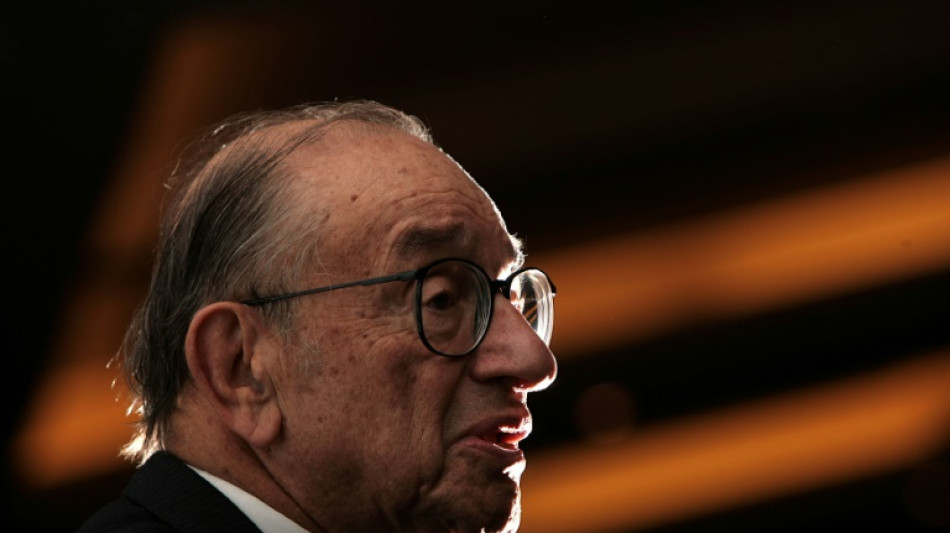
Alan Greenspan: longtime Fed chief with a divided legacy / Photo: Nicolas ASFOURI - AFP/File

Alan Greenspan, the longtime US Federal Reserve chief who presided over an unprecedented period of American economic expansion but was later faulted for failing to rein in markets ahead of the 2008 global financial crisis, has died.
Greenspan -- who died Monday at age 100 -- guided the world's biggest economy through a stock market crash in 1987 as he first took up his post, the Mexican and Asian financial crises, the dotcom boom and bust, and the September 11, 2001 attacks.
A native New Yorker who excelled at math as a child but initially studied music before pivoting to economics, Greenspan spent decades in the inner circles of power in Washington, ultimately leading the Fed for presidents of both political parties.
Greenspan was even hailed as the greatest central banker the world has ever known, winning glowing praise for his steady hand and cool demeanor.
Supporters especially admired his willingness to cut interest rates and keep them low even as unemployment rates fell -- which conventional wisdom and his own early beliefs said would cause inflation to spiral out of control.
But his impenetrable prose -- which he admitted using to avoid committing to any particular course -- and his confidence in unfettered markets and institutions to correct themselves frustrated critics, who believed the US economy needed stronger guardrails.
And after the world sank into crisis in 2008, soon after his retirement in 2006, his decision not to do anything to rein in the mortgage markets was viewed as naive.
- From music to math -
Born on March 6, 1926, Greenspan grew up in New York's immigrant neighborhood of Washington Heights, an only child raised mostly by his mother after she separated from his stockbroker father.
He loved math and memorized train timetables as a boy, but also loved music.
Initially, rather than going to college, he attended the elite Juilliard School to study the clarinet. After he was declared unfit to serve in the military due to a lung issue, he went on to play clarinet and saxophone for the Henry Jerome band.
Greenspan earned $62 a week -- more than his mother was making in her job at a department store, according to biographer Sebastian Mallaby, who wrote "The Man Who Knew: The Life and Times of Alan Greenspan" in 2016.
Content to be a sideman to more talented musicians, he read books on finance in his free time and helped his bandmates with their taxes.
But in 1945, he quit music to attend New York University, where he would eventually earn a PhD in economics.
- Ayn Rand's 'chief economist' -
Greenspan started a consulting firm where he delved deeply into the minutiae of economic and manufacturing data, a habit that would become the trademark -- he was known for poring over statistics in his bathtub.
As his business advising large companies was growing, he became an active member of the libertarian salon surrounding anti-government hero Ayn Rand, even offering her guidance on the economic aspects of her seminal novel "Atlas Shrugged."
His biographer quipped that Greenspan was the author's "chief economist." And while his thinking evolved during his career, he never fully relinquished his Randian support of laissez-faire economies free from government intervention.
- 'Committee to Save the World' -
Greenspan entered politics in the late 1960s as an adviser to Richard Nixon during his successful campaign for president, but initially declined to take a job in the Republican administration.
When he finally did accept the post of White House economic adviser, he was not confirmed until after Nixon resigned in disgrace, and ended up working for Gerald Ford.
Ironically, Greenspan would live in the Watergate complex that became synonymous with the scandal that torpedoed Nixon's presidency.
In 1987, another Republican president, Ronald Reagan, named Greenspan to serve as chair of the Federal Reserve, replacing anti-inflation crusader Paul Volcker.
It was a position he would hold until January 2006 serving under four presidents -- Reagan, George H.W. Bush, his Democratic successor Bill Clinton and George W. Bush.
Greenspan was tested early in his new post -- on "Black Monday" in October 1987, the benchmark Dow Jones Industrial Average collapsed by nearly 23 percent -- still the biggest single-day percentage drop in the index's history -- as part of a global market crash.
The new Fed chair issued a terse statement promising central bank support, and the Fed pumped liquidity into the financial system.
It worked. Rather than another Great Depression like the one that followed the 1929 crash, markets recovered quickly.
The world was nevertheless battered by a series of economic crises in the years that followed: Mexico (1994), Asia (1997) and Russia's debt default (1998).
And then in a precursor to the global meltdown a decade later, Long-Term Capital Management (LTCM), which sold an unregulated financial instrument known as over-the-counter derivatives in 1998, was on the brink of collapsing and taking the financial system down with it.
Greenspan's Fed lowered the benchmark interest rate three times, and it engineered a massive bailout for LTCM.
A few months later, Greenspan was featured on the cover of Time magazine with then Treasury secretary Robert Rubin and his deputy at the time, Lawrence Summers, under the banner headline "The Committee to Save the World."
- 'Dangerously naive' -
But when the US housing market took off in the later 1990s and derivatives again were used to package mortgages to sell to investors -- supposedly to dilute the risk -- the Fed sat back and essentially did nothing.
His faith in the market's ability to regulate itself did not waver, even though the record shows he asked questions about how the Fed could prevent banks from overexposing themselves to such futre risks.
Markets came to rely on the "Greenspan put" -- a perceived guarantee the Fed would cut rates whenever they were in trouble. Those low rates spurred the mortgage market to dangerous heights before it all came crumbling down.
Alan Blinder, a Princeton economics professor who served as Fed vice chair, said Greenspan had a "legitimate claim to being the greatest central banker who ever lived."
But with the financial crisis in the rear view mirror, he said Greenspan "really fell down on the job when it came to regulatory policy."
His "excessive reliance on the self-regulating aspects of markets seemed dangerously naive, and eventually blew up in his face and everybody's face," Blinder told AFP.
Greenspan, who retired just before disaster struck, acknowledged to Congress in late 2008 that he had "made a mistake" in presuming companies were best positioned to protect themselves and their shareholders without government oversight.
The man famous for his grasp of minutiae of economic data said he was "shocked" by the "flaw in the model" of economic behavior he had long relied on.
- 'He continually learned' -
Greenspan preferred a technique known in central banking circles as "jawboning" -- sending a message to markets that he might take action.
But deciphering his true message in speeches or in congressional testimony was a chore, and journalists frequently came to opposite conclusions about what he was saying.
Greenspan once boasted he had "learned to mumble with great incoherence." Even his wife, television journalist Andrea Mitchell, acknowledged that "figuring out what he is saying is a challenge."
Economist Diane Swonk of Grant Thornton said for all his obfuscation, Greenspan actually made the Fed more transparent.
He was the first to throw out the old rule book and keep interest rates lower to "run the economy hot" -- now accepted practice as long as inflation remains tame.
Greenspan is survived by Mitchell, whom he married in 1997.
In a statement announcing her husband's death Monday, Mitchell called Greenspan "a giant of a man who helped shape the U.S. economy for decades under presidents of both parties, but was always honest in acknowledging his mistakes."
K.Inoue--JT