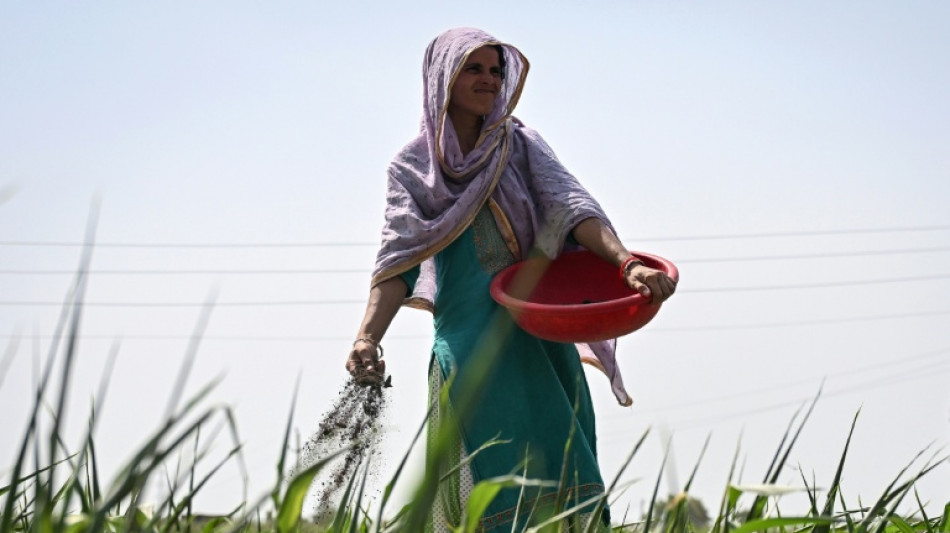
India eyes biofertilisers after Mideast war stoked supply fears / Photo: Arun SANKAR - AFP

Under a shed in north India, women scoop cow dung, lumps of unrefined sugar and flour to produce biofertiliser -- part of a growing effort to tackle anxieties over the supply of chemical fertilisers.
Demand for the organic blend has risen in the country in recent weeks as farmers prepare for the monsoon planting season, with concerns mounting over the availability of diammonium phosphate, a key ingredient in chemical fertiliser.
India is among the world's largest consumers of chemical fertilisers, using roughly 63 million tonnes annually.
But the Middle East conflict has strained shipping routes through the Strait of Hormuz, a key route for supplies, heightening unease among farmers ahead of the July-October sowing period.
While biofertilisers remain a niche input, interest is being driven by supply uncertainty, government promotion of sustainable farming and growing awareness of soil degradation.
The domestic biofertiliser market is still modest -- valued at roughly $150 million but expanding at the rate of about 10 percent as more farmers experiment with alternatives.
"We started thinking about what would benefit small farmers and improve soil health," said Kamlesh Devi, 57, a managing director of Tappal Samriddhi Mahila Kisan Limited, which runs the biofertiliser unit in the northern state of Uttar Pradesh.
Formed under the government's Farmer Producer Organisation (FPO) programme, the company has 1,050 women members across 92 villages in the state and has been designated a "Lighthouse FPO" -- intended as a model for replication.
"Small land-holding farmers struggle to get enough fertiliser, so we thought our FPO can help them," she told AFP.
- Empowering women -
Drawing on traditional knowledge and support from leading experts, the women prepare the biofertiliser using locally available raw materials.
Unlike their chemical counterparts, biofertilisers contain live microorganisms that help plants access nutrients already present in the soil.
For many in Tappal village, the enterprise has helped empower women, traditionally expected to perform household duties.
"We used to remain inside the house," said Joginder, a member who goes by one name.
"Earlier my husband handled all farming decisions. Now I can advise him on what to use in the fields and when."
The unit has supplied some 200 farmers this season, mostly in nearby villages, though similar initiatives are being promoted across other states as part of a national push toward sustainable agriculture.
The unit was set up last year, before the latest geopolitical tensions, but demand has picked up as farmers brace for possible shortages despite government assurances of adequate stock.
"There is concern among farmers, especially about urea availability," said Amit Chauhan, the head of Bharatpur village, adding that some growers had begun stockpiling.
Kishan Prasad, a farmer in a nearby village, said he had already stored 40 sacks of urea, which is used in rice growing.
"There are rumours we may not get DAP and urea," he said. "We need it for the paddy season, so I had to ensure I had enough."
- Cost-effective -
The Tappal biofertiliser sells for 300 rupees ($3.13) per 40-kilogram bag, compared with 266 rupees for a subsidised 50 kg bag of urea and about 1,350 rupees for 50 kg of DAP.
While biofertilisers are not a direct replacement, proponents say they can reduce dependence on chemical inputs.
Neetu, a 28-year-old farmer, said she used the product on her pearl millet crop and cut urea application by about one-third without affecting yields.
"For paddy too, I plan to reduce chemical fertiliser use," she said.
Experts caution that biofertilisers alone cannot meet India's needs.
"Biofertilisers are eco-friendly and cost-effective supplements of chemical fertilisers," said Brijesh Mishra, principal scientist at the Indian Agricultural Research Institute.
But adoption remains limited, partly because benefits are gradual and the same composition cannot be used on all crops, making their use more complex.
"Farmers often expect immediate results and sometimes use only one type of biofertiliser, which limits effectiveness," he said.
"Different crops require different combinations, and the benefits build gradually over time."
Interest in biofertilisers is also tied to environmental concerns, with researchers saying they increase organic carbon in the soil, contributing to carbon sequestration.
A 2024 report by the United Nations Environment Programme and the Food and Agriculture Organization warned that rising nitrous oxide emissions linked to fertiliser use are threatening climate goals.
Mishra said reducing chemical fertiliser use can lower greenhouse gases emissions associated with their manufacture and transport.
For the women in Tappal, however, the goal is more immediate.
"It is enough for us that our land's soil health improves," said Suman, another managing director at Tappal Samriddhi Mahila Kisan.
"We used to have the most healthy soil earlier; we just want that back," she added.
H.Nakamura--JT