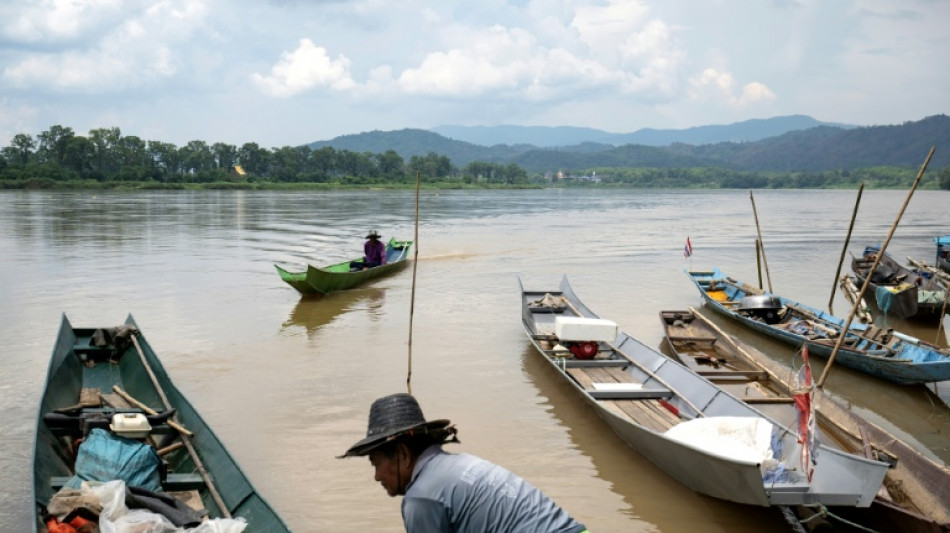
Toxic 'time bomb' threatens Mekong river basin / Photo: Lillian SUWANRUMPHA - AFP

Thai fisherman Somdet Singthong steered his metal skiff across the brown waters of the Mekong river, resigned to the pollution that has put his health and lifelong source of livelihood at risk.
Doctors have found elevated levels of toxic arsenic in his fingernails and urine, with the heavy metal also detected in the river which millions of people in Southeast Asia depend on.
Testing suggests the contamination, which experts and campaigners trace back to illegal mining in Myanmar, is now spreading downstream.
Locals used to buy their fish directly from Somdet on a pier near Chiang Saen in northern Thailand, on the border with Myanmar and Laos.
But since authorities detected arsenic and other heavy metals in several Mekong tributaries last year, his clientele has shrunk, leaving his carp and catfish rotting.
"The impact has been huge," the 69-year-old fisherman told AFP.
"I've never been afraid, but other villagers are worried. They don't eat fish; some won't touch it at all."
Thailand's pollution control department said in April it had found arsenic concentrations of up to 296 milligrams per kilogram of sediment near Chiang Saen -- more than nine times the level considered dangerous for aquatic life.
That was the first time the contamination was detected in the Mekong river itself, and not only its tributaries.
"When it's contaminated with heavy metals and other kinds of toxins, they flow all the way to the Mekong delta," threatening an important rice-growing region in Vietnam, said Pianporn Deetes of the Rivers and Rights campaign group.
"The fish are contaminated already," she added.
- 'The water is dead' -
Researchers and environmental activists generally attribute the pollution to illegal mines in neighbouring Myanmar, whose long-running civil war enables unregulated exploitation of natural resources, including rare earth elements used in smartphones, wind turbines, electric vehicles and more.
"Conflict, fragmented governance, and global markets converge to promote and sustain extraction at the expense of environmental integrity and human security," the Washington-based Stimson Center think tank said in a report in May.
Researchers from Thailand's Chiang Mai University found arsenic levels 10 times higher than normal in sediment from the Kok river, a Mekong tributary.
Assistant professor Wan Wiriya described it as a "time bomb", raising long-term risks of cancer and neurological disorders -- particularly among vulnerable populations.
Buddhist monks in saffron robes led a protest march this month along the contaminated waterway, with participants holding signs reading "Rivers are the veins of our lives".
"We don't see children playing in the water anymore. We don't see birds. We don't see butterflies," said Sansoen Duangdee, a 69-year-old artist.
"The water is dead. And if the water is dead, what about the people?"
- 'Invisible' danger -
Activist Deetes, one of the organisers of the march, called for "diplomatic dialogue" between Thailand and its neighbours, along with China -- the main importer of rare earth elements from Myanmar and Laos.
She denounced "gangsters" who "do what they want and without responsibility", as well as political apathy in the face of largely "invisible" danger.
The inter-governmental Mekong River Commission says it is strengthening regional monitoring and cooperation in the wake of the latest findings, including on heavy metals -- but neither Myanmar nor China are members.
Despite the concerns, Chiang Saen fish vendor Buakhlee Srisawat said some customers "are starting to return".
The merchandise in her plastic coolers was "edible", she said. "There are no contaminants... many agencies have come to inspect it."
Authorities advise against any shellfish from the river or the guts of river fish, but many residents cannot afford safer alternatives.
Fisherman Somdet said he has not changed his diet and continues to "live normally".
"There's nothing else we can do anyway. We have to live with this river, whatever happens to it," he said.
"The river is like life itself... if it could cry, it would have cried by now."
Y.Watanabe--JT