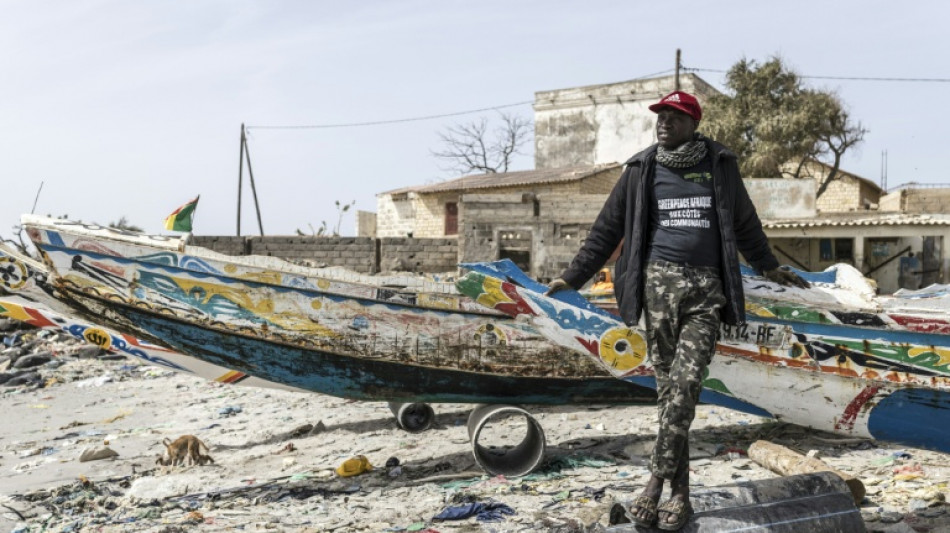
'Plundered': Senegal fishers feel sting of illegal, industrial vessels / Photo: PATRICK MEINHARDT - AFP

Ibrahima Mar first lost his livelihood then lost his son when the fish off Senegal's coast began to disappear, rupturing a way of life that had sustained his family for generations.
Industrial and illegal fishing, among other factors, have contributed to a sharp decline in the region's fish stock, robbing the west African nation of a traditional source of nutrition and income.
In recent years, fish have been "increasingly plundered", said Mar, who lives in a fishing village in the Dakar suburb of Rufisque.
The 55-year-old fisherman, a member of the Lebou ethnicity, a traditional fishing people, spoke to AFP from one of Rufisque's boat landings, explaining that the fish had been "taken from our path. So, there's no hope left".
Bottom trawlers and other industrial ships, generally flagged to Senegal but whose owners' real nationalities are difficult to trace, send their catches abroad.
"If you dig a little deeper into the ultimate beneficial ownership" the boats are Spanish, Italian, French, Chinese and Turkish, among other nationalities, Bassirou Diarra, country manager for Senegal at the Environmental Justice Foundation (EJF), told AFP.
"Not only is there a shortage of fish for the Senegalese market, for food security, but the money that should come back in terms of currency for the national economy isn't coming back," he said.
Destructive and illegal practices meanwhile include "fishing in prohibited areas, nets that do not comply with regulations, MPA (marine protected area) rules that are not respected, and the abusive granting of licences", Diarra said.
- Fish dependency -
A 2025 EJF report suggests that 57 percent of fish populations exploited in Senegal are in a state of collapse.
Members of coastal fishing communities have become increasingly desperate, illegally immigrating in traditional wooden canoes called pirogues along the deadly Atlantic migration route to Europe.
That includes two of Mar's sons, both fishermen.
After one succeeded, Mar received a call several years ago from his other son, in his late teens.
He phoned "to tell me he was in a pirogue heading for Spain. That pirogue had 140 people on it," Mar said.
The family waited the five- to six-day journey for news of his arrival, then 15 days, 20 and 30.
But they never heard from him again.
Colourful pirogues are ubiquitous along Senegal's 700-kilometre (435-mile) coast.
"What a pirogue used to catch in two months, now that same pirogue can fish for six or seven months to catch the same amount, which is a problem," Mamadou Diouf Sene, president of the Fishing Wharf Revenue Commission of Rufisque, told AFP from the city's wharf.
A web of professions from cart driver to ice seller, as well as fishmonger and processor, depend on fish.
Fishmonger Fatou Seck, 39, sat at the Rufisque wharf alongside several other women with small trays of sea bream, white carp and mullet.
"Times are really tough right now," the mother of six told AFP, adding that "many of us base our hopes on this work, which is our only source of income to feed our children".
More than 82,000 people in Senegal work in fishing according to latest census information, comprising some two percent of the workforce in 2023.
A surge of artisanal fishermen has additionally contributed to fish population decline, as people flock to the profession which requires minimal training.
Estimates on pirogue numbers in Senegal vary but generally fall between 12,000 to 19,000.
Meanwhile, climate change is pushing west Africa's small pelagic fish -- smaller, often schooling species caught by artisanal fishers -- to move northward, according to research.
- Wild West -
Fish have declined for some 40 years but artisanal fishers really took note when small pelagics like sardinella and horse mackerel started vanishing some 15 years ago.
The prospect of Senegal having to import fish, a part of its cultural identity and a major natural resource, "is catastrophic", Mar said.
Cheikh Salla Ndiaye of Senegal's Directorate of Fisheries Protection and Surveillance described monitoring the sea as "very difficult", even with assistance from the navy and air force.
Mar recently spent time on a Greenpeace ship with four other fishermen learning how to better spot and report illegal fishing.
"We used to call the high seas like the Wild West because there was no way to see what was happening out there," Sophie Cooke, a fishing vessel analyst with Greenpeace, told AFP aboard the ship.
But technologies such as tracking devices, satellite radar and even smartphones, which fishermen can use to take pictures and pinpoint boats' locations, are changing that, she said.
Mar intends to take these tools back to his community.
With his two fishermen sons now gone, one in Spain and the other taken by the sea, Mar's experience with declining fish stocks is deeply personal.
As for his third son, Mar said: "I put him in a training centre. He's learning metal welding."
M.Matsumoto--JT