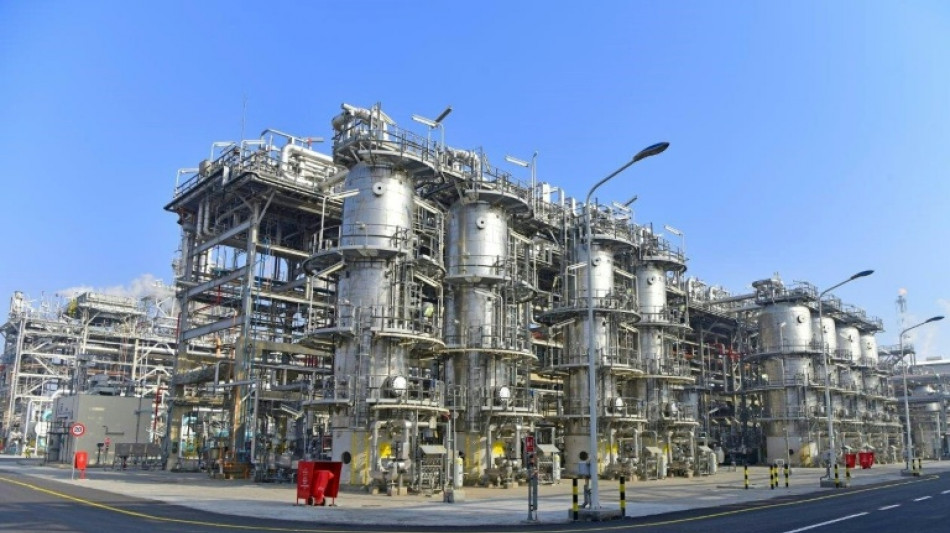
Kuwait refinery hit as Iran marks New Year under shadow of war / Photo: - - KUNA/AFP

Firefighters battled another blaze at a Kuwait oil refinery on Friday after a fresh drone attack from Iran where millions were marking the country's New Year with muted celebrations under the shadow of war.
Despite calls for an end to targeting Gulf energy infrastructure by European leaders on Thursday, Kuwait reported a fire for the second time this week at its giant Mina Al-Ahmadi refinery, a day after a direct hit on Qatar's vital Ras Laffan facility.
Iranian authorities vowed to retaliate after an Israeli strike on Wednesday damaged its South Pars gas field, which draws on the world's biggest known gas reserve and is vital for domestic supplies.
The escalating damage to Gulf energy infrastructure has led to fears of lasting damage to oil and gas supplies, even as Israeli Prime Minister Benjamin Netanyahu indicated an end to the fighting could be close.
"We are winning and Iran is being decimated," the Israeli premier said at a press conference on Thursday, claiming Tehran no longer had the capacity to manufacture ballistic missiles.
"This war is ending a lot faster than people think," he added in comments that also suggested a "ground component" would be needed to overthrow the government.
Iran's leaders, despite an Israeli assassination campaign and three weeks of bombardment, have vowed to end the conflict on their own terms.
"Our missile industry deserves a perfect score... and there is no concern in this regard, because even under wartime conditions we continue missile production," Iran's Revolutionary Guards spokesman Ali Mohammad Naini was quoted as saying by the Fars news agency.
Moments after his message was shared by the agency, the Revolutionary Guards said he had been killed in an airstrike.
- War-hit celebrations -
Tehran suffered a new wave of Israeli bombardment on Friday, dashing hopes of a truce as the country celebrated the new year spring festival Nowruz and Muslims in the Gulf and elsewhere marked the end of Ramadan.
The Israeli army also targeted a northern region around the Caspian Sea, a popular holiday destination that has so far been largely spared attacks.
Sixteen Iranian cargo vessels were sunk in ports on the Gulf "following the American–Zionist air attack", Iran's Tasnim news agency reported.
"We assume and hope that there will be no attacks on the first day of the new year," Hoda, a resident in Saveh south of Tehran, had told AFP on Thursday.
In Tehran's markets, shoppers were out in force buying new clothes and gifts, although sidewalks were less packed than usual for this time of year, with many people having fled north, AFP correspondents said.
Huge banners bearing images of Nowruz, which begins officially in the evening, have replaced portraits of the country's late leader Ali Khamenei who was assassinated on the first day of the war on February 28 by Israel.
- Escalation -
As the war heads towards its fourth week, Iran retains a stranglehold over the strategic Strait of Hormuz through which a fifth of global oil and Liquefied Natural Gas (LNG) usually flows.
Energy analysts and consumers are also scrambling to count the cost of Iranian missiles hitting Qatar's huge Ras Laffan natural gas complex on Thursday.
The attack caused "extensive damage" that Qatar's state energy company said could cost $20 billion a year in lost revenue and take five years to repair.
That could lead to high energy prices that outlast the conflict, which would increase inflation and lower economic growth.
"Short disruptions create price volatility. Sustained damage creates lasting economic shock," Robert Pape, a political science and military expert at the University of Chicago, wrote on his Substack.
"This is how a regional war becomes an historic global economic crisis."
He warned about further escalation that could include US President Donald Trump and Netanyahu ordering a limited ground invasion to try to secure the Strait of Hormuz, or overthrow the government.
Netanyahu indicated that regime change might require "a ground component", without elaborating.
"There are many possibilities for this ground component and I take the liberty of not sharing (those) with you," he said.
Trump denied Thursday that he was thinking about such a move.
"If I were, I certainly wouldn't tell you. But I'm not putting troops," he told reporters.
Iranian state media reported several waves of missiles fired at Israel overnight and Friday morning, with blasts heard over Jerusalem. There were no reports of casualties.
The United Arab Emirates also reported missile attacks, while Saudi Arabia intercepted more than a dozen drones early Friday as Gulf nations began the observation of Eid al-Fitr, the holiday that marks the end of the Islamic fasting month of Ramadan.
- Millions displaced -
The war, which has killed thousands and displaced millions, has quickly spread to Lebanon where the Israeli military has carried out regular bombardments in response to rocket fire on Israel by Iran ally Hezbollah.
Lebanon's health ministry said the death toll from Israeli airstrikes on southern and eastern Lebanon as well as on the capital Beirut and its southern suburbs has surpassed 1,000.
Lebanese President Joseph Aoun, during a meeting with French Foreign Minister Jean-Noel Barrot on Thursday, renewed a call for a truce between Israel and Hezbollah and the opening of negotiations that France's president later said depended on Israel agreeing to join.
As concerns grow over the conflict's economic fallout, President Emmanuel Macron said France planned to talk with permanent members of the UN Security Council about establishing a framework to secure navigation in the Strait of Hormuz -- but only after fighting had stopped.
burs-adp/ser
K.Nakajima--JT