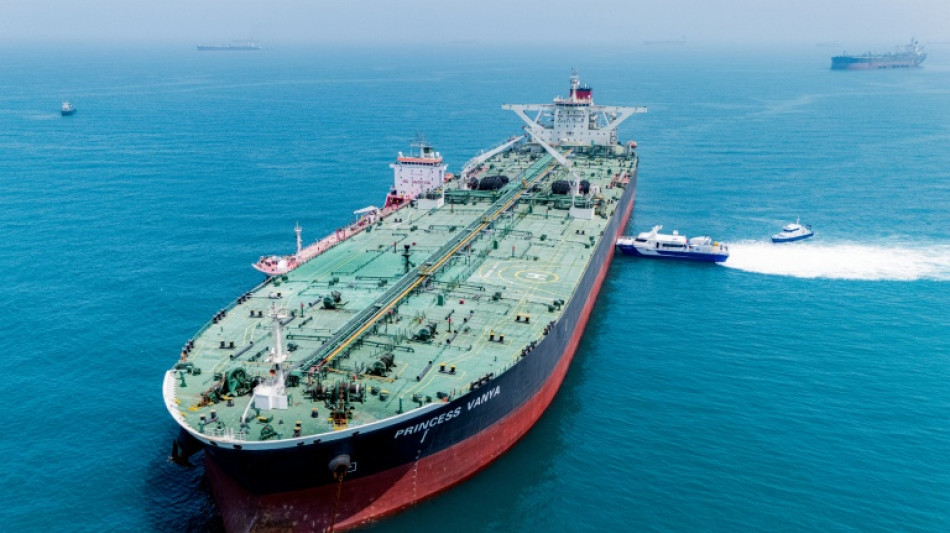
OPEC+ mulls oil production increase in shadow of war / Photo: Hussein FALEH - AFP/File

As a fresh Middle East conflict risks sending oil prices sharply higher, Saudi Arabia, Russia and six other key members of the OPEC+ alliance are widely expected to announce an output increase Sunday, analysts say.
The virtual meeting by the eight members of the Organization of the Petroleum Exporting Countries and allied nations (OPEC+) known as the "Voluntary Eight" (V8) comes a day after the US and Israel launched an ongoing wave of strikes on Iran.
Last year, the V8 group -- comprising Saudi Arabia, Russia, Iraq, the United Arab Emirates, Kuwait, Kazakhstan, Algeria and Oman -- boosted production by around 2.9 million barrels per day (bpd) in total before announcing a three-month pause in output hikes.
But now the picture has changed dramatically.
Even before the conflict erupted on Saturday, the market had already priced in a growing geopolitical risk premium over months of US military build-up in the region.
Brent, the global benchmark for crude oil, jumped more than three percent on Friday to trade over $73 per barrel, up from $61 at the beginning of the year.
Several other developments have squeezed oil supply since early January, said UBS analyst Giovanni Staunovo.
They include "cold weather in the US across January (that) resulted in temporarily production shut-ins", "disruptions in Russia" linked to drone attacks, as well as in Kazakhstan, where "a power outage disrupted production from the Tengiz oil field", he added.
That's why, even before Saturday's strikes, the market was anticipating a quota increase of 137,000 barrels per day.
"These relatively high prices are a good incentive for OPEC+ to resume its production increases" from April, Kpler analyst Homayoun Falakshahi told AFP.
Before the weekend, Falakshahi said a US strike on Iran would not necessarily alter the OPEC+ decision, as the group might prefer to wait and assess the impact on flows before adding more oil to the market than previously planned.
- Iran tensions -
In the short term, the US attack will likely trigger "a massive surge in prices" with what follows depending on how far the conflict escalates, Falakshahi said.
The conflict could certainly severely disrupt global oil supplies and send barrel prices soaring to a level not seen in years.
Iran is a significant oil producer, but the principal risk remains a prolonged blockade of the Straits of Hormuz, through which around 20 million barrels of crude pass each day -- around 20 percent of global production.
And there are virtually no alternatives for crude transport.
Only Saudi Arabia and the UAE have pipeline networks, capable of carrying a maximum of 2.6 million barrels per day, that allow them to bypass the Straits of Hormuz, according to the US Energy Information Administration.
"That said, even if strikes remain limited, we think Brent crude oil prices might rise to about $80pb (around their peak during the 12-day war in June 2025), from $73pb yesterday", wrote William Jackson, chief emerging markets economist at Capital Economics.
But prices would rise much more if the conflict is a prolonged one, particularly if the Strait of Hormuz is blocked for an extended period.
"That could cause oil prices to jump, perhaps to around $100pb," said Jackson.
- Limited impact -
Even if OPEC+ agrees on an output increase of 137,000 barrels per day on Sunday, the impact on oil prices will be limited, especially since the hike would only translate into an actual increase of 80,000 to 90,000 barrels, according to Kpler estimates.
"Spare capacity is much smaller than some perceive, and primarily in the hands of Saudi Arabia," Staunovo told AFP, adding that Russian production had been "on a declining trend over the last two months".
Boosting production would nevertheless allow OPEC+ members to regain market share in the face of competition from other key players such as the United States, Canada, Brazil, and Guyana.
"OPEC+ would prefer prices of $80-90, but around $70 per barrel is the ideal price level for this strategy" because it is "not enough to encourage further investment by US producers but acceptable for OPEC+," Falakshahi said.
T.Sato--JT