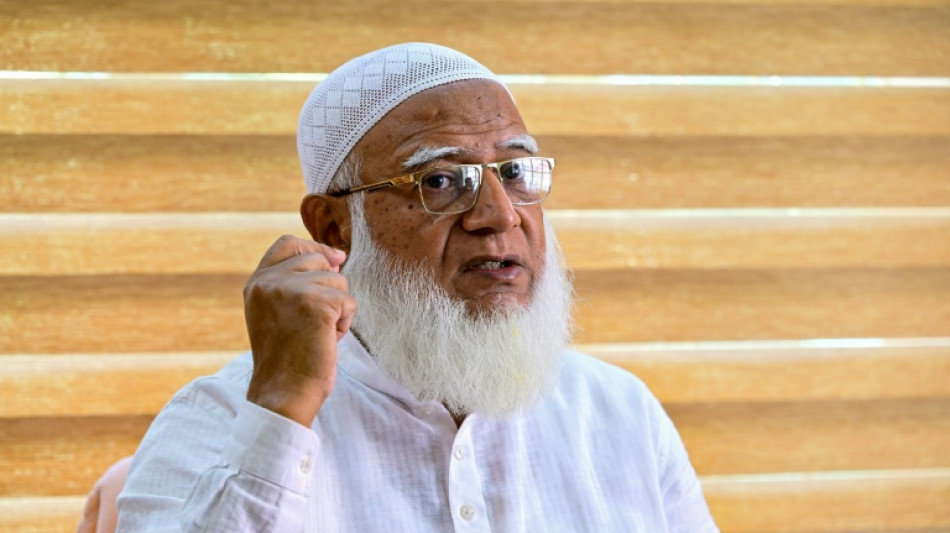
Bangladesh Islamist leader seeks power in post-uprising vote / Photo: Munir Uz Zaman - AFP/File

The leader of Bangladesh's largest Islamist party and prime ministerial hopeful Shafiqur Rahman has contested three elections and lost.
This time, he hopes to finally win.
Voters in the Muslim-majority nation will head to the polls on Thursday for the first time since a 2024 uprising toppled Sheikh Hasina, who in her 15 years as prime minister crushed Islamist movements.
Now, Rahman, a 67-year-old doctor and preacher, hopes his 11-party alliance could deliver him victory, worrying critics and minorities who fear an Islamist win could come at their expense.
"I stand for moral renewal in society," Rahman vowed in election promises.
If successful, the former political prisoner could form the first Islamist-led government in constitutionally secular Bangladesh.
Dressed entirely in white, including a flowing white beard, he cuts a distinctive figure on the campaign trail -- where his Jamaat-e-Islami party has put forward only male candidates.
"Good governance is the foundation of stability, peace and prosperity," he said, pledging rule-based and corruption-free leadership.
Ex-prime minister Hasina, who is close to the Hindu-nationalist government of neighbouring India, went after Islamist supporters and cracked down on extremists, killing scores and arresting hundreds.
Since her fall, key Islamist leaders have been released from prison.
- 'Locks' and brooms -
Born in 1958 in the northeastern district of Moulvibazar, Rahman has been a longtime party activist, running first for parliament in 1996, then again in 2001 and 2018.
His wife, Ameena Shafiq, is also a doctor, who was selected for one of the seats in parliament reserved for women in 2018.
Their two daughters and son are also doctors.
As party member and then leader, or "Ameer", Rahman's determined push for power has sparked concern.
Bangladesh has long been led by powerful women, including Hasina and her longtime rival, the late three-time prime minister Khaleda Zia.
Comments Rahman made last year about women's employment, saying he wanted to encourage stay-at-home mothers, provoked a backlash.
"We don't want to lock women at home -- we don't have enough money to buy the locks," he said at a rally.
In January, broom-waving women in Dhaka marched on the streets to symbolically "sweep" him away after a social media post from Rahman had argued women being "pushed out of home in the name of modernity" was "nothing but another form of prostitution".
Rahman later claimed he had been "hacked" and the post was deleted. In carefully worded statements since, he has sought to reassure women.
But some remain sceptical.
"You have to make your position clear regarding women who do not want to be directed by men, and those who belong to other faiths," said Tajnuba Jabin, who quit the National Citizen Party -- formed by student leaders who spearheaded the uprising -- when it allied with Rahman's party for the polls.
"Talk of women's rights sounds hollow unless you have a clear position," she told AFP.
- 'Inclusive' -
Rahman is leading a coalition of Islamist groups, largely ideologically aligned with the Muslim Brotherhood, who sense their biggest opportunity in decades.
His party and several other Islamist outfits have long been dogged by accusations of having supported Pakistan during Bangladesh's 1971 independence war, sparking anger even today.
But the party's student wing has swept victories in university polls across the country of 170 million people, including in Dhaka University, which is often seen as a bellwether for a national vote.
Salahuddin Muhammad Babar, editor of the right-wing newspaper Naya Diganta, said Rahman was "inclusive and accommodative, which are his greatest strengths".
The prospect of him being prime minister has nevertheless shaken minority communities.
Around 10 percent of Bangladesh's population are non-Muslim, most of them Hindu.
Rahman has sought to ease fears, insisting that the rights of minorities would be protected "regardless of caste or creed", and put one Hindu candidate on the party slate.
He has also struck a conciliatory tone on foreign policy, calling for a "balanced" relationship with India.
But Rahman's Jamaat-led coalition also includes hardliners who have demanded restrictions on cultural activities they consider "anti-Islamic", including music and theatre festivals, women's football matches and kite-flying celebrations.
More violent elements have smashed Sufi shrines, and even exhumed a Sufi leader's body and set it on fire.
Y.Kimura--JT