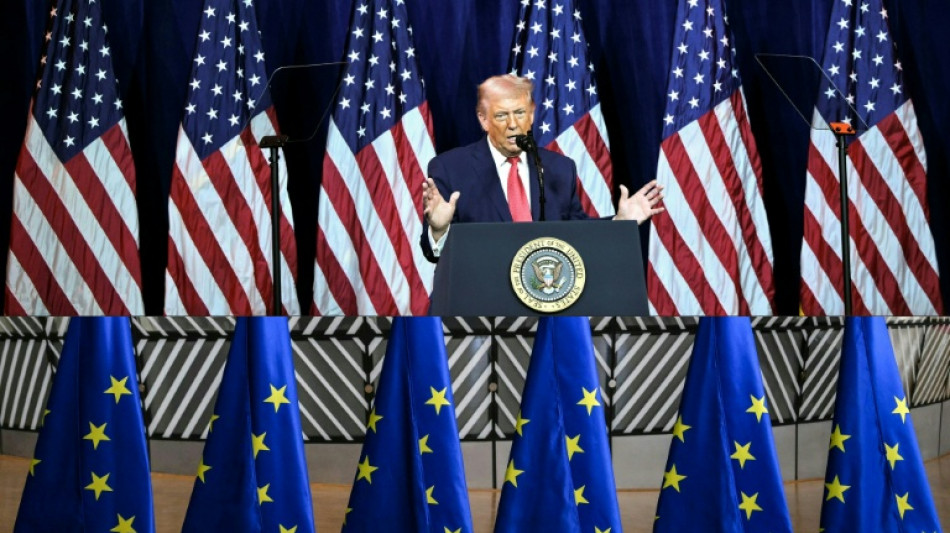
Easier said than done for US to apply tariffs on single EU states / Photo: Mandel NGAN, NICOLAS TUCAT - AFP/File

US President Donald Trump's tariff threats on eight European states, most of which are part of the EU common market, raises the question: can he really target them individually? Technically yes, but in practice -- it's not so simple.
When asked the same question, a smiling European Commission spokesman Olof Gill urged reporters to "take a deep breath" before spelling out his explanation.
Trump stunned Europe at the weekend when he threatened levies of up to 25 percent on EU members Denmark, Finland, France, Germany, the Netherlands and Sweden, plus non-members Britain and Norway.
But because the European Union functions as a single market with a customs union, Brussels explained, while it might be technically possible for Trump to slap sanctions on each, that could mean bureaucratic hell for US importers.
- How does the single market work? -
Denmark, Finland, France, Germany, the Netherlands and Sweden are part of the EU single market with 21 other countries, and a customs union, which allows the free flow of goods from one member state to another.
This also means products made in the EU, which could be exported later to the United States, move around the union without their origin being tracked.
Because of this free movement, many companies use products made from across the bloc. For example, a car might be assembled in Germany using parts made in Slovakia.
This means any restrictions on trade aimed at one of the EU's 27 countries could in theory be circumvented by moving goods to another member state before exporting them.
"Exports of French wine, Dutch cheese and Danish pharmaceuticals from Budapest to the US might suddenly spike," quipped an EU diplomat -- in a nod to the warm ties linking Hungary's Prime Minister Viktor Orban and the White House.
"Let's see if Trump is going to punish his friend Orban with a tariff," the diplomat said.
The situation is different for Norway and the United Kingdom.
Norway is part of the European Economic Area that also includes the EU's 27 states, but there is one major difference -- it is not part of the bloc's customs union and must fulfil extra border checks.
When Britain left the EU, it opted to remain outside the single market.
- So then, are individual tariffs feasible? -
The above means that the United States would have a hard time trying to figure out where European goods actually come from.
"From a customs and operational perspective, it is practically very difficult to attribute goods exclusively to a single member state, given that production and transformation processes are often distributed across the EU," Gill said.
While nothing prevents a third country from demanding more information about national provenance, under EU rules, goods manufactured in the bloc have only to be labelled as "EU origin".
"So to summarise, it is technically possible. It is immensely bureaucratically and procedurally complex to do so," Gill said.
T.Sato--JT